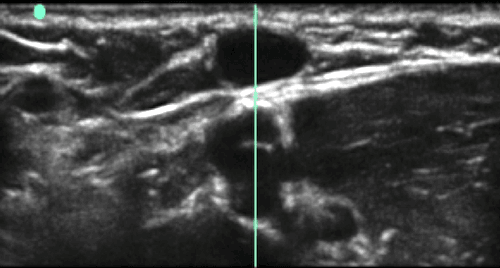
Trick of the Trade: Needle-vein alignment in ultrasound guided peripheral IV
Placing a peripheral IV under ultrasound guidance is often much more challenging than it outwardly appears, especially for novice users. One of the more difficult aspects is in making sure that the target vessel is perfectly in the middle of the screen and then guessing where that corresponds to the middle of the ultrasound probe. [+]

I am Dr. Deborah Diercks, Professor and Department Chair at UT Southwestern: How I Work Smarter
Over the last 50 years, the rates of women graduating from medical school have increased leaps and bounds, from women representing 7% of US graduates in the 1960s to ~47% in the 2010s.1 The How I Work Smarter Series has had an appreciable yet still unbalanced number of women participants, with slightly more than 35% of posts from women leaders. However, in the top echelon of medicine, women are still dramatically under represented. According to AAMC, only 15% of department chairs are women.2 Dr. Deborah Diercks is one of these 15%. As the newly appointed Chair of UT Southwestern Emergency Department, [+]

ALiEM Bookclub: How to Lie with Statistics
Although the title is ostensibly sinister, Darrell Huff’s “How to Lie with Statistics” is anything but. In medicine, we are faced with complicated statistics and “statisticulators” on a daily basis. And as the field of data science and statistics grows, so too does the complexity of these “statisticulations”. A statisticulation, defined by Huff, is “misinforming people with the use of statistical material” and, unfortunately, this is becoming all too common in the profit-driven world of medicine. With carefully crafted “non-inferiority” trials and overpowered industry-funded superiority trials cropping up in the literature, it would easy to give up on statistics altogether; [+]

Should you do a Pediatric Emergency Medicine fellowship?
Each year hundreds of residents apply to Pediatric Emergency Medicine (PEM) fellowships. There are multiple reasons that an EM resident might want to undertake a PEM fellowship, but over the last 15 years, fewer Emergency Medicine (EM) residents are applying for PEM fellowships than Pediatric residents, unpublished data suggesting that Pediatric candidates now outnumber EM candidates 20 to 1. Recently, a group of PEM Fellowship Program Directors formed the “EM-to-PEM task force” of like-minded individuals desiring to promote PEM fellowships to EM residents. A PEM fellowship is an excellent career move for a resident who has a passion for the [+]

Malignancy-Associated Hypercalcemia: Which Bisphosphonate is Best?
Malignancy-associated hypercalcemia (MAH) is the most common metabolic derangement encountered in the oncologic population in the ED. It can occur in up to 30% of cancer patients at some point during the disease.1–3 Clinical manifestations include mental status changes (which may progress to coma) and renal impairment.3 These patients may be classified based on both type and severity. Therapies for managing MAH emergently should focus on correcting the underlying mechanism, as outlined below with their respective causes:3 [+]

ALiEM Chief Resident Incubator: Mentoring the Future Leaders in EM
We at ALiEM are incredibly excited to publicly announce the 2015-16 ALiEM Chief Resident (CR) Incubator. Every single year, I have seen Chief Residents struggle with their new role as a near-peer leader in the residency program. Because Chief Residents are generally high-functioning individuals, they usually figure it out as the year progresses. Why is it that we can’t we do better and prepare them for what is to come? [+]
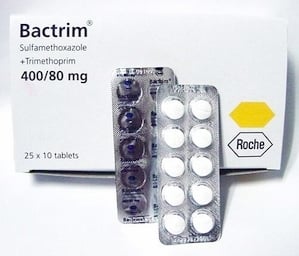
Sulfamethoxazole-Trimethoprim for Skin and Soft Tissue Infections: 1 or 2 Tablets BID?
The 2014 Guidelines for the Diagnosis and Management of Skin and Soft Tissue Infections (SSTI) recommend sulfamethoxazole-trimethoprim (SMX-TMP) for purulent infections where methicillin-resistant S. aureus (MRSA) is a likely pathogen. 1 But, what dose of SMX-TMP should we be prescribing? Both the SSTI and MRSA guidelines say 1-2 double strength tablets twice a day. 1,2 So, which is it, 1 tablet or 2? [+]

I am Dr. John Bailitz, Director of Ultrasound and Collaborative Research at Cook County: How I Work Smarter
As the “How I Work Smarter” series matures, certain patterns emerge. One clear trend is that ultrasonographers have been present front and center. Today’s installment continue the course with Dr. John Bailitz (@AllInCoachMD) up at bat. Dr. Bailitz is an example to follow for future thinking EM clinician-academicians. While he has mastered the traditional avenues of academics via course leadership, publications, and national presentations, he has also embraced digital scholarship. He is the Chair of ACEP Online Education Subcommittee, blogs at How2TrainHeroes, and is on the organizing committee for SMACC 2015. He generously accepted Chris Nickson’s invitation to share his wisdom [+]
ALiEM Bookclub: The Emperor of all Maladies
The Emperor of All Maladies has become my touchstone for medicine. Siddhartha Mukherjee writes in a poignant and humanist voice as he beautifully captures the “Biography of Cancer.” Interweaving science, stories, and his experiences as an oncology fellow, Mukherjee begins his examination of cancer in the ancient Egyptian times with the story of Imhotep, and carries us through to the modern 21st century diagnosis and management of cancer. From laboratory to bedside, Mukherjee provides both a panoramic and microscopic view of the advances and setbacks of cancer discovery, definition, and understanding. [+]
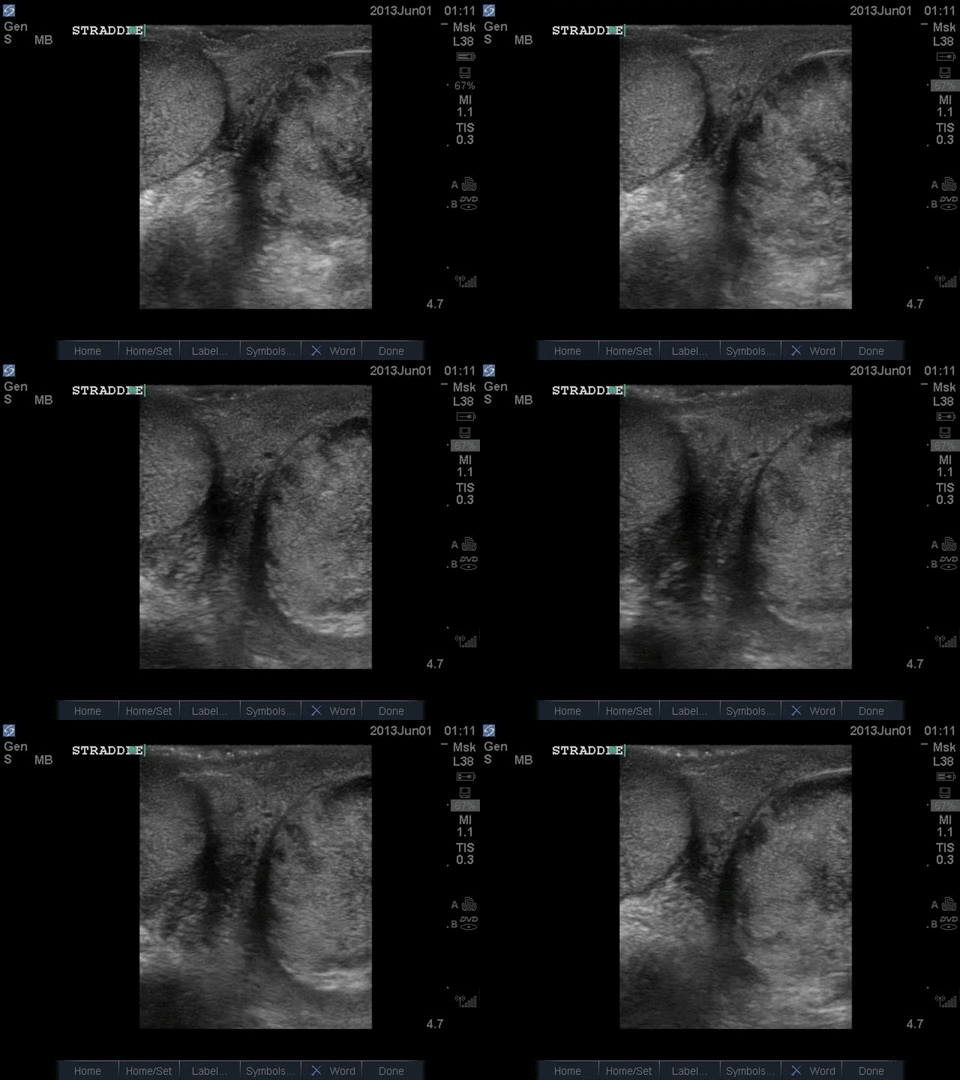
Ultrasound For The Win: 22M with Scrotal Pain #US4TW
Welcome to another ultrasound-based case, part of the “Ultrasound For The Win” (#US4TW) Case Series. In this peer-reviewed case series, we focus on real clinical cases where bedside ultrasound changed management or aided in diagnoses. In this case, a 22-year-old man presents with acute scrotal pain. [+]