About Michelle Lin, MD

ALiEM Founder and CEO
Professor and Digital Innovation Lab Director
Department of Emergency Medicine
University of California, San Francisco

5 rules for creating great Powerpoint presentations

DeathbyPPT

As much as people talk about “Death by Powerpoint”, many of us still use Powerpoint despite its many shortcomings. So how can we make our Powerpoint talks better?

This video reviews 5 great rules to live by. Interestingly, this dynamic video was built using Powerpoint by Nancy Duarte from Duarte Design. Of note, Duarte Design was the company behind the stunning slides which Al Gore used to present his compelling talk on An Inconvenient Truth.

(more…)

By |2019-01-28T23:21:57-08:00Sep 23, 2010|Medical Education|

What is "contextualizing" patient care?

StethoscopeZoomMedicine is as much about Science as it is about Art. This is no better illustrated than an educational intervention study about “contextualizing” patient care, published in JAMA.

What is contextualization?

It is the “process of identifying individual patient circumstances (their context) and, if necessary, modifying the plan of care to accommodate those circumstances”. In other words, this is care beyond the evidence-based guidelines, beyond standardized quality measures, and beyond the checklists.

(more…)

By |2016-11-11T19:00:27-08:00Sep 20, 2010|Education Articles, Medical Education|

Paucis Verbis card: When murmurs need echo evaluation

Cardiac Echocardiography

Have you been in a situation where you are the first to detect a cardiac murmur in a patient? If you are hearing it in a busy, loud Emergency Department, I find that it’s at least a grade III.

Should you order an echocardiogram for further outpatient evaluation? It depends on the grade and characteristic of the murmur, in addition to the patient’s symptoms. For instance, all diastolic murmurs require an echo. There is a useful ACC/AHA algorithm which helps you decide.

PV Card: When Murmurs Need Echocardiography Evaluation


Adapted from [1]
Go to ALiEM (PV) Cards for more resources.

Thanks to Amy Kinard, an Emergency RN and aspiring Family Nurse Practitioner, for drafting this useful Paucis Verbis card for me during her studies. Keep the great ideas coming, everyone!

Reference

  1. Bonow RO, Carabello BA, Chatterjee K, et al. 2008 Focused Update Incorporated Into the ACC/AHA 2006 Guidelines for the Management of Patients With Valvular Heart Disease: A Report of the American College of Cardiology/American Heart Association Task Force on Practice Guidelines (Writing Committee to Revise the 1998 Guidelines for the Management of Patients With Valvular Heart Disease): Endorsed by the Society of Cardiovascular Anesthesiologists, Society for Cardiovascular Angiography and Interventions, and Society of Thoracic Surgeons. Circulation. 2008;118(15):e523-e661. doi: 10.1161/circulationaha.108.190748
By |2021-10-18T10:05:29-07:00Sep 17, 2010|ALiEM Cards, Cardiovascular|

Trick of the trade: I got ultrasound gel in my eye!

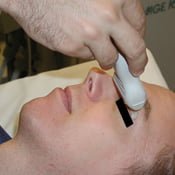
OcularUltrasoundProbeBedside ultrasonography is increasingly being used in the ED to examine the eye. For instance, it can be used to detect a retinal detachment, vitreous hemorrhage, and high intracranial pressure. The technique involves applying ultrasound gel on the patient’s closed eyelid. A generous amount of gel should be used to minimize the amount of direct pressure applied on the patient’s eye by the ultrasound probe.

Sometimes, however, no matter how careful you and the patient are, some gel accidentally contacts the eye itself.

(more…)

By |2019-01-28T23:23:16-08:00Sep 15, 2010|Tricks of the Trade, Ultrasound|

New favorite blog: Wishful thinking in medical education

Wishful Thinking in Medical Education

I recently came upon this great blog by Dr. Anne Marie Cunningham, a general practitioner and Clinical Lecturer at Wales, UK. She has some really insightful posts about education, its future, and the use of new technologies. This blog has been in existence since 2008. Just as interesting are the tons of comments that she gets from a spectrum of readers. Check it out!

She is also extremely active on Twitter with over 2,000 followers (@amcunningham).

 
By |2016-11-11T18:41:00-08:00Sep 7, 2010|Medical Education, Social Media & Tech|

Article Review: Student documentation in the chart

MedicalRecord

Do you have medical students rotating in your Emergency Department? Are they allowed to document in the medical record?

Charting in the medical record is the cornerstone of clinical communication. You document your findings, your clinical reasoning, and management plan. The medical record allows communication amongst providers. Chart documentation is a crucial skill that every medical student should know, as stated by the Association of American Medical Colleges (AAMC).

(more…)

By |2016-11-11T19:00:30-08:00Sep 6, 2010|Education Articles, Medical Education|
Go to Top