Article review: Pitfalls in writing test questions
Which is the best answer?
- A. Yes
- B. No
- C. Maybe
- D. 2 of the 3 above
- E. None of the above
Wait, what?!
What a terribly written test question!
Wait, what?!
What a terribly written test question!
Emergency physicians are procedural experts in central venous access. The subclavian vein is the best site for such access, because it has been shown to have the lowest rate of iatrogenic infections and deep venous clots
Bedside ultrasonography has really revolutionized how we obtain vascular access over the past 10 years. Identifying the subclavian vein using ultrasonography, however, is still technically challenging. The vein is located just posterior to the clavicle, which often gets in the way of the linear transducer.
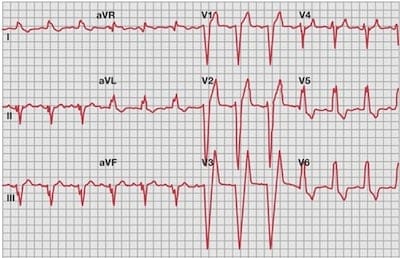
It is difficult to determine if a patient with a left bundle branch block (LBBB) has an acute myocardial infarction (AMI) because ST segments are “appropriately discordant” with the terminal portion of the QRS. That means if the QRS complex is negative (or downgoing), the ST segment normally will be positive (or elevated). Similarly if the QRS complex is positive (or upgoing), the ST segment will be negative (or depressed).
In 1996, Sgarbossa et al looked through the GUSTO-1 trial patients with LBBB and AMI. They derived 3 criteria which may help diagnose the “hidden” AMI. The criteria are:
1. ST elevation ≥ 1 mm concordant with QRS complex (most predictive of AMI of the 3 criteria)
2. ST depression ≥ 1 mm in lead V1, V2, or V3
3. ST elevation ≥ 5 mm where discordant with QRS complex
Use these criteria with caution though. None of these criteria are perfect. They are to help you risk-stratify. For instance, criteria #3 (ST elevation ≥ 5 mm) can exist in asymptomatic patients with LBBB because of concurrent left ventricular hypertrophy and high voltages.
I often get asked by my advisees: “In my residency interview, what should I talk about or do to make myself more competitive?”
To help you demystify the interview process, I wanted to share with you some insights. Overall, the interview day itself helps the program put a person and personality with your online ERAS application. Similarly, you quickly get a sense of the program’s personality. In EM, the residency interview day is generally pretty laid back. Not too many crazy questions. Programs just want to get to know you. Both you and the program should be asking each other– Is this a good fit?
There are many ways to relocate a shoulder dislocation. Most of these ways require procedural sedation. What if the risks of procedural sedation outweigh the risks? What alternative maneuver can you try, which only requires parenteral pain medications +/- an intra-articular lidocaine?
How awesome would it be if there were EM residency programs at the University of Washington and UCSF-SF General Hospital?!
This has been the question for decades. In 2006, I had the pleasure of seeing the UCSF-SFGH program become a reality. And now it’s the University of Washington’s turn. It is close to becoming a reality. It is really one of the last powerhouse institutions which does not have an EM residency program.
The Univ of Washington EM residency’s Program Director is helmed by my superstar friend, Dr. Fiona Gallahue, and will be a 4-year program. The ACGME (accrediting organization) has already site-visited the program. Short of an unforeseen snafu, I can’t imagine that it won’t be approved for a start year of 2011-12. The program will find out the official answer on February 14, 2011.
Unique to the field of EM, letters of recommendations from EM faculty are written on a standardized form. The Standardized Letter of Recommendation (SLOR), downloadable from the CORD website, documents information about the student’s performance in the EM clerkship, qualifications, and global assessment. At the end, the letter writer can provide free-text written comments.