Paucis Verbis card: Subarachnoid hemorrhage high-risk characteristics
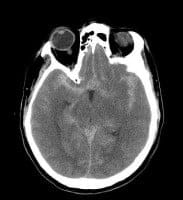 In Wednesday’s post about the Colorado Compendium, Graham mentioned a new 2010 BMJ article on the high-risk signs suggestive of subarachnoid hemorrhage by the gurus in clinical prediction rules in Canada.
We excessively work-up patients for a subarachnoid hemorrhage with a nonspecific headache and no neurologic deficitis. This is because it’s difficult to predict who is high, medium, and low risk for such a bleed. So we throw a wider net so that we don’t miss such a devastating diagnosis. This usually means a CT and LP for many patients with a headache.
In this 5-year multicenter study, the investigators identified clinical decision rules to help identify the higher-risk groups for a subarachnoid hemorrhage. They derived 3 models, based on recursive partitioning. Each has a negative predictive value of 100%.
Before thinking about seeing if your headache patient has any of these high-risk features, pay special attention to see if s/he would have met the inclusion and exclusion criteria of this study.
Inclusion criteria:
- Neurologically intact adults (age ≥ 16 years) with a non-traumatic headache peaking within an hour.
Exclusion criteria:
- History of ≥3 recurrent HA’s of same character/intensity
- Referred from another hospital with confirmed SAH
- Returned for reassessment of same HA which was already evaluated for SAH
- Papilledema
- New focal neurologic deficits
- Previous dx of cerebral aneurysm or SAH
- Previous dx of brain neoplasm
- Known hydrocephalus
Although none of the models are validated as of yet, the cumulative list of clinical characteristics from these 3 models may be able to help you understand who may be at higher risk:
- Age ≥ 40 years
- Witnessed loss of consciousness
- Neck pain or stiffness
- Onset of HA with exertion
- Arrival by ambulance
- Vomiting
- DBP ≥ 100 mmHg or SBP ≥ 160 mmHg
 There is constant debate on whether to image the cervical spine of blunt trauma patients. Fortunately, there are two clinical decision tools available to help you with your evidence-based practice.
 Dyphagia is a disorder of swallowing. It actually occurs in up to 10% of adults older than 50 years old. How can you determine the most likely causes for dysphagia? The secret is to obtain a thorough history and using the algorithm below, which I find really helpful from a review article in American Family Physician.