



Paucis Verbis card: Strep pharyngitis
 Have you heard of the Modified Centor Score for strep pharyngitis? Interestingly, it has been validated in adults and children. The methodology builds on the traditional Centor Score by incorporating the patient’s age, because this disease is more prevalent in kids than adults. In fact, you actually lose a scoring point if you are older than 44 years old.
Brain Slides: My new favorite blog
 I just encountered a new blog called Brain Slides: Presentation Design for Educators, written by Nathan Cashion. This blog eloquently teaches how Powerpoint should and, more importantly, shouldn’t be used.
(more…)
Trick of the Trade: Foley balloon be gone!
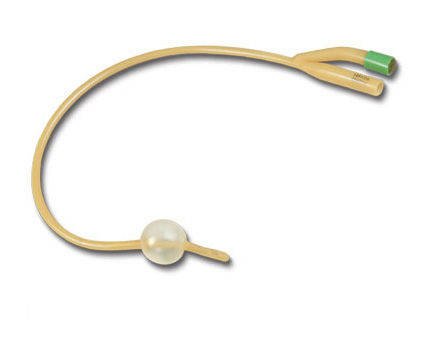 An urethral Foley catheter can sometimes become retained in the bladder, because of its balloon being unable to deflate. A malfunctioning inflation valve or obstructed channel along the length of the catheter is the cause.
How can you deflate the balloon so that the Foley catheter can be removed?
(more…)
Article Review: Premature diagnostic closure
 You are taking care of a patient, who frequently presents to the ED for polysubstance use. You are pretty sure his altered mental status is from polysubstance use again. He was found in his home next to drug paraphernalia. He intermittently becomes severely agitated, and so you give him sedatives. He has a low-grade fever, but you attribute that to his psychomotor agitation and likely stimulant use. Because he remains confused and lethargic after 8 hours, you admit him to an inpatient team to await further metabolism of his recreational drugs and your sedation medications.
The next day, you learn that had meningoencephalitis.
(more…)
Paucis Verbis card: Urine Toxicology Screen

In the Emergency Department, we often order urine toxicology screens for patients with altered mental status without an obvious cause. I find that patients are often rather forthcoming about their drug use, if they are alert enough to talk. In those cases, ordering a urine toxicology screen is unnecessary.
When you do order a tox screen, however, how do you interpret the information? While the result is a binary answer (positive vs negative), there are some nuances to interpretation. For instance, how long does a patient with urine toxicology remain positive for the drugs? Are there any medications that can cause false positives? See the helpful table below from a great review article in American Family Physician.
Check out what your laboratory screens for and, more importantly, what it does NOT screen for. Our lab, for example, does not screen for PCP but does screen for MDMA (ecstacy). That isn’t a big deal, since patients who ingest PCP aren’t too hard to detect clinically. They have crazy vertical nystagmus, and often there are at least 6 police officers trying to restrain the yelling patient.
PV Card: Urine Toxicology Screen
Adapted from [1]
Go to ALiEM (PV) Cards for more resources.
Reference
- Standridge J, Adams S, Zotos A. Urine drug screening: a valuable office procedure. Am Fam Physician. 2010;81(5):635-640. [PubMed]
How to teach procedures in the Emergency Department
 As I was going through the free EM-RAP Educator’s Edition podcasts, somehow missed the March 2010 podcast on how to teach procedures in the Emergency Department. In the 36-minute podcast, Dr. Mak Moayedi (Univ of Maryland) discusses a framework to teaching procedures. Check it out.
More specifically, Dr. Moayedi talks about how teaching procedures has moved beyond the antiquated “see one, do one, teach one” philosophy. Instead, we should follow principles based on accepted adult learning theories.