Trick of the Trade: Oblique CXR to look for pneumothorax


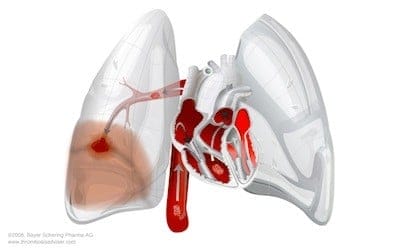
PneumothoraxCTSupine chest xrays have an extremely low sensitivity (12-24%) in detecting pneumothoraces. Because a pneumothorax layers anteriorly on an AP CXR film, the xray beam is perpendicular rather than tangential to the pneumothorax edge. This makes visualizing a small to moderate sized pneumothorax extremely difficult. So you are left to look for indirect signs such as a deep sulcus at the costophrenic angle or subcutaneous air. I’m often surprised at how large of a pneumothorax can be missed on CXR based on CT imaging. The image to the right shows a large left-sided pneumothorax on CT.

What if you have an equivocal bedside ultrasound result in looking for a pneumothorax, and the patient is too unstable to go to CT?

 
By |2019-02-19T18:08:06-08:00Apr 13, 2011|Radiology, Tricks of the Trade|

Paucis Verbis: AMI and ECG Geography

Sometimes a picture is worth MORE than a 1000 words. Such is the case of the above illustration that I saw on the Life In The Fast Lane blog. When I first saw it, I knew that I immediately had to find out who made the graphic. It turns out it is the multitalented Dr. Tor Ercleve, who is an emergency physician at Sir Charles Gairdner Hospital and an established medical illustrator.

ECG anatomy illustration AMI

This graphic demonstrates the EKG findings for the various types of acute MI’s as broken down by coronary vascular anatomy (right coronary artery, left circumflex artery, left anterior descending artery). This detailed illustration won’t be readable in print form but is great in digital format on your mobile device.

Thanks, Tor!

[PDF]

Go to ALiEM (PV) Cards for more resources.
By |2021-10-15T11:17:43-07:00Apr 8, 2011|ALiEM Cards, Cardiovascular, ECG|

Trick of the Trade: Check pupillary constriction with ultrasound

SwollenEyeIn some trauma patients with head and face trauma, you will need to check their pupillary response to light. Severe periorbital and eyelid swelling, however, make this difficult. You want to minimize multiple attempts to retract the eyelids because of the risk of a ruptured globe. What’s a minimally painful and traumatic way to check for pupillary constriction?

By |2019-01-28T22:50:28-08:00Apr 6, 2011|Ophthalmology, Tricks of the Trade, Ultrasound|

Paucis Verbis: Post-exposure prophylaxis (non-occupational)

HIV post exposure prophylaxis

You know how chief complaints present to the ED in multiples? In one week, I had several cases where patients were asking for post-exposure prophylaxis treatment NOT in the content of a sexual assault. I haven’t had to manage such cases in a long time and so needed to look up the recent guidelines from the CDC.1

The trick is not to forget about all the co-existing problems and infections beyond just HIV. Specifically, don’t forget about gonorrhea, chlamydia, and trichomonas.

PV Card: Post-Exposure Prophylaxis for Non-Occupational Contact


Adapted from [2]
Go to ALiEM (PV) Cards for more resources.

References

  1. STD Treatment. Centers for Disease Control. http://www.cdc.gov/std/treatment/default.htm.
  2. Landovitz RJ, Currier JS. Postexposure Prophylaxis for HIV Infection. New England Journal of Medicine. 2009;361(18):1768-1775. doi: 10.1056/nejmcp0904189
By |2021-10-15T11:21:12-07:00Apr 1, 2011|ALiEM Cards, Infectious Disease|

Trick of the Trade: Steristrip-suture combo for thin skin lacerations

Laceration Thin SkinLacerations of elderly patients or chronic corticosteroid users can be a challenge because they often have very thin skin. Sutures can tear through the fragile skin. Tissue adhesives may not adequately close the typically irregularly-edged laceration.

How do you repair these lacerations?
Do you just slap a band-aid on it?

(more…)

By |2019-11-29T18:57:44-08:00Mar 30, 2011|Geriatrics, Trauma, Tricks of the Trade|

Paucis Verbis: Chemical sedation for severe agitation

haldol ativan versed sedation agitation medications

Haldol, Ativan, and Versed… oh my.

In the Emergency Department, some patients present very acutely and aggressively agitated. This is usually the result of illicit drug use or a schizophrenic who hasn’t been taking medications (or both!). Fortunately, we have an arsenal of medications to help sedate the patient.

One study looked to answer the question of what single IM sedation agent is most effective, as measured by the shortest time to sedation and time to arousal.

PV Card: Chemical Sedation for Agitation


Adapted from [1]
Go to ALiEM (PV) Cards for more resources.

Reference

  1. Nobay F, Simon BC, Levitt MA, Dresden GM. A Prospective, Double-blind, Randomized Trial of Midazolam versus Haloperidol versus Lorazepam in the Chemical Restraint of Violent and Severely Agitated Patients. Academic Emergency Medicine. 2004;11(7):744-749. doi: 10.1197/j.aem.2003.06.015
By |2021-10-16T19:23:38-07:00Mar 25, 2011|ALiEM Cards, Tox & Medications|

Trick of the Trade: Benzoin for opening traumatic, swollen eyelids


EyelidRoll1smsmArrowssm

Patients who sustain facial trauma often have swollen eyelids. They may be so swollen that it is impossible to pull back the eyelids for an ocular exam. You use one of our “Tricks of the Trade”ideas and attempt to “roll” the upper eyelid using the Q-tip trick (above).

Fresh blood on the face, however, makes the Q-tip a little slippery along the upper eyelid, preventing an adequate view of the eye itself.

(more…)

By |2016-11-25T15:43:21-08:00Mar 23, 2011|Ophthalmology, Tricks of the Trade|
Go to Top