


Paucis Verbis card: When murmurs need echo evaluation
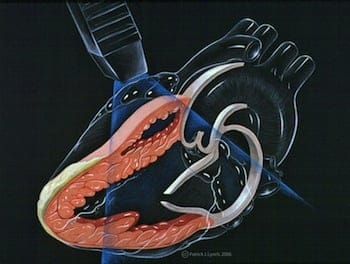
Have you been in a situation where you are the first to detect a cardiac murmur in a patient? If you are hearing it in a busy, loud Emergency Department, I find that it’s at least a grade III.
Should you order an echocardiogram for further outpatient evaluation? It depends on the grade and characteristic of the murmur, in addition to the patient’s symptoms. For instance, all diastolic murmurs require an echo. There is a useful ACC/AHA algorithm which helps you decide.
PV Card: When Murmurs Need Echocardiography Evaluation
Adapted from [1]
Go to ALiEM (PV) Cards for more resources.
Thanks to Amy Kinard, an Emergency RN and aspiring Family Nurse Practitioner, for drafting this useful Paucis Verbis card for me during her studies. Keep the great ideas coming, everyone!
Reference
- Bonow RO, Carabello BA, Chatterjee K, et al. 2008 Focused Update Incorporated Into the ACC/AHA 2006 Guidelines for the Management of Patients With Valvular Heart Disease: A Report of the American College of Cardiology/American Heart Association Task Force on Practice Guidelines (Writing Committee to Revise the 1998 Guidelines for the Management of Patients With Valvular Heart Disease): Endorsed by the Society of Cardiovascular Anesthesiologists, Society for Cardiovascular Angiography and Interventions, and Society of Thoracic Surgeons. Circulation. 2008;118(15):e523-e661. doi: 10.1161/circulationaha.108.190748



 How do you risk-stratify undifferentiated chest pain patients in the Emergency Department? There are a multitude of causes for chest pain. We are always taught to think of the 5 big life-threats: ACS, PE, aortic dissection, tension pneumothorax, and pericardial tamponade.
 Anyone who teaches medicine asks students to list their differential diagnosis when discussing a new clinical case. It’s also part of several models for education including the One-Minute Preceptor and SNAPPS.