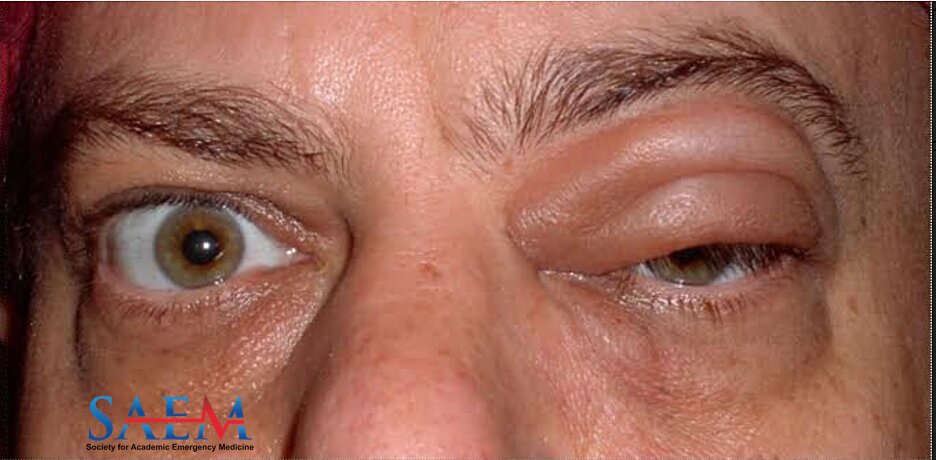
SAEM Clinical Images Series: Facial Swelling

facial swelling

A 5-year-old male with a history of recent frontal sinusitis associated with preseptal cellulitis requiring surgery presented with facial swelling. Swelling developed in the 24 hours prior to presentation without facial pain, nausea, or emesis. Denied facial trauma as well as any neurologic deficits, loss of consciousness, headaches, or fever/chills. At the time of his prior surgery, he presented with swelling localized to the left eye along with worsening pain, nausea, and emesis. After surgery, he was discharged in stable condition on antibiotics for 10 days. He has been in his usual state of health since that time.

Vitals: BP 93/59 (Sitting); HR 84; Temp 37.3 °C (99.1 °F) (Oral); Resp 12; Wt 20.6 kg (45 lb 6.6 oz)

General: Active, alert, normal development, and in no acute distress

HEENT: Swelling over the forehead and nasal bridge. Tenderness to palpation over the forehead. No erythema or overlying skin changes.

Nose: Normal appearance. No congestion or rhinorrhea.

Mouth/Throat: Mucous membranes are moist. Oropharynx is clear.

White blood cell (WBC) count: 8.9 x 10^3/uL

Hemoglobin: 11.5 g/dL

Platelets: 365 x 10^3/uL

ANC: 4.490 x 10^3/uL

ESR: 15 mm

CRP: <0.5 mg

In the initial management of this patient, CT imaging of the head with contrast should be used to characterize the lesion and evaluate for intracranial involvement. In our patient, the CT scan showed frontal bone osteomyelitis with possible extension into the subdural space. He was admitted on broad-spectrum antibiotics and surgical washout was performed the following day.

Pott’s Puffy Tumor is a rare but serious complication of sinusitis with potential intracranial involvement. Complications include orbital cellulitis, intracranial abscess, meningitis, and cavernous sinus thrombosis.

Take-Home Points

  • Pott’s Puffy Tumor is a rare potential complication of sinusitis. Early diagnosis and treatment are essential to reduce morbidity.
  • CT of the head with contrast is the initial imaging that should be obtained in the emergency department.

  • Blumfield E1, Misra M. Pott’s puffy tumor, intracranial, and orbital complications as the initial presentation of sinusitis in healthy adolescents, a case series. Emerg Radiol. 2011 Jun;18(3):203-10. PMID: 21380513.
  • Palabiyik FB1, Yazici Z, Cetin B, Celebi S, Hacimustafaoglu M. Pott Puffy Tumor in Children: A Rare Emergency Clinical Entity. J Craniofac Surg. 2016 May;27(3):e313-6. PMID: 27100642.

By |2022-12-08T22:22:41-08:00Dec 19, 2022|HEENT, Pediatrics, SAEM Clinical Images|

SAEM Clinical Images Series: Finger Pain

finger pain

A 57-year-old male presents after accidentally firing his son’s expired epinephrine autoinjector containing 0.3 mg of epinephrine into his left thumb two hours prior to arrival. He endorses mild pain and numbness at the tip of his thumb. The patient had spoken to poison control who had instructed him to present to the Emergency Department if his symptoms did not improve after two hours. He denied any palpitations or other systemic symptoms.

Vitals: HR 81; BP 128/81; RR 18; SpO2 99%

Extremities: Pallor noted at the distal tip of his left thumb extending 2 to 3 cm proximally with a central 2 mm area of bruising. Capillary refill could not be elicited in the left thumb pad. Sensation was intact to light touch and motor strength was intact in the left thumb.

No lab work was performed.

Treatment modalities are primarily based on case reports and range from conservative measures to local infiltration of vasodilatory medications. [1] Conservative treatments include digital massage, warm water soaks, and local application of nitroglycerin paste. Varying degrees of success have been associated with these conservative treatments. In our case, conservative measures failed and we proceed with local infiltration of phentolamine mesylate. The dosage and volume administered vary widely in reports; however, commonly reported doses were 2 to 3.5 mg of phentolamine reconstituted with 1 to 2 ml of 2% lidocaine or normal saline. This is then injected locally at multiple locations in the affected region or as a digital block. In our case, reperfusion occurred within minutes after local infiltration with approximately 1.5 mg of phentolamine reconstituted with lidocaine. No systemic side effects were noted.

There have been no documented reports of ischemic necrosis associated with accidental digital epinephrine injection. Additionally, spontaneous resolution in the majority of cases at less than two hours has been widely reported, though in some cases symptoms may persist for hours to days. [1,2] Though phentolamine may provide rapid symptomatic relief of pallor, pain, and/or paresthesia for the patient, limited data exist on long-term clinical outcomes and the overall effect on prognosis. [3]

The recommendation to never use lidocaine with epinephrine for digital nerve blocks or local digital infiltration is propagated in medical education. However, a large retrospective review of 127 accidental digital epinephrine injection cases noted a majority had spontaneous resolution. [2] Further, large studies from surgical literature have reported that local infiltration of lidocaine with epinephrine is safe and resulted in prolonged anesthesia and reduced bleeding.

Take-Home Points

  • Spontaneous resolution of accidental digital epinephrine injection often occurs within two hours and no cases of ischemic necrosis have been reported.
  • Symptomatic relief may be achieved with local phentolamine mesylate infiltration if conservative measures have failed. Commonly reported total effective doses range from 2 to 3.5 mg in volumes of 1 to 2 ml of 2% lidocaine or normal saline.

  • McNeil C, Copeland J. Accidental digital epinephrine injection: to treat or not to treat? Can Fam Physician. 2014 Aug;60(8):726-8. PMID: 25122817; PMCID: PMC4131962.
  • Muck AE, Bebarta VS, Borys DJ, Morgan DL. Six years of epinephrine digital injections: absence of significant local or systemic effects. Ann Emerg Med. 2010 Sep;56(3):270-4. doi: 10.1016/j.annemergmed.2010.02.019. Epub 2010 Mar 26. PMID: 20346537.

By |2022-12-08T21:58:38-08:00Dec 12, 2022|SAEM Clinical Images|

SAEM Clinical Images Series: A Rash You Don’t Want to Miss

rash

A 54-year-old female with a past medical history of diabetes presented to the Emergency Department (ED) for evaluation of unresponsiveness. The patient was found unresponsive by her spouse, who notes she had missed several doses of insulin over the past few days. EMS notes the glucometer read ‘HIGH’ on fingerstick. The patient remains unresponsive on presentation and is unable to contribute further history.

Vital Signs: BP 148/105; HR 120; RR 24; Pulse Oximetry 98% on room air; Temperature 97.7°F

Constitutional: Patient is morbidly obese, unresponsive, and toxic-appearing.

Cardiovascular: Regular rhythm with tachycardia. No murmur.

Pulmonary: Pulmonary effort is normal. Lungs clear to auscultation bilaterally.

Abdomen: Abdomen is soft and non-distended. Unable to assess for tenderness given unresponsiveness.

Skin: Cool, pale, mottled. Large gangrenous, draining, foul-smelling wound on proximal left thigh. There is necrotic, malodorous, black skin noted over the left lower abdomen and left upper thigh.

Neurological: Unresponsive. GCS 3.

White blood cell (WBC) count: 20.5

Comprehensive metabolic panel (CMP): K 5.8; Cr 2.06; BUN 86; Glucose >600

Venous blood gas (VBG): pH<7; lactate 3.4; bicarbonate 7

These photographs show advanced Fournier’s Gangrene, a form of necrotizing fasciitis located in the genitals, perineum, or perianal region. Rapid involvement of our surgical colleagues is crucial, as these patients will not recover without the debridement of affected tissues. Aggressive fluid resuscitation and broad-spectrum antibiotics can be initiated after a surgical consult is made.

This patient presented with impressive visual evidence of advanced disease including severe ecchymosis, but our clinical suspicion must be high as Fournier’s is rapidly progressing and carries a high mortality rate (may be upwards of 30%). Earlier symptoms are genital or perineal pain which may be associated with itching, lethargy, or fever. The biggest exam finding to keep in mind is ‘pain out of proportion to the exam’ as up to 40% of these patients may present without localized symptoms. Advanced disease, as seen in this patient, can present with crepitus and severe ecchymosis of tissue involved. This patient was also found to be in DKA, as evidenced by her laboratory findings. This case should serve as a reminder that it is vital to perform a proper skin examination in patients presenting with hyperglycemia. Ultimately in this case, the patient was intubated for airway protection and started on vasopressors for cardiovascular support in the setting of septic shock. She went into VTach arrest and was successfully defibrillated before further decompensating and becoming asystolic.

Take-Home Points

  • The first task after suspected diagnosis of Fournier’s Gangrene is a page to your surgery service for evaluation and emergent debridement in the OR (depending on your institution this may be general surgery, urology, or both). After your patient is on the path to definitive management, you can begin aggressive fluid administration and broad-spectrum antibiotics (gram-positive, gram-negative, and anaerobic coverage needed).
  • Fournier’s Gangrene is a clinical diagnosis. Imaging may assist in atypical or borderline cases, but should never result in delay of surgical evaluation and treatment. Crepitus and ecchymotic tissue are very late findings; have high clinical suspicion inpatients with signs of swelling, erythema, and pain.

  • Shyam DC, Rapsang AG. Fournier’s gangrene. Surgeon. 2013 Aug;11(4):222-32. doi: 10.1016/j.surge.2013.02.001. Epub 2013 Apr 8. PMID: 23578806.
  • Ustin JS, Malangoni MA. Necrotizing soft-tissue infections. Crit Care Med. 2011 Sep;39(9):2156-62. doi: 10.1097/CCM.0b013e31821cb246. Erratum in: Crit Care Med. 2011 Nov;39(11):2592. Dosage error in article text. PMID: 21532474.
  • Harbrecht BG, Nash NA. Necrotizing Soft Tissue Infections: A Review. Surg Infect (Larchmt). 2016 Oct;17(5):503-9. doi: 10.1089/sur.2016.049. Epub 2016 Aug 2. PMID: 27483003.
  • Singh A, Ahmed K, Aydin A, Khan MS, Dasgupta P. Fournier’s gangrene. A clinical review. Arch Ital Urol Androl. 2016 Oct 5;88(3):157-164. doi: 10.4081/aiua.2016.3.157. PMID: 27711086.
  • Sarani B, Strong M, Pascual J, Schwab CW. Necrotizing fasciitis: current concepts and review of the literature. J Am Coll Surg. 2009 Feb;208(2):279-88. doi: 10.1016/j.jamcollsurg.2008.10.032. Epub 2008 Dec 12. PMID: 19228540.
  • Tintinalli JE, Ma O, Yealy DM, Meckler GD, Stapczynski J, Cline DM, Thomas SH. eds. Tintinalli’s Emergency Medicine: A Comprehensive Study Guide, 9e. McGraw Hill; 2020. p.592- 593.

SAEM Clinical Images Series: ‘Tis Not the Season to be Wheezing

wheezing

A 2-year-old male with a history of solitary kidney presented with greater than one month of daily coughing, wheezing, and decreased appetite. The patient was previously seen by his primary care physician after three weeks of symptoms where he was prescribed albuterol as needed for viral bronchospasm. The patient’s wheezing did not improve after two weeks of albuterol treatment so a chest x-ray was ordered. The patient’s mother denied any fevers, vomiting, diarrhea, weight changes, or night sweats.

Vitals: BP 131/60; Pulse 148; Temp 36.7 °C (98.1 °F) (Axillary); Resp 28; Wt 15.7 kg (34 lb 9.8 oz); SpO2 95%

General: Alert; well appearing

HEENT: Pupils equally reactive to light; moist mucous membranes; nares with normal mucosa without discharge

Cardiovascular: Regular rate; regular rhythm; normal S1, S2; no murmur noted; distal pulses 2+

Pulmonary: Good aeration throughout all lung fields; clear breath sounds bilaterally; prolonged expiratory phase; stridor with agitation

Abdomen: Soft; non-tender; non-distended

White blood cell (WBC) count: 56.1/uL (Blasts 58%)

Platelets: 288/uL

Uric acid: 8.3 mg/dL

LDH: 2231 iU/LD

D-Dimer: 3.22 ug/mL

Fibrinogen: 463 mg/dL

Bronchospasm, bronchiolitis, viral infection, pneumonia, foreign body aspiration, space-occupying lesion, vocal cord dysfunction, cardiac dysfunction, and acute chest in patients with sickle cell disease.

The radiograph shown demonstrates a mediastinal mass. This patient was ultimately diagnosed with T-cell acute lymphoblastic leukemia. T-ALL can present with fatigue, fevers, weight loss, easy bleeding/bruising, paleness, or a mediastinal mass. Mediastinal masses found on chest x-ray require further evaluation to determine the diagnosis, location, and treatment. If malignancy is suspected, an oncology referral and bone marrow sample will be necessary.

Take-Home Points

  • In patients with first-time wheezing that does not improve with bronchodilator therapy, consider alternative diagnoses and further evaluation.
  • A mediastinal mass is found at the time of diagnosis in 10% to 15% of children with acute lymphoblastic leukemia.

  • Steuber, P (2021). Overview of common presenting signs and symptoms of childhood cancer.UpToDate. Retrieved January 2, 2021.2.
  • Juanpere, S., Cañete, N., Ortuño, P., Martínez, S., Sanchez, G., & Bernado, L. (2013). A diagnostic approach to the mediastinal masses. Insights into imaging, 4(1), 29–52.https://doi.org/10.1007/s13244-012-0201-0

SAEM Clinical Images Series: An Enlarging Scalp Mass

scalp mass

A 27-day-old female infant born at 34 weeks 4 days with a prenatal history of maternal syphilis treated with penicillin presented with an enlarging scalp mass since birth. Since birth, the patient has had a 1 cm erythematous and flat lesion on her scalp. Since that time, the lesion has continued to grow and develop scales. On the day of presentation, the lesion was noted to be 7-8cm in diameter with multiple surrounding smaller lesions. There is some clear to bloody drainage coming from the main lesion. The patient has otherwise been growing and developing normally. No fevers or other sick symptoms. Feeding well. Mom has no concerns with bowel movements or voiding habits.

General: She is active. She is not in acute distress. She is well-developed.

HEENT: No congestion or rhinorrhea. Mucous membranes are moist. No posterior oropharyngeal erythema.

Cardiovascular: Normal rate and regular rhythm. Normal pulses. No murmur heard.

Pulmonary: Respiratory effort is normal. No retractions. Normal breath sounds. No wheezing.

Skin: Skin is warm. Capillary refill takes less than 2 seconds. On the left side of the scalp, there is a large raised keratinized plaque with a stuck-on appearance. Some red blood is noted when tapped with a white sheet. The plaque is firm and non-tender. On the rest of the scalp, there are several peeling flat lesions with hair attached, and intermittent alopecia.

Neurological: No focal deficit present. She is alert. Suck is normal.

Scalp ultrasound: Posteriorly exophytic left parietal lesion is peripherally echogenic, possibly representing a calcified lesion or cephalohematoma. CT or MRI may be useful for further evaluation, as clinically indicated.

a. Seborrheic Dermatitis: A common, self-limiting eruption consisting of erythematous plaques with greasy, yellow-colored scales that distribute to the areas of the body with sebaceous glands.

b. Atopic Dermatitis: Erythematous, scaly, crusted lesions that are poorly demarcated. It is pruritic and commonly involves the cheeks, scalp, and extensor surfaces.

c. Psoriasis: Uncommon in infants, but can mimic seborrheic dermatitis with sharply demarcated, shiny, erythematous plaques with fine silvery scales in non-intertriginous regions.

d. Tinea Capitis: While rare, tinea can present with a scaly scalp rash in infants. There may be a mild to moderate inflammatory reaction associated as well as hair loss.

e. Langerhans Cell Histiocytosis (LCH): LCH can present as refractory seborrheic dermatitis. There may also be papules or reddish-brown nodules that appear with the rash.

Pityriasis Amiantacea secondary to Seborrheic Dermatitis with a significant build-up of crust and scale. Pityriasis amiantacea is an exaggerated inflammatory response to regional dermatitis, most often seborrheic dermatitis. Treatment consists of a keratinolytic and antibacterial ointment. In this patient, 1:4 part vinegar and water soaks were recommended twice daily, followed by mupirocin ointment until the resolution of the lesions.

Take-Home Points

  • Seborrheic dermatitis is a commonly presenting rash in infancy.
  • When rashes are refractory to conservative management, additional diagnoses and sequelae need to be considered.

  • Amorim GM, Fernandes NC. Pityriasis amiantacea: a study of seven cases. An Bras Dermatol. 2016 Sep-Oct;91(5):694-696. doi: 10.1590/abd1806-4841.20164951. PMID: 27828657; PMCID: PMC5087242.
  • Olanrewaju O. Falusi; Seborrhea. Pediatr Rev February 2019; 40 (2): 93–95. https://doi.org/10.1542/pir.2017-0215. PMID: 30709979.

By |2023-03-22T12:13:28-07:00Nov 7, 2022|Dermatology, Pediatrics, SAEM Clinical Images|

SAEM Clinical Images Series: My Eye is Swollen

eye

A 56-year-old male presented to the Emergency Department with a chief complaint of painful eyelid swelling and itching upon waking up. He reported no history of trauma or fever. He had one similar episode in the past which was self-limiting. The patient denied vision loss, diplopia, pain with extraocular movement, and ophthalmoplegia.

Vitals: T 37.4°C; BP 129/73; HR 91; RR 16

General: A/O x 3; well nourished in NAD

HEENT:  Extraocular movements intact in both eyes. Pupils are equal, round, and reactive to light and accommodation bilaterally. Visual Acuity: OD 20/20, OS 20/25.

Left eye: Diffuse swelling and erythema to the left upper and medial lower eyelids with minimal purulent discharge from the lacrimal puncta. Tenderness localized to the medial canthal region.

Right eye: Normal.

Complete blood count (CBC): within normal limits

Comprehensive metabolic panel (CMP): within normal limits

Acute dacryocystitis. Dacryocystitis is defined by inflammation or infection of the nasolacrimal sac. Whether acute or chronic, acquired or congenital, inflammation is caused by obstruction of the nasolacrimal duct usually from infection, trauma, or a space-occupying lesion. The most common infectious organisms are Staphylococcus and beta-hemolytic streptococcus species. The classic clinical presentation is a sudden onset of swelling, erythema, and tenderness in the medial part of the orbit. Conjunctival injection and swelling around the entire orbit can suggest the development of preseptal cellulitis. Complications of dacryocystitis include orbital abscess, orbital cellulitis, vision loss, ophthalmoplegia, and eyelid necrosis. The differential diagnosis includes dacryoadenitis, lacrimal sac or sinonasal tumor, ethmoid sinusitis, and infected sebaceous or dermoid cyst.

Treatment for dacryocystitis depends on the severity and clinical manifestations of the disease. In mild cases, symptoms will resolve with the application of warm compresses, lacrimal sac massage (Crigler technique), and topical antibiotics if indicated. Severe cases may require oral or parenteral antibiotics and surgical decompression.

Take-Home Points

  • Dacryocystitis is inflammation of the medial nasolacrimal sac preceded by obstruction and may be acute or chronic, congenital or acquired.
  • Dacryocystitis exhibits a bimodal age distribution. The common congenital form is found in infancy, and in adulthood at age of 40 years older.
  • Dacryocystitis is occasionally mistaken for dacryoadenitis (inflammation of the nasolacrimal gland with superolateral eyelid edema). Far less common, dacryoadenitis is associated with systemic inflammatory conditions such as malignancy, Sjogren syndrome, sarcoidosis, Crohn’s disease, and other autoimmune diseases.
  • Proper recognition and prompt treatment may prevent serious complications including orbital cellulitis, vision loss, and sepsis.

  • Alsalamah AK, Alkatan HM, Al-Faky YH. Acute dacryocystitis complicated by orbital cellulitis and loss of vision: A case report and review of the literature. Int J Surg Case Rep. 2018;50:130-134. doi: 10.1016/j.ijscr.2018.07.045. Epub 2018 Aug 9. PMID: 30118963; PMCID: PMC6098209.
  • Carlisle RT, Digiovanni J. Differential Diagnosis of the Swollen Red Eyelid. Am Fam Physician. 2015 Jul 15;92(2):106-12. PMID: 26176369.

By |2022-09-11T10:08:30-07:00Sep 19, 2022|HEENT, SAEM Clinical Images|

SAEM Clinical Images Series: Unilateral Facial Pain

swelling

A 78-year-old male with a past medical history of Lewy body dementia, hypertension on bisoprolol, hypothyroidism, COPD, chronic lower extremity edema on furosemide, and overactive bladder on oxybutynin presented to the emergency department for evaluation of three days of progressively worsening left-sided neck and facial swelling. Associated symptoms included poor oral intake, a nonproductive cough, and one week of sore throat.

The black arrow represents the left parotid gland.

Vitals: Afebrile; normal room air saturation

HEENT: Firm, tender, warm and erythematous swelling over the left mandibular ramus that extended to the cheek, left neck, and spread caudally into the supraclavicular region and anterior chest. There were no identifiable hard masses or areas of fluctuance. Further inspection of the oral cavity revealed dry mucous membranes, poor dental hygiene without identifiable dental abscess, tonsils were normal size and equal bilaterally, and uvula was midline. Direct pressure externally over the area of concern revealed purulent discharge from Stenson’s duct.

White blood cell (WBC) count: 22.15

Comprehensive metabolic panel (CMP): Na 131; BUN 39; Cr 3.3

Lactic acid: 2.9

Acute suppurative parotitis (ASP) is a serious bacterial infection of the parotid gland that occurs in patients with diminished salivary flow, increased susceptibility to infection, and poor oral hygiene. Our patient had multiple risk factors for this disease which can include dehydration, advanced age, sialolithiasis, medications (diuretics, beta-blockers, antihistamines, phenothiazines, tricyclic antidepressants, anticholinergics), and certain disorders including diabetes, HIV, hypothyroidism, Sjogren’s syndrome. The most common organisms responsible for ASP are Staphylococcus aureus and oral flora anaerobes.

The most feared complications include supraglottitis, cervical necrotizing fasciitis, and other deep neck space infections which can be surgical emergencies and rarely cause impending airway obstruction. Further central and vascular complications include brain abscess, central venous thrombosis, and Lemierre’s syndrome

Take-Home Points

  • The role of bedside ultrasound in acute suppurative parotitis can help to rule out a superficial abscess or sialolithiasis. CT scan is beneficial in ruling out deep space infections as a complication from this disease process or other causes of head and neck swelling.
  • ASP-associated complications are rare but can lead to significant morbidity and mortality secondary to the parotid gland’s proximity to vital structures and ability to spread to adjacent deep spaces.
  • Emergency medicine physicians will manage acute suppurative parotitis and must be aware of the potential complications when determining safe disposition and appropriate treatment.

  • Markovich A, Ronen O. Factors predicting length of stay in patients hospitalized for acute parotitis. J Investig Med. 2021 Feb;69(2):388-392. doi: 10.1136/jim-2020-001506. Epub 2020 Oct 21. PMID: 33087427.

By |2022-09-11T10:03:16-07:00Sep 12, 2022|HEENT, SAEM Clinical Images|
Go to Top