

SAEM Clinical Images Series: A Man with Blurry Vision

cranial nerve

A middle-aged man with a past medical history of hypertension and tobacco use disorder presented to the Emergency Department after evaluation by an ophthalmologist.  He complained of ten days of a right-sided headache and three days of diplopia. He denied eye pain, pain with eye movements, photophobia, and vision loss.

Vitals: Temp 98.4 °F (36.9 °C); BP 122/72; Pulse 90; Resp 16; SpO2 100%

Neuro: Ptosis, “down and out” deviation and pupil dilation of the right eye were noted. Extraocular movements were intact and pupils were reactive to light bilaterally. No other neurologic deficits were observed.

Non-contributory

This patient has a partial cranial nerve (CN) III (oculomotor nerve) palsy. CN III is composed of: (a) internal somatic motor fibers that innervate the levator palpebrae superioris (which elevates the upper eyelid) and the medial recti, superior recti, inferior recti, and inferior oblique extraocular muscles, and (b) external parasympathetic fibers innervating the ciliary muscles (involved in accommodation) and sphincter pupillae (involved in pupillary constriction). The presentation of complete isolated CN III palsy generally involves ipsilateral ptosis (due to levator palpebrae paralysis) and “down and out” ocular deviation (due to preservation of superior oblique and lateral rectus function).

The most common etiology of CN III palsy is ischemia of the nerve fibers secondary to diabetes mellitus or hypertension, which preferentially affects the internal somatic fibers that surround the blood supply. This etiology classically results in a pupil-sparing palsy due to preserved function of the external parasympathetic fibers. However, the most feared etiology is an intracranial aneurysm, most commonly a posterior communicating artery aneurysm. This source of external compression classically affects both the internal somatic motor fibers and external parasympathetic fibers, resulting in asymmetric pupil dilation.

Take-Home Points

  • CN III palsy etiologies include ischemia secondary to diabetes mellitus or hypertension, and structural causes, most commonly a posterior communicating artery aneurysm.
  • On exam, complete CN III palsies will present with ipsilateral ptosis, “down and out” ocular deviation, and pupillary dilation. Partial CN III palsies may have a more subtle presentation.
  • New-onset CN III palsy should be evaluated with a CTA to rule out an aneurysm.

  • Biousse V, Newman NJ. Third nerve palsies. Semin Neurol. 2000;20(1):55-74. doi: 10.1055/s-2000-6833. PMID: 10874777. 2. Singh A, Bahuguna C, Nagpal R, Kumar B. Surgical management of third nerve palsy. Oman J Ophthalmol. 2016 May-Aug;9(2):80-6. doi: 10.4103/0974-620X.184509. PMID: 27433033; PMCID: PMC4932800.

Images and cases from the Society of Academic Emergency Medicine (SAEM) Clinical Images Exhibit at the 2021 SAEM Annual Meeting | Copyrighted by SAEM 2021 – all rights reserved. View other cases from this Clinical Image Series on ALiEM.
By |2023-08-14T14:10:25-07:00Aug 18, 2023|Neurology, SAEM Clinical Images|

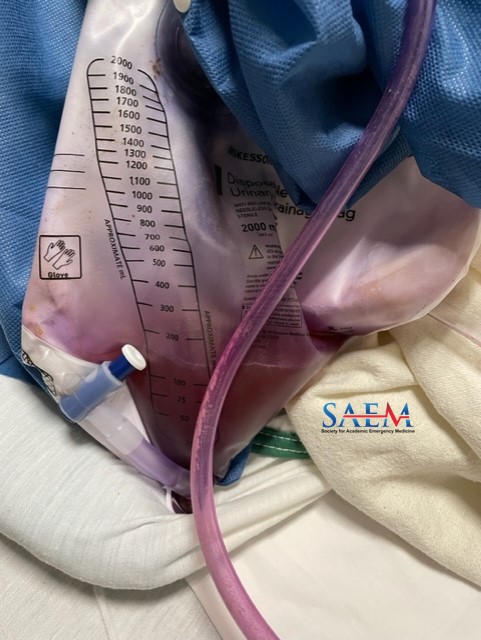
SAEM Clinical Images Series: The Color Purple

purple urine

A 64-year-old female with a history of quadriplegia and bladder rupture secondary to a motor vehicle accident two years ago, complicated by chronic indwelling suprapubic foley, presents from her skilled nursing facility with fever, oliguria, tachycardia, low blood pressure, and a change in the color of her urine.

Vitals: T 100.4°F; HR 126; BP 105/74; RR 24

General: Pleasant but mildly confused morbidly obese female smelling strongly of urine

Genitourinary: Poorly maintained indwelling suprapubic catheter with purulence noted around the ostomy and purple urine in her foley tubing and bag

Urinalysis (UA): 168 WBC, >182 RBC, Large leukocyte esterase, Positive nitrite

This is a case of Purple Urine Bag syndrome (PUBS), an uncommon subset of CAUTI that generally occurs in female patients with constipation and an indwelling foley. Although not fully understood, it is thought that the long stool transit time of constipation allows GI flora to break tryptophan down into indoles which travel to the liver via the portal system where they become indoxyl sulfate, which is excreted into the urine. Bacterial enzymes there catalyze this to indoxyl which oxidizes in alkaline urine to both indigo (blue) and indirubin (red), the combination of which, plus interaction with the plastic catheter tubing, causes the vivid purple discoloration. Risk factors include women, chronically catheterized, elderly, recurrent UTI, institutionalization, and chronic constipation.

Causative organisms are primarily gram-negative and include Proteus mirabilis, Escherichia coli, Klebsiella pneumonia, Pseudomonas aeruginosa, Morganella morganii, and Enterococcus species.

Take-Home Points

  • PUBS is a rare subset of CAUTI primarily caused by gram-negative bacteria.
  • It is predominantly found in women, chronically catheterized, institutionalized, and constipated patients.
  • Treatment is appropriate antibiotics and improved foley hygiene, foley exchange as well as improved bowel regimen to increase stool transit time.
  • Meekins Pauline, Ramsay Amy, Ramsay Michael. Purple Urine Bag Syndrome. West J Emerg Med. 2012 Dec;13(6):499-500. 2. Scleszka Laura, Swan Tricia. October 9, 2020. Can Urine Color Guide Management? [online] EMRA. Available at: https://www.emra.org/emresident/article/purple-urine-bag-syndrome/ [Accessed 19 Dec. 2022]

By |2023-08-14T09:14:36-07:00Aug 14, 2023|Infectious Disease, SAEM Clinical Images|

SAEM Clinical Images Series: Back Yard Football Injury

sternoclavicular

A 10-year-old male with no past medical history presents to the Emergency Department (ED) by EMS for evaluation of an injury sustained while playing tackle football. The patient was forcibly hit by another child against a tree. He complains of sharp right shoulder and chest pain that worsens with movement of his right upper extremity and he arrives wearing a sling to immobilize the arm.

Vitals: BP 123/86; HR 121; RR 25; T 37°C

General: Alert and oriented, in moderate distress

Cardiovascular: RRR without murmurs, rubs, or gallops, peripheral pulses 2+ throughout

Pulmonary:  Bilateral breath sounds, clear to auscultation

Chest: Inability to visualize the right medial clavicular notch or clavicular ridge along with palpable tenderness at the right upper sternoclavicular joint

MSK: The shoulders are asymmetric with the right slightly higher than the left. The right arm is held adducted and internally rotated in a sling. The patient is reluctant to abduct the right arm secondary to pain.

Neuro: No gross motor or sensory deficits were appreciated

Non-contributory

Sternoclavicular (SC) joint dislocation

SC joint dislocation can occur with anterior or posterior displacement of the medial clavicular head. Anterior dislocations are mostly caused by medial impact to the lateral shoulder. Anterior dislocations are more common and generally regarded as less serious. Conversely, posterior dislocations are more serious but less common. Posterior dislocations usually result from impact directly to the anterior chest wall. High-speed motor vehicle accidents or high-impact sports are common causes of posterior dislocations.

Subclavian vascular injury, pneumothorax, esophageal injury, cardiac arrhythmias, brachial plexus injury, tracheal injury, and thoracic outlet syndrome are all potential complications of an SC joint dislocation. When the medial head of the clavicle is forced posteriorly into the superior mediastinum several structures are at risk of impingement which could cause serious complications. In patients with suspicion of clavicular fracture or dislocation, the presence of dyspnea, stridor, dysphagia, or hoarseness should raise genuine concern for a compressive mediastinal syndrome that may require emergent closed or surgical relocation attempts.

Take-Home Points

  • An anterior medial head sternoclavicular dislocation is generally apparent and easily palpable on physical examination, while a posterior dislocation may be difficult to appreciate.
  • A posterior medial head sternoclavicular dislocation may require computed tomography to diagnose and requires computed tomography angiography to fully assess all mediastinal structures.
  • Closed reduction is the gold standard for the treatment of non-complicated posterior dislocations. Surgical fixation may be required when compressive complications such as vascular injury are confirmed or when closed reduction is unsuccessful.
  • Patients with a previous history of sternoclavicular dislocation are at higher risk of developing thoracic outlet syndrome.

SAEM Clinical Images Series: My Eye Looks Different

cone

A 29 year-old-male with a past medical history of left eye enucleation secondary to a gunshot wound several years prior presents to the Emergency Department (ED) for blurry vision, redness, and concern for a deformity to his right eye. The patient states symptoms started 2-3 months ago and he initially thought symptoms were due to allergies and recalls rubbing his eye a lot. Over the past 3-4 days, he noticed an acute decline in his vision with what the patient describes as a “cloudy bump” appearing during that time. The patient normally does not wear contacts or corrective lenses but states his vision is very blurry and he is now having difficulty reading. He also reports photophobia and mild eye pain. Review of systems is negative for any fevers, headache, eye discharge, or any recent falls or trauma.

Vitals: BP 125/83; Pulse 70; Temp 97.6 F (36.4 C); Resp 17; SpO2 100%

Constitutional: No acute distress, lying in stretcher comfortably.

Head: No visible traumatic injuries. No peri-orbital edema or facial swelling.

Eyes:

  • OD: Edematous cone-shaped protrusion with central haziness. V-shaped deformity to lower lid margin noted on downward gaze. The patient reports no pain when performing extraocular movement testing which is intact and pupil is reactive to light. Visual fields intact. There is no fluorescein uptake upon Wood’s Lamp exam and IOP is 18. VisualAcuity OD 20/200.
  • OS: Eye prosthesis in place.

Nose: No foreign bodies.

Mouth/Throat: Oropharynx is clear and moist and mucous membranes are normal.

Neck: Normal range of motion.

Corneal hydrops secondary to keratoconus.

Keratoconus is a degenerative, multifactorial, non-inflammatory disorder of the cornea that causes bilateral thinning of the cornea and distorted vision. The corneal thinning leads to a structural weakness in the collagen fibers that causes the characteristic bulging, “cone-shaped” cornea. If the thinning is significant enough, a break in collagen fibers and Descemet’s membrane lead to sudden edema which appears as a corneal opacification. This complication is known as corneal hydrops and causes sudden eye pain and decreased visual acuity. Patients with keratoconus present in young adulthood with progressive blurry or distorted vision. Risk factors include connective tissue disorders and Down syndrome as well as a familial history of keratoconus. There is also a risk in patients with a history of eye rubbing as was the case with this patient. The initial treatment for keratoconus is corrective eyewear for refractive correction.

The clinical hallmark of keratoconus is the cone-like protrusion of the cornea. The bulging may eventually lead to “Munson’s sign”, a v-shaped indentation of the lower eyelid on downward gaze as the cornea bulges outward that is seen in advanced keratoconus.

Take-Home Points

  • Suspect keratoconus in patients with a history of constant eye rubbing, developmental delay (i.e. Down Syndrome), and in patients with connective tissue disorders.
  • Munson’s Sign is a v-shaped indentation of the lower eyelid on downward gaze as the cornea bulges outward.
  • Initial treatment of keratoconus is conservative management with prompt ophthalmology follow-up.

  • V. Mas Tur, C. MacGregor, R. Jayaswal, D. O’Brart, N. MaycockA review of keratoconus: Diagnosis, pathophysiology, and genetics Surv Ophthalmol, 62 (6) (2017), pp. 770-783
  • Gold J, Chauhan V, Rojanasthien S, Fitzgerald J. Munson’s Sign: An Obvious Finding to Explain Acute Vision Loss. Clin Pract Cases Emerg Med. 2019 Jul 8;3(3):312-313. doi: 10.5811/cpcem.2019.5.42793. PMID: 31403106; PMCID: PMC6682229.
  • Gialousakis, John P. “Management of Acute Corneal Hydrops in a Patient with Keratoconus: a Teaching Case Report.” The Journal of the Association of Schools and Colleges of Optometry, vol. 45, 2020.
  • Greenwald MF, Vislisel JM, Goins KM. Acute Corneal Hydrops. EyeRounds.org. August 3, 2016; Available from: http://EyeRounds.org/cases/241-acute-corneal-hydrops.htm
  • Stack L, Sheedy C, Bales B. Corneeal Hydrops: A Complication of Keratoconus. Visual Diagnosis Ophthalmology. Published 2015 Dec 11. Available from: https://www.emra.org/emresident/article/corneal-hydrops-a-complication-of-keratoconus/

By |2023-04-05T14:07:32-07:00Apr 17, 2023|HEENT, Ophthalmology, SAEM Clinical Images|

SAEM Clinical Images Series: A Rare Pediatric Scalp Rash

rash

The patient is a 3-month-old, full-term male who presents with a rash on his head. The rash started one day prior to presentation on his forehead and spread to the rest of his head. Today, it developed a central clearing with surrounding redness. He has a history of sensitive skin since birth with patches of eczema and cradle cap. He treats these with Aquaphor and Honest Co. Cream; he has never been prescribed topical steroids for his rashes. Denies fever, cough, rhinorrhea, congestion, decreased appetite, diarrhea, and decreased urination. He had an uncomplicated birth history.

General: Well appearing, no distress.

Skin: Large, serpiginous rash on the left forehead and scalp with central clearing and peripheral erythema as well as areas of erythematous plaques. He has some erythema of the left medial epicanthus. He also has a large erythematous patch at the base of his skull. The remainder of his skin is clear.

CV: Normal rate and rhythm, no murmur.

White blood cell (WBC) count: 8.4

Hemoglobin: 12.4

Hematocrit: 37.1

Platelet Count: 468

Complete metabolic panel (CMP): ALT 30, AST 60, Alk phos 266, Tbili 0.7, Total Protein 6.4

The image is of the cutaneous manifestation of neonatal lupus erythematosus. Neonatal lupus erythematosus is an autoimmune disease caused by transplacental passage of maternal autoantibodies to Sjögren’s syndrome A or B autoantigens (SS-A/SS-B). It can present with reversible changes including cutaneous lesions (most common, in up to 40% of patients), hepatobiliary disease, and cytopenias, which resolve once maternal autoantibodies have been cleared.

All infants that present with concern for neonatal lupus erythematosus should have screening labs performed to evaluate for hematologic, cardiac, and hepatobiliary involvement including a CBC with differential, liver enzymes, and antibody testing. In addition, an EKG is essential given that neonates can present with irreversible total atrioventricular heart block, which can present in utero or after birth.

The rash typically presents in the first few weeks of life but can present as late as 2-3 months of life (usually within 1-2 days of first sun exposure). Eighty percent of cases are not clear at birth and present in the first month of life. The rash appears as a coalescing rash with raised margins, with annular and discoid erythema involving the head in 95% of cases. It is often misdiagnosed as skin infections or eczema if the mom is asymptomatic. Fifty percent resolve by four months of life and 100% by one year.

Any neonate with a slow fetal heart rate or the postnatal diagnosis of atrioventricular heart block warrants immediate maternal testing for these autoantibodies. Most cardiac changes from neonatal lupus are diagnosed before 26 weeks gestation, with <20% later in pregnancy and 2% detected postnatally.

Take-Home Points

  • While cutaneous findings of neonatal lupus most commonly present in the first month of life, they can present as late as 2-3 months.
  • The cutaneous findings associated with neonatal lupus most of the time resolve in 4-6 months (when maternal antibodies are cleared from the infant’s circulation).
  • Any baby with findings concerning for neonatal lupus should have an EKG performed. Around 2% of infants present with heart block postnatally within the first month.

  • Diaz-Frias J, Badri T. Neonatal Lupus Erythematosus. [Updated 2021 Jun 30]. In: StatPearls [Internet]. Treasure Island (FL): StatPearls Publishing; 2021 Jan-. Available from: https://www.ncbi.nlm.nih.gov/books/NBK526061/
  • Lee LA. Neonatal lupus erythematosus: clinical findings and pathogenesis. J Investig Dermatol Symp Proc. 2004 Jan;9(1):52-6. doi: 10.1111/j.1087-0024.2004.00827.x. PMID: 14870986.

By |2023-04-05T14:00:29-07:00Apr 10, 2023|Dermatology, Pediatrics, SAEM Clinical Images|

SAEM Clinical Images Series: An 8-year-old Male with Dysuria

dysuria

An 8-year-old Caucasian male with no significant past medical history presented to the pediatric emergency department (ED) with complaints of three days of abdominal pain and dysuria, accompanied by nausea, vomiting, and poor oral intake. The patient had previously presented to his pediatrician, where he was found to have microscopic hematuria and subsequently sent to the ED. Microscopic hematuria and increased abdominal pain in the ED prompted a point of care ultrasound (POCUS).

GI: Soft on palpation, normal bowel sounds, tender to palpation at midline below the umbilicus.

GU: No trauma or erythema of the penis.

Remaining exam wnl.

Urinalysis (UA): Yellow; Cloudy; Ketones: 15; Protein >=300; Leukocyte esterase: large; Nitrite: positive; WBC/HPF: Packed; RBC/HPF:51-100

Urine Culture: >100,000 staphylococcus CFU/mL

The most likely site of abnormality in this patient is the urethra. Image 1 shows massive bilateral hydronephrosis while image 2 shows hydroureter and bladder wall thickening. This presentation in a male, together with the lab findings suggestive of a UTI, should raise concerns for posterior urethral valves (PUV). PUV, a congenital obstruction of the urethra, is one of the most common causes of lower urinary tract obstruction in males. [1]

The next step in management for patients with probable PUV is a referral to a urologist for a voiding cystourethrogram (VCUG) and cystoscopy to assess for vesicoureteral reflux and valvular obstruction. Patients who are found to have PUV can then undergo incision and correction of the urethral valve. PUV typically presents in the newborn period in males with a poor urinary stream, urinary tract infections, and other voiding complaints and can be corrected with bladder catheterization or valvular ablation [1,2].

Take-Home Points

  • While rare, PUV should be considered in the differential for any pediatric patient presenting with urinary tract-related complaints, abdominal pain, and unexplained nausea or vomiting, particularly in school-aged males.
  • A school-aged male without an underlying diagnosis presenting to the hospital with a UTI should prompt clinicians to look for underlying predisposing conditions, such as PUV – an undertaking in which bedside ultrasound can be extremely useful.
  • Point of care ultrasound (POCUS) is a tool used in real time by emergency physicians to provide evidence for hydronephrosis, which can lead to the diagnosis of PUV.

  • Hodges SJ, Patel B, McLorie G, Atala A. Posterior urethral valves. ScientificWorldJournal. 2009 Oct 14;9:1119-26. doi: 10.1100/tsw.2009.127. PMID: 19838598; PMCID: PMC5823193.
  • Shields LBE, White JT, Mohamed AZ, Peppas DS, Rosenberg E. Delayed Presentation of Urethral Valves: A Diagnosis That Should Be Suspected Despite a Normal Prenatal Ultrasound. Glob Pediatr Health. 2020 Oct 15;7:2333794X20958918. doi: 10.1177/2333794X20958918. PMID: 33117862; PMCID: PMC7570289.

SAEM Clinical Images Series: My Shoulder Hurts

An 18-year-old male presents to the Emergency Department (ED) with right shoulder pain after wrestling with his brother. He heard a “pop,” and has been having pain along his right clavicle and shoulder since. He is unable to move his right shoulder. No numbness, tingling, or weakness in his arm or hand. No dysphagia, stridor, or shortness of breath. No medical or surgical history. He has no history of shoulder dislocation or fractures.

Vitals: HR 71; BP 139/77; RR 18; O2 sat 98% on RA

General: Uncomfortable appearing young man with his right arm held in adduction and internal rotation.

Respiratory: Clear breath sounds without stridor or shortness of breath.

CV: Heart is regular rate and rhythm without murmur, rub or gallop. Radial pulses are 2+ bilaterally, with brisk capillary refill.

MSK: Right shoulder without gross deformity. Right sternoclavicular joint is boggy, tender to palpation, and asymmetric when compared to the left. Limited active range of motion due to pain.

Neuro: Grip strength is 5/5 bilaterally, with intact motor and sensation demonstrated in the radial, median and ulnar distributions.

Shoulder and clavicular x-ray: No fracture or dislocation.

Point-of-care ultrasound: Clavicle (blue circle) posterior to the sternum (red square) at the sternoclavicular joint.

This is a posterior sternoclavicular dislocation. These dislocations are rare and are often the result of indirect lateral shoulder compression. It takes a high level of suspicion to diagnose as the physical exam and initial x-ray may be unrevealing. These patients require admission with emergent orthopedic consultation as there is a 30% chance of developing life-threatening complications due to damage of underlying structures including the trachea, esophagus, innominate artery and vein, and thoracic duct. Closed reduction in the operating room (OR) is typically the first line of treatment, with open reduction and internal fixation with cardiothoracic surgery consult available as the secondary treatment option.

CT with contrast is the imaging modality of choice, showing the sternoclavicular relationship in detail and allowing for evaluation of the underlying vascular and mediastinal structures. If unavailable, an oblique “serendipity view” x-ray may allow for better evaluation of the sternoclavicular joint than a standard shoulder or clavicle series. Additionally, point-of-care ultrasound can be an imaging modality that allows for quick and reliable bedside evaluation and diagnosis of sternoclavicular dislocation.

Take-Home Points

  •  Consider posterior sternoclavicular dislocation for those with traumatic shoulder or clavicular pain, particularly when the initial x-ray is unrevealing.
  • Posterior sternoclavicular dislocation can have subtle exam findings that are easily missed if a high level of suspicion is not maintained.
  • Posterior sternoclavicular dislocations can result in damage to underlying structures and require emergent orthopedic consultation for reduction in the OR with cardiothoracic backup available.

  • Bengtzen RR, Petering RC.Point-of-Care Ultrasound Diagnosis of Posterior Sternoclavicular Joint Dislocation. The Journal of Emergency Medicine. (2017) Volume 52,(4) 513-515. https://https://doi.org/10.1016/j.jemermed.2016.11.001.
  • Deren ME, Behrens SB, Vopat BG, Blaine TA. Posterior sternoclavicular dislocations: a brief review and technique for closed management of a rare but serious injury. Orthop Rev (Pavia). 2014 Mar 12;6(1):5245. doi: 10.4081/or.2014.5245. PMID: 24744842; PMCID: PMC3980158.
  • Grantier III RL, Craddock P. Recanting Impressions: Posterior Sternoclavicular Joint Dislocation. EMResident, Published 2018 June 6.
  • Roepke C, Kleiner M, Jhun P, Bright A, Herbert M. Chest Pain Bounce-Back: Posterior Sternoclavicular Dislocation. Ann Emerg Med. 2015 Nov;66(5):559-61. doi: 10.1016/j.annemergmed.2015.09.015. PMID: 26497437.

By |2023-03-18T23:11:47-07:00Mar 20, 2023|Orthopedic, SAEM Clinical Images|
Go to Top