SAEM Clinical Images Series: Breast Swelling

A female in her 50s with a past medical history of coronary artery disease, pacemaker placement, hypertension, and ESRD presented to the emergency department with the chief complaint of missed dialysis, breast engorgement, and an increase in vascularity in her chest and abdomen. The patient reported an increase in breast swelling and increased vascularity in her belly over the past three months. Additionally, she woke up short of breath on the morning of presentation and reported dyspnea at rest. She denied chest pain, diaphoresis, breast pain, fever, rash, trauma to the breasts, or drainage.

Vitals: T 36.9°C; HR 105; BP 109/74; RR 20; O2 sat 97% on nasal canula @ 3L

Neck: JVD

Lungs: Bilateral crackles

Chest and abdomen: Increased vascularity

Breast: Bilateral breast swelling and redness

Lower extremity: Bilateral pitting edema and varicose veins

Basic metabolic panel (BMP): K 6.9; Cr 9.53

Brain natriuretic peptide (BNP): >35,000

Troponin I: 0.1

DDX: Inflammatory carcinoma, mastitis, superior vena cava syndrome, portal hypertension, pulmonary hypertension, pulmonary embolism.

Superior vena cava (SVC) syndrome results from any condition that leads to obstruction of blood flow through the SVC. Our case was caused by complete occlusion from a thrombus and the patient presented with bilateral breast swelling, skin changes (peau d’orange), and an increase in vascularity in the abdomen and chest (caput medusa). Breast tissue largely drains into the axillary veins, and more proximally into the subclavian veins. Due to occlusion of the SVC, a complete backup of venous flow occurs, resulting in all of the noted collateral hypervascularity.  Often SVC occlusion is caused by malignancy obstructing the superior vena cava or invading the vein.

The CTA demonstrates occlusion of the superior vena cava. There are multiple varices in the chest wall and the imaged upper abdominal wall. There is also diffuse subcutaneous edema with diffuse soft tissue swelling and skin thickening of the bilateral breasts.

Take-Home Points

  • Consider superior vena cava occlusion in patients undergoing hemodialysis who present with the above physical exam findings.
  • Consider occult malignancy as the source or cause of thrombosis.
  • Be sure to fully expose your patient when appropriate and keep your differential broad.

  • Corduff N, Rozen WM, Taylor GI. The superficial venous drainage of the breast: a clinical study and implications for breast reduction surgery. J Plast Reconstr Aesthet Surg. 2010 May;63(5):809-13. doi: 10.1016/j.bjps.2009.02.055. Epub 2009 Apr 3. PMID: 19345164.
  • Friedman T, Quencer KB, Kishore SA, Winokur RS, Madoff DC. Malignant Venous Obstruction: Superior Vena Cava Syndrome and Beyond. Semin Intervent Radiol. 2017 Dec;34(4):398-408. doi: 10.1055/s-0037-1608863. Epub 2017 Dec 14. PMID: 29249864; PMCID: PMC5730434.

SAEM Clinical Images Series: Localized Weakness

sturge-weber

A 69-year-old Caucasian female with a past medical history of seizures, cerebral vascular accident, and Parkinson’s disease presents by EMS for evaluation of a 30-minute episode of left upper and lower extremity weakness and left facial drooping. The patient complains of a right-sided “migraine-type” headache similar to that experienced with her prior stroke.

Vitals: Temp 36.5°C; BP 186/74; P 74; RR 18; O2 Sat 95%

General: Alert; no acute distress

Skin: Warm; dry; dark red discoloration localized to the left side of face, neck, chest, and upper extremity

HEENT: Normocephalic; left-sided facial droop; pupils are equal round and reactive to light

Cardiovascular: Regular rate and rhythm; no murmurs or gallops

Neurological: Alert and oriented x 4; CN II-XII grossly intact; slow and sluggish speech with left-sided facial droop; motor strength 4/5 LUE and LLE; tremor consistent with Parkinson’s disease

Comprehensive Metabolic Panel (CMP) and Complete Blood Count (CBC) are within normal limits.

Brain Computed Tomography demonstrates chronic atrophy, subcortical calcification, and microvascular ischemia.

Port-wine stain birthmark. This birthmark typically occurs on the forehead, scalp, or around the eye, and is unilateral. It is a manifestation of an overabundance of capillaries near the surface of the skin and exhibits a classic light pink to dark red discoloration.

When located around the eye, port wine stains have been associated with an increased incidence of glaucoma. Large port wine stains on the arm or leg have been associated with extra growth in that limb known as Klippel-Trenaunay syndrome. Port wine staining of the face, forehead, and scalp, when associated with cerebral leptomeningeal angiomas that elicit migraine headaches, seizures, strokes, and intellectual impairment as in this patient, are the classic findings of Sturge-Weber syndrome.

Take-Home Points

  • Sturge-Weber syndrome is the third most prevalent neurocutaneous disorder impacting 1 in 20,000 live births. It is a sporadic congenital neurocutaneous disorder that is caused by somatic activating mutations in the GNAQ gene.
  • Sturge-Weber syndrome is characterized by a facial port-wine stain, leptomeningeal angiomatosis, and glaucoma. Brain involvement can begin early in infancy, and manifests as seizures, strokes, stroke-like episodes, and a variety of neurological impairments.
  • Anticonvulsants, low-dose aspirin, and glaucoma medications are often employed in the management of Sturge-Weber syndrome as well as skin pulse dye laser therapy as desired for cosmesis. The prognosis of this condition depends on the extent of leptomeningeal involvement and the severity of glaucoma.

  • Comi AM. Sturge-Weber syndrome. Handb Clin Neurol. 2015;132:157-68. doi:10.1016/B978-0-444-62702-5.00011-1. PMID: 26564078.
  • Higueros E, Roe E, Granell E, Baselga E. Sturge-Weber Syndrome: A Review. ActasDermosifiliogr. 2017 Jun;108(5):407-417. English, Spanish. doi: 10.1016/j.ad.2016.09.022. Epub2017 Jan 23. PMID: 28126187.

By |2022-08-18T21:54:43-07:00Aug 22, 2022|Dermatology, Neurology, SAEM Clinical Images|

SAEM Clinical Images Series: Found Down

found down

A 67-year-old caucasian male experiencing homelessness was “found down” in a parking lot. EMS reported that he had a GCS of 6 with a systolic blood pressure in the 80’s, finger stick glucose of 100, and no response to intranasal naloxone. He was intubated in the field and arrived to the emergency department unresponsive with a BP of 95/60, HR 125, T 38°C, and O2 Sat 100%. Hemodynamic stabilization was achieved with central venous access, and laboratory and imaging studies for the evaluation of altered mental status ensued.

General: Disheveled male

HEENT: Normocephalic; PERRLA 3-2 mm; dried blood in nares

Skin: Warm; dry; no visible signs of trauma

Cardiovascular: Tachycardic with no murmurs, rubs, or gallops

Respiratory: Bilateral breath sounds on ventilator; diffuse rales

Gastrointestinal: Soft; non-distended; bowel sounds present

Musculoskeletal: No deformities

Neurologic: Unresponsive; GCS 3

COVID-19 rapid antigen: Detected

Complete Blood Count (CBC): WBC 17 k; Hemoglobin 15; Platelets 185

Comprehensive Metabolic Panel (CMP): Na 133; K 4.6; Cl 91; CO2 21; BUN 18; Cr 2.2; Ca 8.4; Alb 2.1; Tbili 0.4; Alk phos 112; AST 242; ALT 68

ABG on FiO2 100%: 6.99/>95/405/23/100%

Lactate: 16.4

Ammonia: 90

CK total: 716

Trop I HS: 809

PT: 14

INR: 1.05

PTT: 45

Urinalysis: Unremarkable

EtOH, Acetaminophen, Salicylate: Negative

UDS: Negative

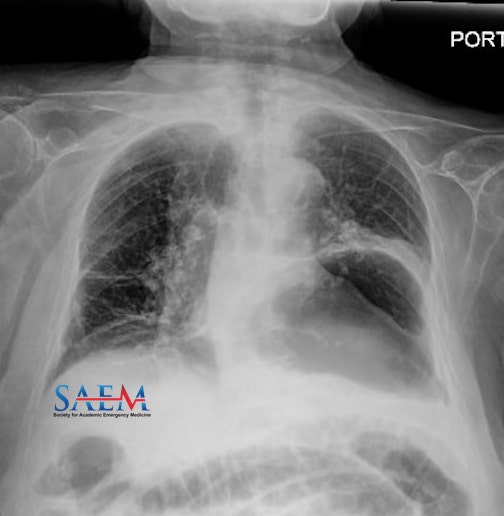
Chest Radiograph: Diffuse ground-glass opacities

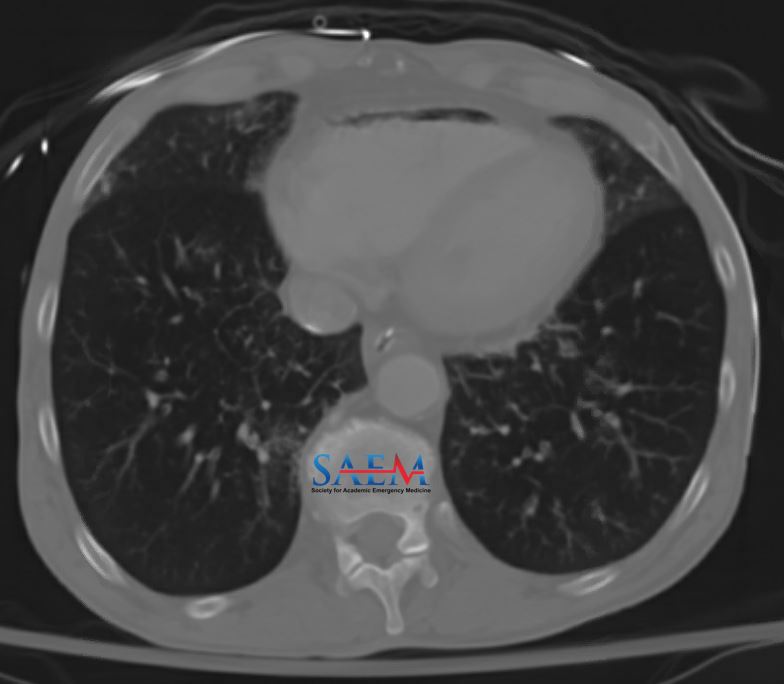
Air embolism to the right ventricle and pulmonary artery. As little as 20 mL or less of air rapidly infused may cause obstruction, ischemia, and hemodynamic collapse.

Risk factors include central venous catheterization, lung trauma, ventilator usage, hemodialysis, surgery (esp. coronary, neurosurgery), childbirth, and scuba diving barotrauma.

Take-Home Points

  • In the appropriate clinical scenario, especially those involving respiratory, cardiac, and neurologic findings where invasive procedures were utilized, the diagnosis of venous air embolism should be entertained.
  • Immediate management of an air embolism involves administration of 100% oxygen by nonrebreather mask (NRM) or ventilator and placement of the patient in the left lateral decubitus (Durant maneuver) and Trendelenburg positions. Hyperbaric oxygen therapy has also been used if there is no clinical improvement.
  • The purpose of the Durant maneuver and Trendelenburg position is to trap air along the lateral right ventricular wall, preventing right ventricular outflow obstruction and embolization into the pulmonary circulation.

  • Gordy S, Rowell S. Vascular air embolism. International Journal of Critical Illness and Injury Science. 2013;3(1):73. doi:10.4103/2229-5151.109428 Malik N, Claus PL, Illman JE, Kligerman SJ, Moynagh MR, Levin DL, Woodrum DA, Arani A, Arunachalam SP, Araoz PA. Air embolism: diagnosis and management. Future Cardiol. 2017 Jul;13(4):365-378. doi: 10.2217/fca-2017-0015. Epub 2017 Jun 23. PMID: 28644058.

SAEM Clinical Images Series: A Backpacker’s Rash

rash

A 33-year-old female presented with a progressively worsening rash for one week. The patient just finished hiking the John Muir Trail, a backpacking trip that encompassed three weeks and over 240 miles. On the last days of the trip, the patient started to develop a severely itchy, red rash on both feet. She tried using a topical anti-fungal, which seemed to make the rash worse. She now has swelling and difficulty walking. The rash does not involve the hands or other parts of the body. She denies fever, open wounds, nausea, vomiting, or systemic symptoms, and has never had a similar rash before.

Skin: Diffuse edema and erythematous maculopapular rash to both feet, with vesicles and bullae overlying the dorsal and plantar surfaces of toes and feet. No rash proximal to the ankles. No petechiae or purpura noted. Normal hands and palms.

Non-contributory

The rash has both vesicles and bullae which narrow the differential to contact dermatitis and dyshidrotic eczema. Without petechiae or purpura, it is less likely vasculitis (such as exercise-induced vasculitis). There is no fever, spreading redness, or systemic signs, and it is bilateral, making cellulitis less likely. There were no known exposures to poison oak and the patient never walked without shoes or socks. There were no known tick bites, the hike was in California, and the rash did not involve the palms, making an infectious cause such as Rocky Mountain Spotted Fever unlikely. The rash became worse with topical anti-fungal cream, making fungal infection less likely.

The most concentrated areas of the rash are on the plantar surface of the foot and toes. Upon further inspection, it appears in a pattern that may be consistent with sports tape being used during hiking for blisters and plantar fasciitis pain. The patient later received patch testing by dermatology and was diagnosed with a colophony allergy. In this case, colophony was found in the sports tape causing severe allergic contact dermatitis on the feet. This is a T-cell-mediated reaction caused by repeated exposure to an allergen on the skin. Colophony is a mixture of many different compounds that are all derived from pine trees and is a common ingredient in medical and sports tapes. It is also sometimes used in making shoes.

Take-Home Points

  • The presence of vesicles and bullae narrow differential to contact dermatitis or dyshidrotic eczema. Both of these should respond to topical and/or oral steroids.
  • Look for patterns on the highest concentrated area of the rash to suggest allergic contact dermatitis.
  • Repeated lengthy exposure over a short course of time can cause allergic contact dermatitis to develop.

  • Litchman G, Nair PA, Atwater AR, Bhutta BS. Contact Dermatitis. 2022 May 8. In: StatPearls [Internet]. Treasure Island (FL): StatPearls Publishing; 2022 Jan–. PMID: 29083649.

SAEM Clinical Image Series: Snowball Effects

A 13-year-old boy presented to the emergency department with complaints of a right eye injury. Five hours prior to arrival, he was struck directly in the right eye with a snowball resulting in immediate eye pain, localized swelling, some flashes of light in his vision and blurry vision. Prior to arrival, the patient had been seen at an optometry center where puff pressures of his eyes were obtained and the right eye was noted to have an increased intraocular pressure (IOP) of 46 mmHg compared to a pressure of 13 mmHg on the left. He continued to endorse photophobia and mild right eye pain.

Eye:

  • No bony tenderness or crepitus surrounding the right eye
  • Positive blood fluid level in the anterior chamber
  • EOMI
  • On confrontation of visual fields, the patient was unable to count fingers in all fields on the right but could detect light and movement
  • Red reflex could not be elicited on fundoscopic exam
  • On fluorescein exam, no flow of aqueous humor and no corneal abrasions
  • Tono-Pen IOP measurements were 41mmHg in the right eye, and 27 mmHg in the left eye

Non-contributory

The red flags include a history of vision loss and the presence of ocular hypertension with the hyphema. Ophthalmology was emergently consulted for the intraocular hypertension. By the time of evaluation by the specialist, the patient stated that his vision was less blurry and he did not see any spots in his vision. The photos demonstrate progression of the traumatic hyphema from grade IV, to grade II, and then grade I.


The emergent conditions that must be addressed include open globe and intraocular hypertension. Ophthalmology IOP measurements were 14 mmHg bilaterally. Visual acuities were 20/40 on the right and 20/20 on the left. A dilated eye exam with the slit lamp could not fully assess the posterior eye structures due to haziness. A metal eye shield was applied to the patient’s right eye, and he was discharged with cyclopentolate and prednisolone acetate eye drops, and an ophthalmology follow-up appointment within 24 hours. The patient was instructed to be on bed rest with the head of the bed elevated and to avoid straining.


Take-Home Points

  • In traumatic eye injury, pay attention to eye color changes with grade IV hyphema which can be missed unless you compare it to the uninjured side.
  • Look for features of an open globe which include irregularly shaped pupils, delayed consensual light response, extrusion of vitreous, Seidel’s sign (fluorescein streaming of tears away from the puncture site).
  • Beware of intraocular hypertension (>21 mmHg) with high-grade traumatic hyphema which needs to be emergently addressed to prevent optic nerve atrophy and permanent vision loss.

  • Brandt MT, Haug RH. Traumatic hyphema: a comprehensive review. J Oral Maxillofac Surg. 2001 Dec;59(12):1462-70. doi: 10.1053/joms.2001.28284. PMID: 11732035.
  • Gharaibeh A, Savage HI, Scherer RW, Goldberg MF, Lindsley K. Medical interventions for traumatic hyphema. Cochrane Database Syst Rev. 2011 Jan 19;(1):CD005431. doi: 10.1002/14651858.CD005431.pub2. Update in: Cochrane Database Syst Rev. 2013;12:CD005431. PMID: 21249670; PMCID: PMC3437611.


SAEM Clinical Image Series: An Uncommon Cause of Shortness of Breath

shortness of breath

A 102-year-old female presents with intermittent epigastric abdominal pain for the last two days. Episodes have no relieving or exacerbating factors. The pain originates in the epigastrium and radiates diffusely to the abdomen and back, resolving on its own within minutes of onset. She has had one episode of nonbilious, non-bloody emesis. Her last bowel movement was two days prior and she hasn’t been able to pass gas. The pain is associated with mild shortness of breath which has been progressively worsening since the onset of symptoms. Her family was concerned and called EMS because the shortness of breath has worsened and the episodes of pain have been progressively worsening in intensity. The patient denies fever, chills, hematuria, urinary frequency, chest pain, headache, dizziness, syncope, recent traumatic events, and any other associated symptoms.

General: Well-appearing; no acute distress; awake, alert, and oriented to date, place, and person

Cardiovascular: Regular rate and rhythm; S1/S2 present; 2+ systolic ejection murmur; capillary refill <2 seconds; 2+ pulses in all extremities

Respiratory: Lungs clear to auscultation bilaterally with diminished breath sounds in the left lower lobe; no signs of respiratory distress; no accessory muscle use

Abdomen: Soft; non-tender; non distended; no palpable masses; no guarding or rebound tenderness; no signs of peritonitis

Extremities: Full range of motion of all extremities; nonambulatory at baseline

Complete blood count (CBC): WBC 10.8 x 10^3/mcl; Hgb 12 g/dl; Hct 40.1%; Plt 375 x 10^3/mcl

Basic metabolic panel (BMP): Na 139 mmol/L; K 3.7 mmol/L; Cl 97 mmol/L; CO2 31 mmol/L; Glucose 170 mg/dL; BUN 10 mg/dL; Cr 0.58 mg/dL; Ca 10.2 mmol/L

Liver function test: AST 19 U/L; ALT 7 U/L; Alk Phos 144 U/L

Lipase: 11 U/L

Venous blood gas (VBG): pH 7.33; pCO2 61.1 mmHg; pO2 38 mmHg; BE -7 mmol/L

Lactic acid: 1.56 mmol/L

Small bowel obstruction (SBO) secondary to a spigellian hernia with an associated hiatal hernia. 

The CT demonstrates a spigellian hernia causing a small bowel obstruction. Spigellian hernias are hernias in the spigellian fascia which is located between the semilunar line and the lateral edge of the rectus abdominus muscle. These hernias constitute 0.12% of abdominal wall hernias, making them very rare and difficult to diagnose clinically. Spigellian hernias often go unnoticed until they are strangulated and require surgery. This patient not only had a rare spigellian hernia but also had a hiatal hernia causing the stomach to enter the pleural space. It’s possible that the bowel obstruction worsened the hiatal hernia with the backup of gastric contents and gas.

Take-Home Points

  • Spigellian hernias are rare abdominal wall hernias with a myriad of potential complications.
  • Shortness of breath is frequently considered a pathology involving the lungs or pulmonary vasculature, however abdominal complaints, especially in this case, can cause significant respiratory distress.
  • Elderly patients may have difficulty verbalizing their exact symptoms, and it is good practice to gather collateral information from families to aid in caring for these patients.

  • Spangen L. Spigelian hernia. World J Surg. 1989 Sep-Oct;13(5):573-80. doi: 10.1007/BF01658873. PMID: 2683401.


SAEM Clinical Image Series: Eye Pain

necrotizing

A 59-year-old gentleman experiencing homelessness with a history of hepatocellular carcinoma, hepatitis C, alcohol use disorder, and tobacco dependence presented to the emergency department (ED) with severe, worsening right eye pain, blurry vision, swelling, redness, and purulent discharge after scraping his upper face on concrete during a mechanical fall two weeks prior. Of note, his partner presented to the ED at the same time with a necrotic infection of the breast as well as multiple skin lesions reportedly due to insect bites.

Vitals: T 102.4°F; HR 108; BP 121/94

Head: Lice nits visible in his hair

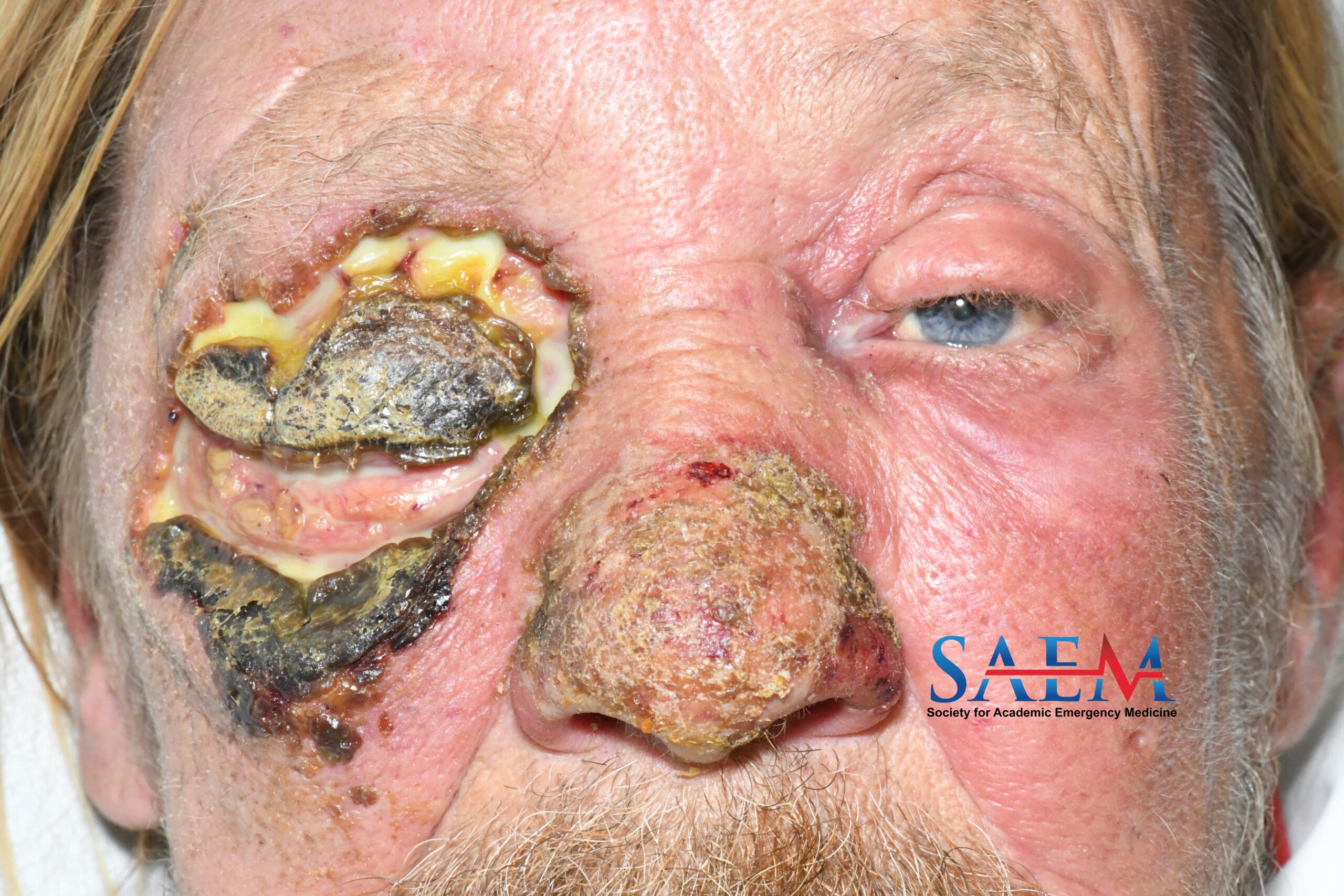
Eye: Unable to open right eye without assistance; eyelids crusted and necrotic with underlying orbicularis oculi muscle visible; EOM full but painful in all fields of gaze; visual acuity 20/60 in each eye; pupils 2 mm, equal and minimally reactive.

White blood cell (WBC) count: 27,600/μl

Comprehensive metabolic panel (CMP): Na 121; K 2.8; Cl 83; AST 113; ALT 45

Wound culture: Positive for MRSA, Streptococcus pyogenes, Enterobacter cloacae, and Staphyloccocus epidermis

This patient’s presentation is consistent with periorbital necrotizing fasciitis complicated by severe sepsis.

This patient had type 1 necrotizing fasciitis given the polymicrobial source of infection with both aerobic and anaerobic organisms growing from his wound culture. Type 2 necrotizing fasciitis is attributable to streptococcal and/or staphylococcal infection alone. Group A strep is the most common organism responsible for necrotizing fasciitis, found in about 50% of cases.

Independent risk factors for necrotizing fasciitis include advanced age, diabetes mellitus, heart disease, liver cirrhosis, alcohol use disorder, and trauma. Furthermore, persons who experience homelessness are at risk of skin lesions due to insect bites, burns, and physical trauma which predispose them to secondary bacterial infections because of inadequate hygiene resources.

A systematic review of periorbital necrotizing fasciitis showed that 35% of cases were triggered by trauma, while 14% were caused by other infections such as acute dacryocystitis, sinus infections, and infections of the parotid glands.  Thus, it is likely that the patient’s contact with his partner who had a necrotic soft tissue infection secondary to insect bites, as well as his recent trauma to the eye, predisposed his development of this condition.

Initiation of broad-spectrum intravenous (IV) antibiotics with vancomycin, piperacillin/tazobactam, and clindamycin, as well as IV fluids.

In this case, the patient received the above antibiotics, underwent operative debridement, frequent wound care including dilute hypochlorous acid, local vancomycin administered via intra-orbital catheter, as well as lid reconstruction with glabellar flap. He was ultimately discharged on a two-week course of oral moxifloxacin and linezolid, healing well at his one-month follow-up appointment.


Take-Home Points

  • Skin problems are a common reason that persons experiencing homelessness seek medical care, given their risk factors for both primary insults and subsequent superinfection.
  • Common sources of infection for periorbital necrotizing fasciitis include trauma, surgery, and other infections of the upper face.
  • The standard of care for periorbital necrotizing fasciitis consists of IV and local antibiotics, and operative debridement.

  • Amrith S, Hosdurga Pai V, Ling WW. Periorbital necrotizing fasciitis — a review. Acta Ophthalmol. 2013 Nov;91(7):596-603. doi: 10.1111/j.1755-3768.2012.02420.x. Epub 2012 Apr 20. PMID: 22520175.


Go to Top