2020 ACLS Guidelines on Vasopressors and Non-Vasopressors During Cardiac Arrest

The 2020 ACLS Guidelines were published in October 2020 [1]. This first of 3 blog posts will focus on vasopressor and non-vasopressor medications during cardiac arrest. Part 2 will focus on specific arrhythmia management and Part 3 will focus on toxicologic interventions.

Summary

There were no major updates for vasopressors and non-vasopressors used during cardiac arrest. The American Heart Association (AHA) published Highlights of the 2020 Guidelines [PDF] as a clear and concise summary. Now that the AHA is releasing focused updates in the 5-year period between guidelines (like this one on lidocaine), fewer major changes likely will be needed when the full guidelines are published.


Vasopressor Non-Vasopressor

Epinephrine

  • Recommended for patients in cardiac arrest (COR 1, LOE B-R)
  • Reasonable to administer 1 mg every 3-5 minute (COR 2a, LOE B-R)
  • Reasonable to administer as soon as feasible in non-shockable rhythm (COR 2a, LOE C-LD)
  • May be reasonable to administer after initial defibrillation attempts have failed in shockable rhythm (COR 2b, LOE C-LD)

Amiodarone or lidocaine

  • May be considered for VF/pVT unresponsive to defibrillation (COR 2b, LOE B-R)


Vasopressin

  • Offers no advantage over epinephrine (COR 2b, LOE C-LD)

Steroids

  • During CPR, are of uncertain benefit in OHCA (COR 2b, LOE C-LD)
 

Calcium

  • Routine use NOT recommended (COR 3, LOE B-NR)
 

Sodium bicarbonate

  • Routine use NOT recommended (COR 3)
 

Magnesium

  • Routine use NOT recommended (LOE B-R)

Table: Vasopressors and non-vasopressors used during cardiac arrest (VF: ventricular fibrillation, pVT: pulseless ventricular tachycardia)


Reference:

Panchal AR, Bartos JA, Cabañas JG, et al; Adult Basic and Advanced Life Support Writing Group. Part 3: Adult Basic and Advanced Life Support: 2020 American Heart Association Guidelines for Cardiopulmonary Resuscitation and Emergency Cardiovascular Care. Circulation. 2020 Oct 20;142(16_suppl_2):S366-S468. doi: 10.1161/CIR.0000000000000916. Epub 2020 Oct 21. PMID: 33081529.

ACEP E-QUAL: The Electronic ICU


eICU

Building on already increasing interest in telehealth, the COVID-19 pandemic accelerated the development and implementation of telemedicine services in a variety of clinical settings. In 2018, Dr. Jason Woods hosted an episode of the ACEP E-QUAL Network podcast highlighting the creation of an electronic intensive care unit (eICU) through Emory Healthcare. In this episode, Dr. Tim Buchman and Critical Care Nurse Cheryl Hiddelson share their innovative approach to delivering critical care services via telehealth. We present highlights from this discussion below.


What is an eICU?

The eICU allows for critical care oversight, without having to be on site. It provides comprehensive monitoring and data analysis and online audio or video support for patients and families. Utilizing advanced information technology (IT) platforms and approaching with a business strategy, telehealth allows for innovative ways to provide critical care services remotely.

Why is there a need for an eICU?

The US population is aging, with the number of Americans age 65 or older increasing steadily. Demand for critical care services increases with age. The availability of critical care physicians is limited in large areas of the US. Similarly, as more nurses are reaching retirement than those entering the workforce, critical care providers are becoming hard to come by. Recruiting and maintaining critical care providers is only one part of the issue, with staffing on nights, weekends, and holidays creating a constant challenge. Telehealth poses a contemporary solution to the scarcity of healthcare providers.

What does the eICU setup look like?

The eICU is akin to airline control towers. There is 24/7 coverage by nursing and physician staff, overseeing more than a hundred beds. Various screens facilitate a “sentry” role in which surveillance monitoring algorithms allow staff to detect problems possibly even before the bedside staff. The eICU integrates bedside monitor data with additional system-wide data to create different views of what is occurring in the unit being monitored. Staff can track discharge readiness and filter lists by system or condition.

Camera sessions allow for bi-directional communication with patients and families, but also for just-in-time-training with staff as well as consultation with specialists.

What unique challenges has the eICU been able to address?

  • On-site advanced practice providers (APPs) such as physician assistants, nurse-practitioners, can be supervised by critical care nurses and physicians to provide in-person care.
  • Alternative staffing from geographic areas that are in a different time zone can help fill night shifts. The Emory group used travel nurses and physicians who were stationed in Australia.
  • Distance and delay to care become irrelevant when an intensivist can be available 24/7.

What benefits have been observed with the eICU?

The Emory eICU was able to realize decreased mortality, decreased transfer rates, decreased length of stay, and an increase in patient experience metrics for the hospitals it covered compared to other local facilities. Analysis of costs suggested savings of thousands of dollars per patient and increased revenue for small community hospitals that could retain and increase their daily census of critical care patients.

Can this concept be applied to Emergency Medicine?

There may be a role in applying telehealth data monitoring to emergency department waiting rooms in an attempt to identify patients at high risk for sudden deterioration or decompensation.

Interested in more ACEP-EQUAL podcasts?

Listen to the other ACEP E-QUAL podcasts on our Soundcloud account.

SAEM Clinical Image Series: Distended Abdomen after ROSC

distended abdomen

A 64-year-old female presented to the emergency department (ED) in cardiac arrest. Her family members heard her fall in the bathroom and started CPR. EMS intubated the patient and 20 minutes of CPR was done en route. Return of spontaneous circulation (ROSC) was achieved after fifteen minutes of resuscitation in the ED.

At baseline, the patient ambulated with her walker and was conversant. She was having abdominal pain and nausea for the past three days after recently being diagnosed with a urinary tract infection. On arrival to the ED, the patient was pulseless with ventricular fibrillation. The patient received ten doses of epinephrine, two doses of sodium bicarbonate, calcium, amiodarone, magnesium, and one dose of naloxone during the resuscitation. One defibrillatory shock was administered. She was started on a norepinephrine drip and an amiodarone drip.

Computed tomography (CT) of the head was negative. CT of the chest was significant for left pneumothorax and left-sided subcutaneous emphysema. A pigtail chest tube was placed. After a few hours, she developed worsening abdominal distension. An abdominal CT scan revealed the images shown.

(more…)

Just-in-Time Training for Emergency Medicine Radial Arterial Line Placement

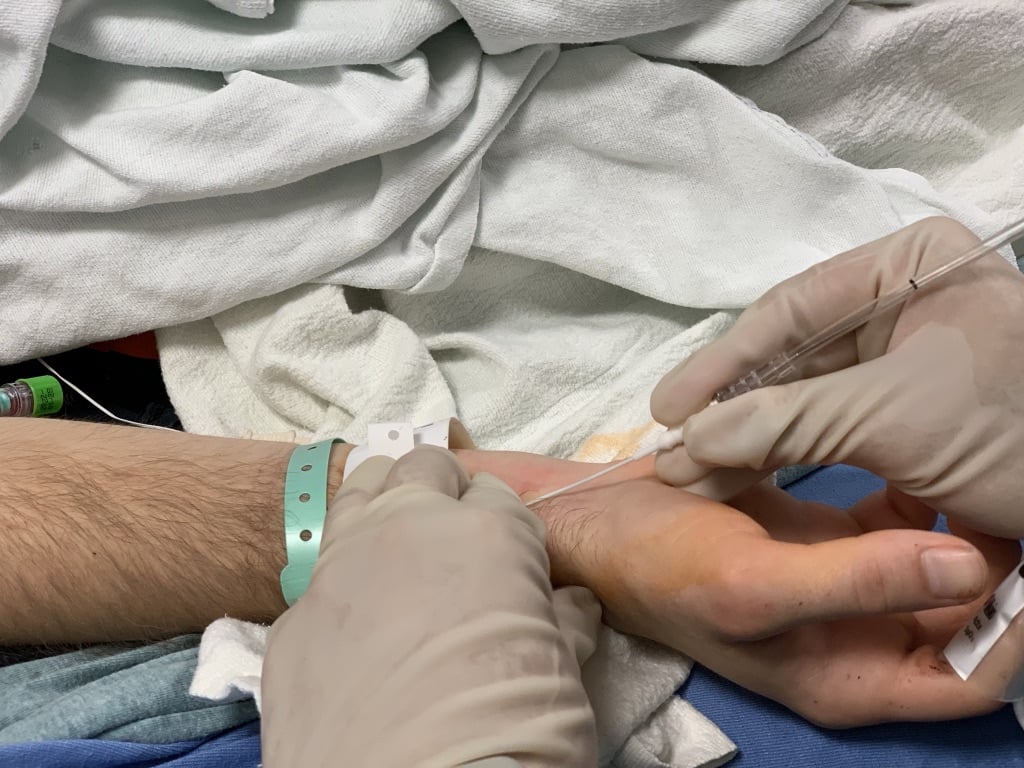
A 63-year-old male presents for acute onset of headache, neck pain, and altered mental status. He has a prior history of hypertension and hyperlipidemia but recently lost his insurance and has been unable to fill his medications. As a well-informed 2nd year resident, you suspect the presence of a ruptured subarachnoid hemorrhage and arrange an expedited trip to the CT scanner. The patient’s blood pressure continues to remain elevated and you initiate an antihypertensive drip. You decide that in order to have accurate titration, you need more reliable data and decide to place a radial arterial line. However, the last two arterial lines you placed did not go according to plan! Before you start the procedure, you decide to review the procedure and some common pitfalls in placing radial arterial lines. You remember your attendings telling you during prior attempts to do things a certain way and you want to incorporate these in your practice.

(more…)

End-Tidal CO2 in Cardiopulmonary Resuscitation

Capnography in CPR

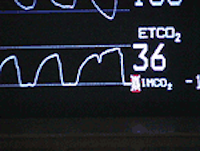
End-tidal CO2 (EtCO2) monitoring is a measure of metabolism, perfusion, and ventilation. In the ED, we typically think of a EtCO2 as a marker of perfusion and ventilation. However, EtCO2 is an extremely powerful surrogate for endotracheal tube (ETT) Position, CPR Quality, Return of spontaneous circulation (ROSC), Strategies for treatment, and Termination (of CPR). Do these letters look familiar? They should! In this post we take a deep dive into each of these potential uses of EtCO2 in the ED.

(more…)
By |2026-06-16T16:14:11-07:00Feb 6, 2019|Critical Care/ Resus, Pulmonary|

The 4 T’s of Postpartum Hemorrhage

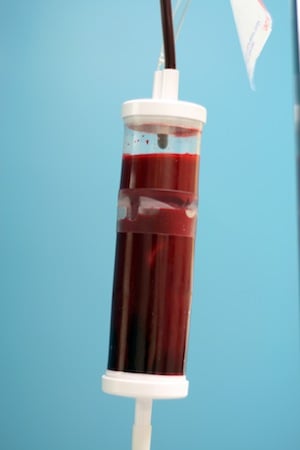
Blood transfusion Drip Chamber

A 28-year-old G4P3 at 41 weeks presents to the ED via EMS. She is in active labor. On exam, a neonatal head is visible. Two minutes later, you deliver a healthy vigorous baby boy and hand him to your colleague. You notice persistent bleeding from her vaginal canal. Her tachycardia climbs to 110 bpm and her latest blood pressure is 78/48 mm Hg. We review postpartum hemorrhage (PPH) and the 4 T’s – a memory aid to help ED providers manage this life-threatening presentation.

(more…)
By |2026-06-16T16:14:13-07:00Feb 6, 2019|Critical Care/ Resus, Ob/Gyn|

IDEA Series: A Low-fidelity Simulation Workshop for Teaching Cricothyroidotomy

The Problem

idea series teaching residents quality improvement

Cricothyroidotomy is an emergency life-saving procedure that involves surgical placement of a tube through the cricothyroid membrane in order to establish a patent airway for oxygenation and ventilation. The indications for this procedure are when traditional means, such as orotracheal or nasotracheal intubation, are contraindicated or have failed during attempts to establish an emergency airway.1,2 It is a critical skill for emergency physicians but the declining rate of this procedure has resulted in decreased exposure during training.3,4

(more…)

By |2019-03-28T21:25:08-07:00Feb 3, 2019|Critical Care/ Resus, IDEA series|
Go to Top