Trick of the Trade: Gel-free ultrasound-guided peripheral IV technique

Ever finally step away from a busy resuscitation and someone stops you for peripheral IV access? You set up everything, have the patient positioned, and then notice there is no sterile ultrasound gel. No gel? No problem. The trick is to eliminate anything of poor acoustic impedance between the ultrasound probe and the patient’s skin.
Trick of the Trade

1. Apply a transparent adhesive dressing with a thin alcohol layer on the probe

Instead of using gel, we squeeze alcohol pads to create a thin alcohol layer and place a transparent adhesive cover, such as Tegaderm ©. The thin alcohol layer serves to eliminate any air bubbles under the adhesive cover as well as minimizes residual adhesive material sticking to the probe when removing the cover. The adhesive cover itself serves as a sterile barrier and a slick surface to improve probe maneuverability. Note that some ultrasound manufacturers do not recommend the use of isopropyl alcohol on their transducers. Therefore check your specific ultrasound’s recommendations before trying [1, 2].

2. Use sterile saline instead of gel on the patient’s skin

Squirt normal saline flush on the patient’s skin to create a coupling medium between the probe and the patient.

Why it works:

Ultrasound procedures use a range of frequencies (1.5-20 MHz) to visualize internal structures and require a medium to replace air, which has a poor acoustic impedance for the ultrasound waves [3]. Acoustic impedance is defined as the resistance of the propagation of ultrasound waves through tissues and is the product of the density and speed of sound in the tissue [4]. Ultrasound gel has an acoustic impedance that is similar to soft tissue and is therefore considered the ideal medium [3]. Because most soft tissue is comprised of water, the acoustic impedance of water, and therefore 0.9% saline, is actually pretty similar [5], as demonstrated by water bath techniques for ultrasounding distal extremity injuries [6].

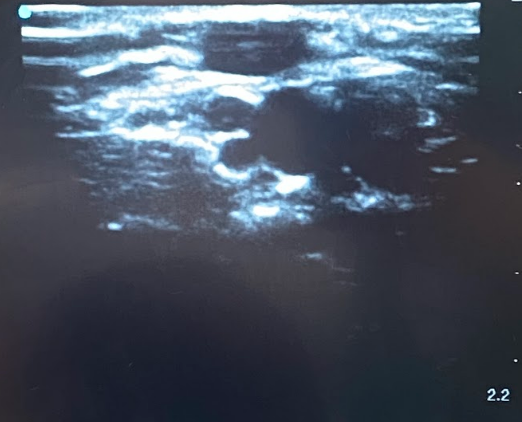
We find great visual clarity for performing ultrasound-guided peripheral IVs using this trick, as shown in Figure 1.

Peripheral IV ultrasound screen without gel

Figure 1: Peripheral IV ultrasound using alcohol under transparent film dressing and topical saline flush – all without ultrasound gel

Read other Tricks of the Trade articles.

References

  1. Cleaning and Disinfecting FUJIFILM SonoSite Products User Guide [PDF]. Sonosite. 2015. Accessed April 5, 2023.
  2. Disinfectants and Cleaning Solutions for Ultrasound Systems and Transducers [PDF]. Philips. 2021. Accessed April 5, 2023
  3. Afzal S, Zahid M, Rehan ZA, et al. Preparation and Evaluation of Polymer-Based Ultrasound Gel and Its Application in Ultrasonography. Gels. 2022 Jan 6;8(1):42. doi: 10.3390/gels8010042. PMID: 35049577; PMCID: PMC8774352
  4. Suzuko S, Peter G, Philipp L. 20 – Local Anesthetics, Ed(s): Hugh C. Hemmings, Talmage D. Egan, Pharmacology and Physiology for Anesthesia (Second Edition), Elsevier, 2019, Pages 390-411, ISBN 9780323481106. DOI: 10.1016/B978-0-323-48110-6.00020-X
  5. R. Alkins, K. Hynynen, 10.08 – Ultrasound Therapy, Editor(s): Anders Brahme, Comprehensive Biomedical Physics, Elsevier, 2014, Pages 153-168, ISBN 9780444536334. DOI 10.1016/B978-0-444-53632-7.01010-8
  6. LeDonne S, Sengupta D. US Probe: Ultrasound Water Bath for Distal Extremity Evaluation. Alerhand S, Singh M, editors. emDOCs.net – Emergency Medicine Education. 2017.
By |2023-04-06T20:53:38-07:00Apr 12, 2023|Radiology, Tricks of the Trade, Ultrasound|

Trick of the Trade: Chest tube rewarming with Foley tubing connector

You have a pulseless hypothermic patient requiring aggressive internal rewarming. ECMO is not available, and you’ve made the decision to initiate thoracic lavage. After placing your chest tubes, you step back triumphantly, but in short order, the nurse hands you large diameter IV tubing with warmed fluids so that you can connect it to the chest tube. You are left with the IV tubing in one hand and a chest tube in the other with no time to waste, but no elegant or straightforward solution to interface the two.

Trick of the Trade

Using Foley bag tubing

The tube from a standard Foley bag, available in all emergency departments, contains a Luer lock near the tapered nozzle. This unique connector setup allows you to instill warm fluids into the thoracic space with minimal spillage.

rewarming hypothermia IV tubing chest tube foley tubing

Technique for Rewarming

  1. Attach the warmed IV fluids to the Luer lock port on the Foley bag tubing.
  2. Insert the tapered nozzle on the Foley bag tubing (typically interfaces with the urine drainage port of the Foley catheter) into the chest tube.
  3. Clamp the remainder of the Foley bag tubing just proximal to the Luer lock to minimize backflow of IV fluids into the bag.
  4. Optional: Cut the tubing proximal to the clamp to declutter the space around the interface.
  5. Instill warm fluid through one chest tube and drain it from the adjacent chest tube.
  6. Continue rewarming resuscitation protocols.
Chest tube connected to IV tubing via Foley bag tubing

IV tubing connected to chest tube via Foley bag tube (left photo is a closeup view with arrow designating IV fluid flow)

Read other Tricks of the Trade posts.

Trick of the Trade: Antibiotic ointment for removal of artificial nail glue from eyelids

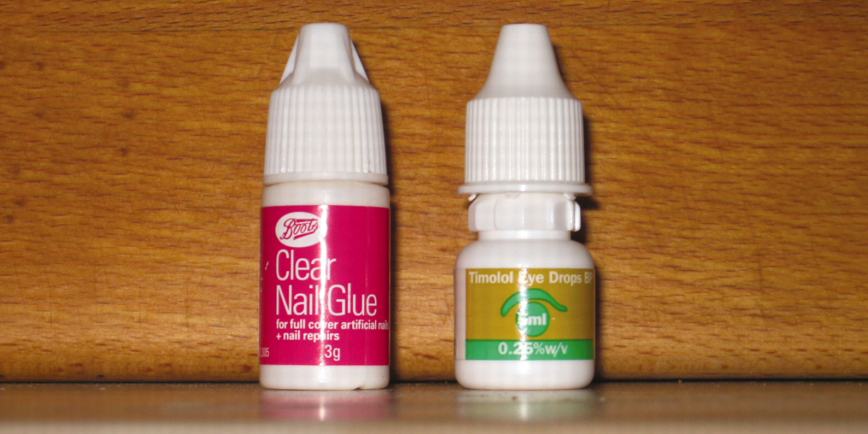
A bottle of nail glue and timolol eye drops (reproduced with permission from BMJ Publishing Group Ltd [1])

You are working a busy shift in your department’s fast track area and sign up for a patient with a complaint of “eye pain.” The patient is a fan of glue-on nails and mistook her nail glue bottle for her eyedrops. Now she is unable to open her eyelid for the exam and you struggle to open it yourself. You want to avoid cutting the adhered eyelashes and wonder if there’s a better solution.

Background rise of artificial, press-on nails

Artificial acrylic or “press-on” nails were first invented in the 1950s; however, they did not gain in popularity until the 1980s as nail art became a trend [2]. Shortly thereafter, they fell out of style until a resurgence occurred with the COVID pandemic forcing the closure of nail salons. Compared to pre-pandemic values, Google searches for “press on nails” increased 300% [3]. Application of most nails requires nail glue, which often contains a mixture of alcohol, cyanoacrylate (superglue), or photo-bonded methacrylate [4].

Nail glue complications

Use of nail glue at home can result in adverse exposures with the most common location being the eye [5]. Because nail glue is often packaged in small containers identical to eye drop bottles, patients can mistake the nail glue for ophthalmic drops — especially those with visual impairment [6]. This exposure was first described in the medical literature in 1982 and has been described many times since despite repeated calls for manufacturers to modify the bottles to be safer [1].

In the presence of water, cyanoacrylate rapidly polymerizes, leading to the bonding effect [5]. If the glue gets into a person’s eye, reflexive blinking pushes the glue to the eyelid margins resulting in the eyelashes or eyelid margins sticking together [5], also known as inadvertent tarsorrhaphy. Methods to open the eyelids include removal of glue with forceps, removal or cutting of the eyelashes, or soaking the eye for hours to days with a moist gauze [1, 6, 7].

Although the most successful solvent to dissolve dried glue is acetone, this can cause corneal and conjunctival injuries [8]. The effectiveness of other solvents has been debated in the literature with mixed reports of efficacy [9].

Trick of the Trade: Apply petroleum-based topical antibiotic ointment

Our personal experience managing several of these cases suggests that a petroleum-based topical antibiotic ointment, such as Bacitracin, can help loosen the glue bond. It is an inexpensive option with minimal harm to fix inadvertent eyelid adhesion from nail glue (or other superglue). It is worth trying before attempting more aggressive techniques.

eyelid nail glue adhesion inadvertent tarsorrhaphy ointment

Before and after application of topical antibiotic ointment to remove inadvertent nail glue causing eyelid adhesion

Materials Needed

  • Bacitracin ointment (1-2 tubes)
  • Cotton-tipped applicatiors (Q-tips)

Technique

  1. Apply the topical ointment liberally to the affected eye.
  2. Let rest undisturbed for 15-20 minutes.
  3. Gently pull the eyelids and eyelashes apart.
    • Be careful not to massage the area too vigorously onto the eye itself, as any residual local glue can result in corneal trauma.
    • You can use cotton-tipped applicators to help gently tease the lid margins apart.
  4. Copiously irrigate the eye.
  5. Perform an eye exam to assess for ocular injury.
  6. Consider obtaining an ophthalmology consult.

References

  1. Yusuf IH, Patel CK. A sticky sight: cyanoacrylate “superglue” injuries of the eye. BMJ Case Rep. 2010;2010:bcr11.2009.2435. doi:10.1136/bcr.11.2009.2435
  2. Quinn J. Not Your ’80s Press-Ons: Why the Press-On Manicure Trend Is a Must-Try. Sunday Edit. Published June 10, 2022. Accessed October 26, 2022.
  3. Google Trends on “press on nails”. Google Trends. Accessed October 26, 2022.
  4. Brambilla E, Crevani M, Petrolini VM, et al. Exposure to Nail and False Eyelash Glue: A Case Series Study. Int J Environ Res Public Health. 2020;17(12):E4283. doi:10.3390/ijerph17124283
  5. Forrester MB. Characteristics of ocular nail glue exposures reported to the National Electronic Injury Surveillance System during 2000-2019. Clin Toxicol Phila Pa. 2021;59(7):633-638. doi:10.1080/15563650.2020.1834115
  6. Samet A, Li DQ, Al-Qahtani A, Arthurs B, El-Hadad C. Nail glue injuries to the eye: assessment of two cases. Can J Ophthalmol. 2022;57(1):e11-e13. doi:10.1016/j.jcjo.2021.04.026
  7. Cohen J. Super Glued Shut. Brown Emergency Medicine. Published Apr 12, 2017. Accessed February 5, 2023.
  8. Reddy SC. Superglue injuries of the eye. Int J Ophthalmol. 2012;5(5):634-637. doi:10.3980/j.issn.2222-3959.2012.05.18
  9. Prouty H, Adams DS, Heard K. Evaluation of Treatments for Cyanoacrylate Eyelash Adhesion Using an In-Vitro Model. Cutan Ocul Toxicol. 2008;27(1):11-14. doi:10.1080/15569520701856732
By |2023-02-06T13:59:27-08:00Feb 8, 2023|Ophthalmology, Tricks of the Trade|

Trick of the Trade: Managing Epistaxis with Merocel Nasal Packing and an Angiocatheter


There are many ways to manage epistaxis. Once nasal clamping and cauterization fail, the next step is to consider using tranexamic acid (TXA) and performing nasal packing. Inflatable packing devices such as a Rhinorocket are painful to insert and do not conform well to the shape of the naris. The expandable Merocel nasal packing, a compressed, dehydrated sponge, provides a softer, alternative option, although the insertion process can be painful given its initial rigid, edged structure. We propose 2 strategic tricks to optimize your nasal packing technique using the Merocel sponge.

Trick of the Trade: Strategic expansion of the Merocel sponge

The common approach for Merocel packing involves inserting the unexpanded sponge into the nose, tilting the patient’s head back, and dripping in TXA solution to expand the sponge to tamponade the bleeding.

Trick #1: Wet the tip of the Merocel’s sharp edge to allow for a softer cushion to slide the packing more comfortably and deeper into the naris.

Trick #2: Use an angiocatheter to deliver the TXA solution directly onto the mid-portion of the packing. Commonly, the TXA solution is dripped onto the outer end, which may cause an uneven and inadequate expansion at the site where the bleeding may be occurring. Because blood also can react with the packing, it is likely the blood will expand the packing before TXA reaches the center by osmosis. Another benefit of Merocel expansion starting at the center is that it will help anchor the sponge in place. In contrast, TXA administration at the outer tip first may pull the sponge out of the naris a few millimeters.

Equipment

  • 20g or 22g angiocatheter (closed IV catheter system)
  • Tranexamic acid solution
  • A syringe
  • Merocel nasal dressing

Technique

merocel sponge nasal packing trick setup

1. Insert the angiocatheter needle into the Merocel packing about ⅓ the distance from the external end of the packing. Remove the needle, leaving the plastic angiocatheter in place.

merocel tip moisten txa trick

2. Soak the insertion tip of the nasal packing with a drop of TXA to soften it. Or apply a light coat of an antibiotic ointment or petroleum jelly to the insertion tip for lubrication. This will make it easier to advance the packing and also less painful for patients. Advance the Merocel into the affected naris just as you would a nasogastric tube. Some additional tips are in the ALiEM article about nasogastric and nasopharyngeal tube insertion.

3. Once the nasal packing is fully inserted, expand the sponge by administering TXA via the attached angiocatheter. The mid-portion of the sponge should expand first, thus preventing outward slippage of packing. Also TXA more quickly reaches the area of bleeding rather than from a more gradual osmotic effect when dripped in from the external tip.

Trick of the Trade: Winging It with External Jugular Cannulation

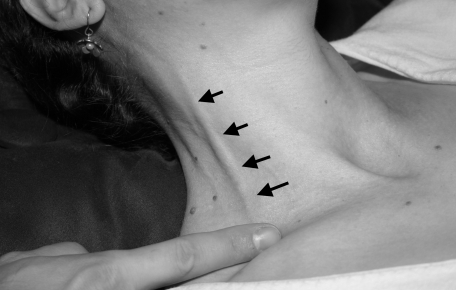
external jugular

Sankoff J, et al. WJEM (2008)

Imagine yourself caring for a patient that needs urgent vascular access, but several attempts at peripheral intravenous (IV) cannulation have been unsuccessful. You aren’t quite at the point where emergent intraosseous or central venous access is indicated. Maybe those options aren’t even available where you’re working. From across the room, though, you can see a very prominent external jugular (EJ) vein. Sadly, you remember the last EJ line you placed falling out almost immediately.

Patients with challenging peripheral intravenous access in the extremities may require and benefit from cannulation of the EJ. Often done in the setting of resuscitation, securing these angiocatheters on the neck can be difficult. Tape and dressings may not stick due to sweat and anatomical limitations. Rotation, flexion, and extension of the neck can displace the catheter.

Trick of the Trade

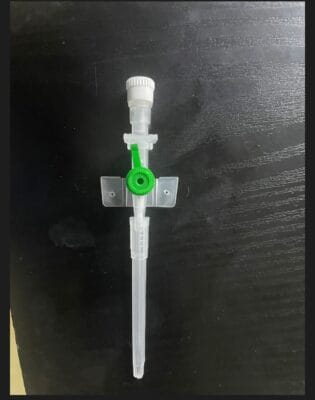
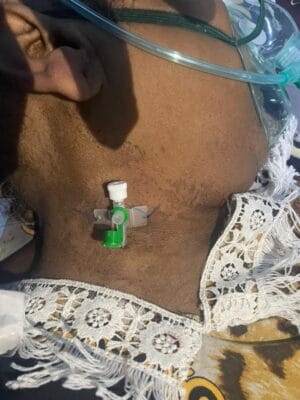
If available, modify a winged angiocatheter to allow suturing to the skin of the neck.

angiocatheter


  • Create two small holes, one on each wing of the angiocatheter, using a sharp instrument such as scissors, scalpel, or needle.
  • Place EJ line and secure to the skin using sutures, similar to stabilization of central or arterial line.

Winged angiocatheters may not be available in all clinical institutions. International readers of ALiEM may be more familiar with their use.

However, this trick introduces the idea of finding creative modifications of available catheters to allow for suturing and securing of alternative IV lines. Modifications similar to this Trick of the Trade can be considered when placing “deep” peripheral IVs or pseudo-midline IVs such as when using extended-length angiocatheters or repurposed arterial catheters where suture can be wrapped around the hub. This approach may also be useful in peripheral cannulation of the internal jugular vein. 

Tip: Be careful not to pierce the catheter or compress it down when suturing.

More from ALiEM on EJ cannulation:

Interest in other tricks?

Read more articles in the Tricks of the Trade series.

By |2022-09-08T15:18:30-07:00Sep 9, 2022|Tricks of the Trade|

Trick of the Trade: Getting the last bit of ultrasound gel from the bottle

It’s a busy shift and you need to perform a bedside ultrasound on a patient’s belly to rule out cholecystitis, when you realize that the ultrasound gel bottle is nearly empty. No matter how many times you vigorously shake the bottle, it’s impossible to get the viscous gel out. In a pinch, you could use hand sanitizer, sterile lubricant, or even water as a substitute for gel. Or you could run to the storage room on the other side of the busy department to grab a new bottle. Or…

Trick of the Trade

Use centrifugal force to move the gel to the top of the bottle!

trick ultrasound bottle gel out


  • Turn the bottle upside down so the cap is facing the ground.
  • Place the bottle into a (fresh) patient’s sock or transducer cover. Alternatively, you can use a plastic bag or ortho tubular stockinette.
  • Firmly holding the bag, and spin the bag for a few seconds in a circular motion, almost like you were throwing a grappling hook.
  • The centrifugal motion will generate an outward force pushing all of the viscous gel to the bottle cap!
  • Once you’ve used the gel, store the bottle cap-side down so you don’t have to do this again.

This trick is useful in a pinch, because it makes use of the entire gel bottle and promotes an eco-friendly use of ED resources.

Tip: Just don’t let go while you swing, lest you turn that patient with the belly pain into a trauma activation from a bottle to the face.

Interest in other tricks?

Read more articles in the Tricks of the Trade series.

By |2022-07-25T11:26:09-07:00Jul 27, 2022|Tricks of the Trade, Ultrasound|

Trick of the Trade: A “Fiberbougie” through a supraglottic airway device (King tube)

king tubeResuscitation before intubation is a critical construct in modern emergency medicine. The prevention of peri-intubation arrest by correcting pre-intubation hypoxia, hypotension, and acidosis is often easier said than done. Worse yet, the intubation process itself, especially if difficult, can worsen hypoxia and hypotension which is often unrecoverable [1, 2] Supraglottic devices, such as a King Airway or laryngeal mask airway, can be placed quickly, and they effectively oxygenate and ventilate patients with a high degree of success [3]. Unfortunately, when the King (or similar device) is exchanged for an endotracheal tube, success is far from guaranteed. Ideally the King could be blindly changed over a tube exchanger however it is quite easy to lose the airway completely during this process. We describe a potentially safer and more effective alternative.

Trick of the Trade

After a patient is stabilized after initial resuscitation, the supraglottic King airway device should be exchanged. A disposable, single-patient-use bronchoscope can serve as a bougie-like guide.

equipment fiberbougie king

Equipment Needed

  • Disposable bronchoscope
  • Endotracheal tube
  • 50 mL syringe
  • Laryngoscope (video or direct)
  • Trauma shears
  • Suction
  • Capnography
fiberbougie through supraglottic device king airway

Left: Demonstrating the technique inserting a single-use bronchoscope through a supraglottic King tube in a simulation patient. Right: Corresponding view of the vocal cords through the King side port in a real patient.

Description of the Trick

  1. Insert a disposable bronchoscope through the airway port of the King airway
  2. Guide the bronchoscope to exit through the side port of the King and into the trachea until you approach the carina
  3. Cut the disposable bronchoscope at the level of the handle, leaving a “fiberbougie” in the trachea above the carina
  4. Remove the King airway over the cut fiberscope in a modified Seldinger technique while suctioning airway
  5. Insert the endotracheal tube over the “fiberbougie”
  6. Use video or direct laryngoscopy to visualize the tube sliding over the “fiberbougie” into cords
  7. Confirm placement with capnography and/or with direct visualization and x-ray
bronch bougie equipment

Insertion of the endotracheal tube over the “fiberbougie” with video laryngoscopy confirmation with a simulation patient. The inset image was captured from a Glidescope on a real patient during the exchange.


Video Tutorial of the Fiberbougie Technique to Exchange a King Tube


References

  1. April MD, Arana A, Reynolds JC, et al. Peri-intubation cardiac arrest in the Emergency Department: A National Emergency Airway Registry (NEAR) study. Resuscitation. 2021;162:403-411. doi:10.1016/j.resuscitation.2021.02.039. PMID 33684505
  2. Russotto V, Tassistro E, Myatra SN, et al. Peri-intubation Cardiovascular Collapse in Critically Ill Patients: Insights from the INTUBE Study [published online ahead of print, 2022 May 10]. Am J Respir Crit Care Med. 2022. doi:10.1164/rccm.202111-2575OC. PMID 35536310
  3. Burns JB Jr, Branson R, Barnes SL, Tsuei BJ. Emergency airway placement by EMS providers: comparison between the King LT supralaryngeal airway and endotracheal intubation. Prehosp Disaster Med. 2010;25(1):92-95. doi:10.1017/s1049023x00007743. PMID 20405470 
Go to Top