ACMT Toxicology Visual Pearl: The Heart Won’t Go On and On

Which cardiotoxic plant is shown?
- Lily of the valley
- Moonflower
- Morning glory
- Water hemlock
- White snakeroot



Which cardiotoxic plant is shown?

A 48-year-old female with a past medical history of opioid use disorder on suboxone presents with abdominal pain for one day. The patient developed sharp diffuse upper abdominal pain the evening prior to arrival that resolved. The pain recurred again today and was associated with bilious emesis. The patient notes persistent upper abdominal pain with paroxysmal exacerbation. She has a history of a hysterectomy, but no other abdominal surgeries. No history of gallstone pathology.
Vitals: HR 38; BP 120/63; RR 14; SpO2 100%
HEENT: No jugular venous distention, no scleral icterus.
CV: Normal S1, S2, regular rhythm.
Respiratory: Clear breath sounds bilaterally.
Abdominal: Mild tenderness to palpation in the epigastrium, without rebound or guarding.
Extremities: Warm and well perfused, no edema.
White blood cell (WBC) count: 11
Alk phos: 123
Total Bilirubin: 0.5
Lipase: 24
Troponin: 0
Lactate: 1
An echo was performed for bradycardia and a brief episode of hypoxia in the emergency department. A large, tethered mass is seen likely originating from the left atrium. This finding is most consistent with an atrial myxoma, though it can also represent a clot. The patient was ultimately diagnosed with gallstone ileus and an atrial myxoma.
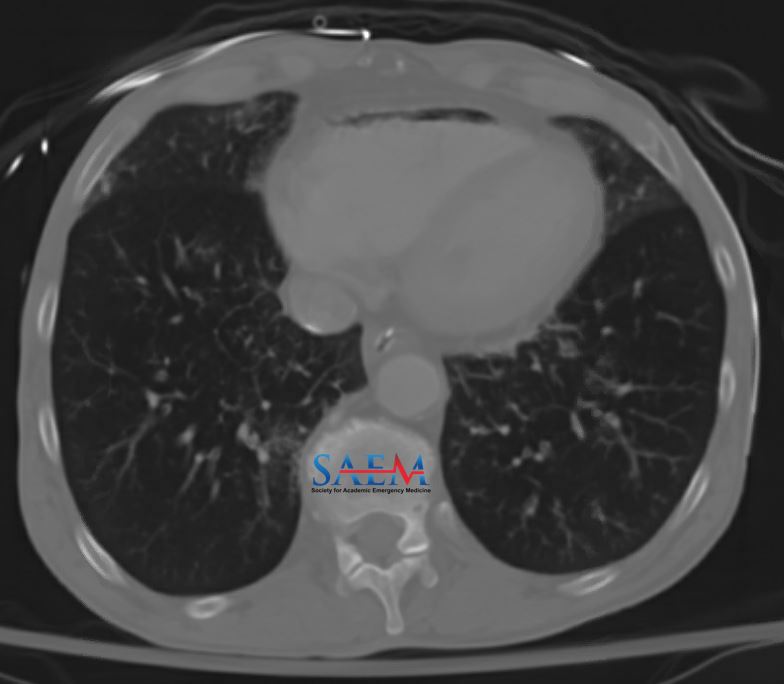
A 67-year-old caucasian male experiencing homelessness was “found down” in a parking lot. EMS reported that he had a GCS of 6 with a systolic blood pressure in the 80’s, finger stick glucose of 100, and no response to intranasal naloxone. He was intubated in the field and arrived to the emergency department unresponsive with a BP of 95/60, HR 125, T 38°C, and O2 Sat 100%. Hemodynamic stabilization was achieved with central venous access, and laboratory and imaging studies for the evaluation of altered mental status ensued.
General: Disheveled male
HEENT: Normocephalic; PERRLA 3-2 mm; dried blood in nares
Skin: Warm; dry; no visible signs of trauma
Cardiovascular: Tachycardic with no murmurs, rubs, or gallops
Respiratory: Bilateral breath sounds on ventilator; diffuse rales
Gastrointestinal: Soft; non-distended; bowel sounds present
Musculoskeletal: No deformities
Neurologic: Unresponsive; GCS 3
COVID-19 rapid antigen: Detected
Complete Blood Count (CBC): WBC 17 k; Hemoglobin 15; Platelets 185
Comprehensive Metabolic Panel (CMP): Na 133; K 4.6; Cl 91; CO2 21; BUN 18; Cr 2.2; Ca 8.4; Alb 2.1; Tbili 0.4; Alk phos 112; AST 242; ALT 68
ABG on FiO2 100%: 6.99/>95/405/23/100%
Lactate: 16.4
Ammonia: 90
CK total: 716
Trop I HS: 809
PT: 14
INR: 1.05
PTT: 45
Urinalysis: Unremarkable
EtOH, Acetaminophen, Salicylate: Negative
UDS: Negative
Chest Radiograph: Diffuse ground-glass opacities
Air embolism to the right ventricle and pulmonary artery. As little as 20 mL or less of air rapidly infused may cause obstruction, ischemia, and hemodynamic collapse.
Risk factors include central venous catheterization, lung trauma, ventilator usage, hemodialysis, surgery (esp. coronary, neurosurgery), childbirth, and scuba diving barotrauma.

What is the correct antidote for a patient who is poisoned with the pictured substance?
(photo used with permission courtesy of Maureen Dallhoff, MD)

Which toxic exposure can present with the pictured rash along with hypertension and tachycardia mimicking pheochromocytoma?

An acute aortic dissection (AAD) can be a life-threatening emergency which frequently requires rapid and precise control of the patient’s heart rate and blood pressure. The 2010 guidelines for management of patients with thoracic aortic disease suggest a heart rate goal of <60 bpm and a systolic blood pressure between 100-120 mmHg. In order to achieve this, a rapid-acting beta-blocker (i.e., esmolol) may be used in combination with an IV calcium channel blocker (i.e., nicardipine or clevidipine). These medications need to be monitored closely to avoid overshooting these goals and causing hemodynamic compromise. Ideally, an arterial line would be used to monitor the patient’s blood pressure, however this may not always be feasible so a traditional, noninvasive blood pressure cuff can be used. This may be complicated if the patient has the classic, but not universal, finding of unequal systolic blood pressure values between their left and right extremities. This raises the question, in a patient with an AAD and disparate blood pressures in each arm, which arm reading should be used for monitoring?
A 2018 study from Um et al. evaluated 111 patients with an AAD and compared them with 111 control patients. This study found that while a systolic blood pressure difference of >20 mmHg between sides was a positive predictor for an AAD, the presence of a pulse deficit had a higher diagnostic accuracy. For the purpose of this study, a pulse deficit was defined as “any recorded difference in volume/force or difference in obvious signs of malperfusion”. The cause of an unequal blood pressure or pulse deficit in the upper extremities in this population is typically due to dissection of the brachiocephalic or subclavian arteries. In order to properly achieve the desired blood pressure reduction in patients with divergent blood pressure values, the higher value should be used for titration of antihypertensives. This is due to the occurrence of pseudohypotension occurring in the limb with the dissected artery.
Read other articles in the EM Pharm Pearls Series and find previous pearls on the PharmERToxguy site.

Welcome to the AIR ACS Module! After carefully reviewing all relevant posts from the top 50 sites of the Social Media Index, the ALiEM AIR Team is proud to present the highest quality online content related to ACS emergencies in the Emergency Department. 7 blog posts met our standard of online excellence and were curated and approved for residency training by the AIR Series Board. We identified 4 AIR and 3 Honorable Mentions. We recommend programs give 4 hours (about 30 minutes per article) of III credit for this module.
In an effort to truly emphasize the highest quality posts, we have 2 subsets of recommended resources. The AIR stamp of approval is awarded only to posts scoring above a strict scoring cut-off of ≥30 points (out of 35 total), based on our scoring instrument. The other subset is for “Honorable Mention” posts. These posts have been flagged by and agreed upon by AIR Board members as worthwhile, accurate, unbiased, and appropriately referenced despite an average score.
Interested in taking the ACS quiz for fun or asynchronous (Individualized Interactive Instruction) credit? Please go to the above link. You will need to create a free, 1-time login account.
| Site | Article | Author(s) | Date | Label |
|---|---|---|---|---|
| EM Cases | Reciprocal Change and Occlusion MI | Jesse McLaren, MD | 10 Aug 2021 | AIR |
| EM Cases | Wellen’s Syndrome, Re-occlusion, and MI | Jesse McLaren, MD | 13 Jul 2021 | AIR |
| EM Cases | HyperAcute T waves and Occlusion MI | Jesse McLaren, MD | 4 May 2021 | AIR |
| EM Cases | ST elevations mnemonic and Occlusion MI | Jesse McLaren, MD | 12 Jan 2021 | AIR |
| Rebel EM | The OMI/NOMI Paradigm | Salim Rezaie, MD and Tarlan Hedayati, MD | 3 Oct 2021 | HM |
| Dr. Smith’s ECG blog | Accuracy of OMI ECG findings versus STEMI criteria for diagnosis of acute OMI | Steve Smith, MD and Pendell Myers, MD | 12 Apr 2021 | HM |
| emDocs | Cocaine and ST elevation | Brannon Inman, MD and Lloyd Tannenbaum, MD | 10 Dec 2020 | HM |
(AIR = Approved Instructional Resource; HM = Honorable Mention)
If you have any questions or comments on the AIR series, or this AIR module, please contact us! More in-depth information regarding the Social Media Index.
Thank you to the Society of Academic Emergency Medicine (SAEM) and the Council of EM Residency Directors (CORD) for jointly sponsoring the AIR Series! We are thrilled to partner with both on shaping the future of medical education.

