ACMT Toxicology Visual Pearl: Out of the Blue

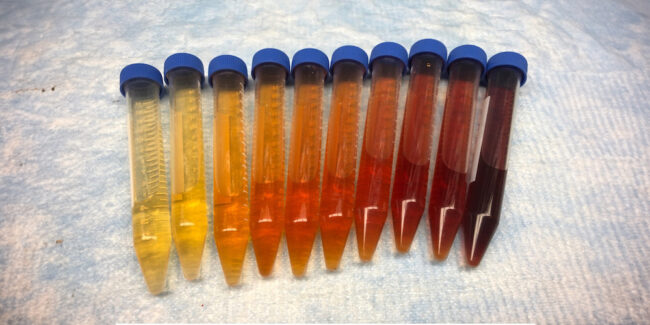
Exposure to which of the following could produce the pictured results?
- Carbon monoxide
- Lead paint
- Morphine
- Oral analgesic gel

Exposure to which of the following could produce the pictured results?

A 64-year-old female with a history of quadriplegia and bladder rupture secondary to a motor vehicle accident two years ago, complicated by chronic indwelling suprapubic foley, presents from her skilled nursing facility with fever, oliguria, tachycardia, low blood pressure, and a change in the color of her urine.

Read this tutorial on the use of point of care ultrasonography (POCUS) for pediatric lung ultrasound. Then test your skills on the ALiEMU course page to receive your PEM POCUS badge worth 2 hours of ALiEMU course credit.
A 6-year-old boy presents to the emergency department complaining of cough for 3 days and fever for the last day. His fever was 103°F this morning and he received ibuprofen. He has also had abdominal and back pain. He was seen at the emergency department earlier in the day where he had a chest X-ray 6 hours prior that was interpreted as negative for consolidation and bloodwork including a complete blood count and comprehensive metabolic panel that were within normal limits. He presents with persistent cough and fever and now has increased work of breathing.
On arrival, his vital signs are:
| Vital Sign | Finding |
|---|---|
| Temperature | 99.7 F |
| Heart Rate | 138 bpm |
| Blood Pressure | 102/61 |
| Respiratory Rate | 32 |
| Oxygen Saturation (room air) | 100% |
He is well appearing but has increased work of breathing. His lungs have decreased breath sounds and crackles over the left lung base. No wheezes are appreciated. He has mild subcostal retractions. His abdomen is soft, non-tender, and non-distended. His back is non-tender to palpation. He has normal HEENT, neck, and cardiac examinations, with the exception of tachycardia as above.
Given his presenting signs and symptoms in the setting of a recent chest X-ray that was interpreted as normal, you decide to perform a lung point-of-care ultrasound (POCUS) examination.

The patient’s chest X-ray from earlier in the day was interpreted by the pediatric radiologist as negative for consolidation or other pulmonary pathology. You performed a lung POCUS with a linear, high-frequency probe and observed the following:
Though this child with cough, fever, focal lung findings, and respiratory distress had a negative chest X-ray performed 6 hours earlier, your POCUS evaluation identified a left lower lobe pneumonia which helped you make your diagnosis and start the appropriate treatment.
The patient received antibiotics for pneumonia. His work of breathing increased during his emergency department visit, and he was started on high flow nasal cannula at 30 L/min with improvement in his respiratory status. He was admitted to the pediatric intensive care unit. He had a repeat chest X-ray 12 hours later that was interpreted by the pediatric radiologist as having new pleural and parenchymal changes in the left hemithorax with questionable pneumonia. He continued antibiotics, and his repeat X-ray 48 hours later showed a clear left lower lobe consolidation with pleural effusion.

A 10-year-old male with no past medical history presents to the Emergency Department (ED) by EMS for evaluation of an injury sustained while playing tackle football. The patient was forcibly hit by another child against a tree. He complains of sharp right shoulder and chest pain that worsens with movement of his right upper extremity and he arrives wearing a sling to immobilize the arm.
You have a severely dehydrated patient with a peripheral IV line, requiring urgent fluid resuscitation. However, the crystalloid fluids are not flowing freely. Multiple attempts were made to place this line with the latest having a flash of blood return and a smoothly flowing saline flush. You can not seem to find your pressure infusion cuff to squeeze the IV bag and accelerate fluid administration.


Thanks to Twitter feedback from @cpatrick_89, be careful of introducing bacteria when attaching these pieces to the IV tubing, based on an in vitro study. Wearing gloves helped reduce bacterial contamination [1].
Note that conventional pressure bags may not be readily available in emergency departments and could blow the line you worked hard to secure. This “gentle pressure” technique allows the clinician to gauge how much positive pressure to administer to minimize the risk of fluid extravasation.

Welcome to the AIR Infectious Disease Module! After carefully reviewing all relevant posts in the past 12 months from the top 50 sites of the Digital Impact Factor [1], the ALiEM AIR Team is proud to present the highest quality online content related to related to infectious diseases in the Emergency Department. 6 blog posts met our standard of online excellence and were approved for residency training by the AIR Series Board. More specifically, we identified 1 AIR and 5 Honorable Mentions. We recommend programs give 3 hours of III credit for this module.
In an effort to truly emphasize the highest quality posts, we have 2 subsets of recommended resources. The AIR stamp of approval is awarded only to posts scoring above a strict scoring cut-off of ≥30 points (out of 35 total), based on our scoring instrument. The other subset is for “Honorable Mention” posts. These posts have been flagged by and agreed upon by AIR Board members as worthwhile, accurate, unbiased, and appropriately referenced despite an average score.
Interested in taking the AIR quiz for fun or asynchronous (Individualized Interactive Instruction) credit? Please go to the above link. You will need to create a free, 1-time login account.
| Site | Article | Author | Date | Label |
|---|---|---|---|---|
| SGEM | Lumbar punctures in febrile infants with positive urinalysis – it’s just overkill | Dennis Ren, MD | December 31, 2022 | AIR |
| EMDocs | Bacterial Meningitis | Mounir Contreras Cejin, MD | January 28, 2023 | HM |
| ALiEM | The Febrile Infant | Corey Ziemba, MD, Justin Hacnik, MD and J.D. Cambron, DO | March 29, 2023 | HM |
| EMCrit | Approach to CNS infection | Josh Farkas, MD | August 15, 2022 | HM |
| Core EM | Updates in STI Care | Daniel Imas, MD | March 17, 2022 | HM |
| REBEL EM | Short course antibiotics for Peds CAP | Marco Propersi, DO | Dec 5, 2022 | HM |
(AIR = Approved Instructional Resource; HM = Honorable Mention)
If you have any questions or comments on the AIR series, or this AIR module, please contact us!
Thank you to the Society of Academic Emergency Medicine (SAEM) and the Council of EM Residency Directors (CORD) for jointly sponsoring the AIR Series! We are thrilled to partner with both on shaping the future of medical education.

Which cardiotoxic plant is shown?