SAEM Clinical Image Series: Pediatric Penis Swelling

A 3-year-old healthy uncircumcised male presents to the Emergency Department with five days of penis swelling and pain. Five days prior, his father noted that the patient’s foreskin appeared stuck behind the head of the penis. The patient was seen at an urgent care facility four days prior and was given an antifungal cream for presumed balanitis, however, this did not resolve the patient’s symptoms. Since that time, the penis has been getting progressively more swollen and painful. The patient has not experienced the inability to urinate, decreased urine output, penile discharge, other penile lesions, fever, chills, abdominal pain, nausea, vomiting, testicular pain, or testicular swelling.

Vitals: Within normal limits

General: Alert, anxious

Genitourinary: Penile swelling, erythema, and tenderness to palpation

Non-contributory

Paraphimosis is a medical emergency due to the risk of tissue necrosis. A preputial or phimotic ring – a circumferential band of tissue – caught behind the glans causes swelling of penile tissue.

In the evaluation of painful penile swelling, the first step is to determine whether the patient is circumcised or not through a review of the medical record or discussion with the patient’s family. In an uncircumcised male, the critical next step is to assess for an entrapped and retracted foreskin (paraphimosis). Visualization of the glans penis and the urethral meatus as in this case demonstrates that the foreskin is retracted. Additionally, visualization of the glans penis and urethral meatus makes a scarred and unretractable foreskin (pathologic paraphimosis) unlikely to be the primary diagnosis. The differential diagnosis also includes hair tourniquet syndrome, chigger bites, and inflammation of the glans and foreskin (balanitis and balanoposthitis).

Take-Home Points

  • In any male presenting with penile pain, it is critical to first ascertain his circumcision status. In an uncircumcised male, visualizing the glans and urethral meatus demonstrates that the foreskin is retracted.
  • Paraphimosis is a medical emergency caused by an entrapped, retracted foreskin.
  1. Bragg BN, Kong EL, Leslie SW. Paraphimosis. 2021 May 4. In: StatPearls [Internet]. Treasure Island (FL): StatPearls Publishing; 2021 Jan–. PMID: 29083645.
  2. 2. Simonis K, Rink M. Paraphimosis. In: Urology at a Glance. Springer Berlin Heidelberg; 2014:361-364. doi:10.1007/978-3-642-54859-8_65


By |2021-09-13T10:34:13-07:00Sep 13, 2021|Genitourinary, Pediatrics, SAEM Clinical Images|

EMRad: Can’t Miss Adult Traumatic Hip and Pelvis Injuries


Have you ever been working a shift at 3 AM and wondered, “Am I missing something? I’ll just splint and instruct the patient to follow up with their PCP in 1 week.” This is a reasonable approach, especially if you’re concerned there could be a fracture. But we can do better. Enter the “Can’t Miss” series: a series organized by body part that will help identify injuries that ideally should not be missed. This list is not meant to be a comprehensive review of each body part, but rather to highlight and improve your sensitivity for these potentially catastrophic injuries. We’ve already covered the adult elbow, wrist, shoulder, ankle/foot, and knee. Now: the hip.


(more…)

By |2021-09-01T17:23:13-07:00Sep 3, 2021|Orthopedic, Radiology, SplintER, Trauma|

SAEM Clinical Image Series: Pulseless and Painful Blue Leg

painful blue leg

A 57-year-old male who works as a truck driver with a history of hypertension, type 2 diabetes, and recent COVID-19 infection presents with right lower extremity pain for two hours. He reports experiencing one day of dull aching of the right leg, then being suddenly awakened with the abrupt onset of severe right leg pain and shortness of breath. He denies chest pain. EMS reports a pulseless and painful blue leg en route. The patient denies any history of trauma, irregular heartbeat, or anticoagulation.

Vitals: T 97.5°F; BP 120/78; HR 102; RR 20; oxygen saturation 100%

General: Writhing and moaning in pain

Cardiovascular: Tachycardic; 2+ pulses in all extremities except for the right lower extremity

Pulmonary: No respiratory distress

Hemoglobin: 12.9 g/dL

INR: 1.02

Phlegmasia cerulea dolens

When a patient presents with a painful, pulseless extremity, acute limb ischemia, with etiologies including aortic dissection, arterial thromboembolism, and phlegmasia dolens, is of the highest concern. Unlike a typical deep venous thrombosis (DVT), phlegmasia dolens is a DVT that causes complete occlusion, resulting in venous congestion and hypoperfusion. Risk factors for phlegmasia dolens and DVT are the same; this patient had both a sedentary occupation and recent COVID-19 as risk factors.

Phlegmasia is usually characterized early on with pale discoloration (alba) due to patency of collaterals and later with blue/cyanotic discoloration (cerulea) after complete occlusion of the venous system. It is important to remember this exam finding might be limited in pigmented skin. Venous gangrene and compartment syndrome can be delayed exam findings. The exam should include immediate evaluation of pulses with doppler and compartment checks. Imaging modalities are controversial and should not delay vascular surgery consultation. Bedside ultrasound can be rapidly performed for clot evaluation, but CT venogram would be the preferred method for surgical planning. A common femoral vein DVT can be seen on the accompanied ultrasound and CT images. The limb should be elevated, and heparin infusion should be initiated. Surgical consultation should include a discussion of thrombectomy or catheter-directed thrombolysis.

Take-Home Points

  • Phlegmasia cerulea dolens is an uncommon complication of DVT that presents with a discolored, painful, pulseless extremity, and is associated with high morbidity and mortality.
  • Initial management includes vascular surgery consultation, elevation of the extremity, and heparinization.
  1. Baker, William, and Samuel Kim. “Risking Life And Limb: Management Of Phlegmasia AlbaAnd Cerulea Dolens”. Emra.Org, 2020, https://www.emra.org/emresident/article/risking-life-and-limb-management-of-phlegmasia–alba-and-cerulea-dolens/.
  2. Gardella L, Faulk J. Phlegmasia Alba And Cerulea Dolens. 2020 Oct 12. In: StatPearls [Internet]. Treasure Island (FL): StatPearls Publishing; 2021 Jan–. PMID: 33085284.


Diagnosis on Sight: “I have a rapid heart rate”

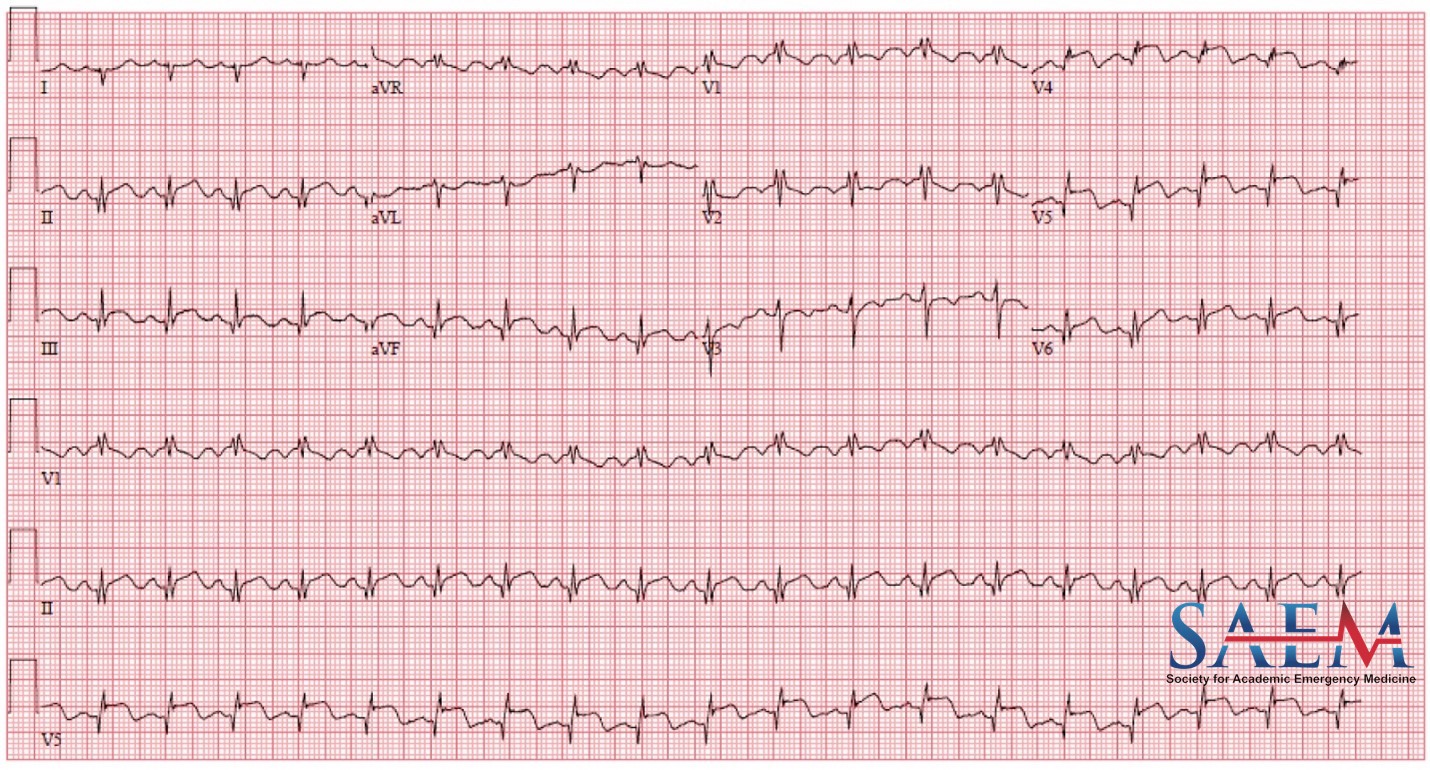
A 31-year-old male presented to the emergency department with palpitations. The patient stated that he thinks his symptoms began “last night” and felt like he had “a rapid heart rate.” He said that prior to last night he felt fine. He did admit to drinking alcohol with his friends 2 nights prior. The patient estimated that he “must have drunk about 30 beers.” On review of systems, he reported feeling anxious. He denied illicit drug use, headache, chest pain, cough, shortness of breath, fevers, nausea, vomiting, abdominal pain, dysuria, or increased urinary frequency. He reported that he was unaware of any family history of early heart disease or sudden death. His initial EKG is shown below.

After consultation with cardiology, the decision was made to cardiovert the patient given the wide complex tachycardia.  After cardioversion, the resulting EKG is shown below:

On review of previous records, the patient had a recent ED visit 2 months ago with the EKG shown below:

What is the diagnosis?

Preexcited atrial fibrillation with underlying Wolf-Parkinson-White syndrome

Explanation:

Wolf-Parkinson-White (WPW) syndrome and the WPW pattern on EKG are rare disorders. Only 0.13 – 0.25% of the population have a WPW pattern on EKG [1,2]. However, only a small fraction of these people will develop WPW syndrome. WPW syndrome is defined as a symptomatic arrhythmia with a WPW pattern on EKG.

The patient’s initial EKG showed a wide complex tachycardia that was ultimately determined to be preexcited rapid atrial fibrillation. After cardioversion, the patient’s underlying baseline EKG tracing showed findings of Wolf-Parkinson-White with:

  • A shortened PR interval
  • Widened QRS complex
  • Delta wave: Slurred upstroke of the QRS complex

The most common arrhythmias associated with WPW syndrome are:

  • AV Reentrant Tachycardia (AVRT): Seen in over 90% of patients with WPW syndrome [3,4]
  • Atrial Fibrillation: 10-30% [5,6]
  • Atrial Flutter: Less than 5%

As in this case, AVRT (i.e. SVT) is often followed by atrial fibrillation in patients with WPW. Although the pathophysiology is unclear, up to 35% of instances of atrial fibrillation were preceded by AVRT [5,7,8].

Fortunately, fatal dysrhythmias such as ventricular fibrillation and ventricular tachycardia are very rare with WPW.

Case Conclusion:

Following cardioversion, the patient remained stable in sinus rhythm. After consultation with cardiology, the patient was discharged on Flecainide and Metoprolol and a referral for outpatient cardiology was placed for follow-up care. Soon after, the patient had an electrophysiology study that showed a left posterolateral accessory conduction pathway. He then underwent successful ablation of his orthodromic AVRT.

Want more visual stimulation? Check out the Diagnose on Sight archives!


References:

  1. Krahn AD, Manfreda J, Tate RB, et al. The natural history of electrocardiographic preexcitation in men. The Manitoba Follow-up Study. Ann Intern Med 1992; 116:456. PMID: 1739235
  2. Kobza R, Toggweiler S, Dillier R, et al. Prevalence of preexcitation in a young population of male Swiss conscripts. Pacing Clin Electrophysiol 2011; 34:949. PMID: 21453334
  3. Josephson ME. Preexcitation syndromes. In: Clinical Cardiac Electrophysiology, 4th, Lippincot Williams & Wilkins, Philadelphia 2008. p.339.
  4. Chugh A, Morady F. Atrioventricular reentry and variants. In: Cardiac electrophysiology from cell to bedside, 5th edition, Zipes DP, Jalife J (Eds), Saunders/Elsevier, Philadelphia 2009. p.605-614.
  5. Campbell RW, Smith RA, Gallagher JJ, et al. Atrial fibrillation in the preexcitation syndrome. Am J Cardiol 1977; 40:514. PMID: 910715
  6. Sharma AD, Klein GJ, Guiraudon GM, Milstein S. Atrial fibrillation in patients with Wolff-Parkinson-White syndrome: incidence after surgical ablation of the accessory pathway. Circulation 1985; 72:161. PMID: 4006127
  7. Sung RJ, Castellanos A, Mallon SM, et al. Mechanisms of spontaneous alternation between reciprocating tachycardia and atrial flutter-fibrillation in the Wolff-Parkinson-White syndrome. Circulation 1977; 56:409. PMID: 884796
  8. Fujimura O, Klein GJ, Yee R, Sharma AD. Mode of onset of atrial fibrillation in the Wolff-Parkinson-White syndrome: how important is the accessory pathway? J Am Coll Cardiol 1990; 15:1082. PMID: 2312962
By |2021-08-27T09:10:41-07:00Aug 25, 2021|Cardiovascular, Diagnose on Sight, ECG|

SAEM Clinical Image Series: A Recurring Neck Mass

A 30-year-old female with no significant past medical history presents to the Emergency Department with a six-day history of an enlarging, tender, red “bump” on her anterior neck. She reports similar swelling during bouts of pharyngitis. She also reports a recent upper respiratory infection one week ago that was marked by fever, cough, congestion, sore throat, and myalgia. She denies shortness of breath, neck trauma, travel, or animal exposures.

Vitals: T 37°C; BP 122/78; HR 77; RR 17

General: Well-developed, well-nourished female in no acute distress

HEENT: 2cm tender, fluctuant, mobile right anterior neck mass with surrounding erythema; no drainage noted; mass does not move with swallowing

The remainder of the exam is unremarkable.

Non-contributory

Second branchial cleft cyst

Branchial cleft anomalies are the second most common type of congenital neck mass and present as cartilaginous remnants, sinuses, fistulas, or cysts due to the failure of the branchial apparatus to obliterate. The most common are second branchial cleft anomalies, representing 95% of these cases. Second branchial cleft anomalies are usually located along the anterior border of the sternocleidomastoid muscle on the left side of the neck.

Differential diagnoses include thyroglossal duct cyst, neck abscess, cystic hygroma, cervical lymphadenopathy, metastatic lymph nodes, and cat scratch disease.

The gold standard of treatment necessitates complete surgical excision of the entire branchial cleft anomaly. Branchial cleft anomalies are most commonly diagnosed with computerized tomography (CT) that shows a uniformly hypo-or-anechoic mass with well-defined margins and thin walls. Preoperative fine needle aspiration cytology can be used to view histopathological findings of the mass and help to rule out malignant disease. Ultrasound and MRI can also be helpful for diagnosis, preoperative localization, and preoperative identification of surrounding structures. However, for definitive diagnosis, surgical excision of the entire anomaly and pathology examination is required. If full resection is not achieved, recurrence is possible.

Take-Home Points

  • A branchial cleft anomaly is the second most common type of congenital neck mass.
  • Branchial cleft anomalies are due to failure of the branchial apparatus to obliterate and can present as cartilaginous remnants, sinuses, fistulas, or cysts.
  • The gold standard of treatment requires complete surgical excision of the entire branchial cleft anomaly to prevent recurrence.
  1. Muller S, Aiken A, Magliocca K, Chen AY. Second Branchial Cleft Cyst. Head Neck Pathol.2015;9(3):379-383. doi:10.1007/s12105-014-0592-y Zaifullah S, YunusMR, See GB. Diagnosis and treatment of branchial cleft anomalies in UKMMC: a 10-year retrospective study. Eur Arch  2013;270(4):1501-1506. doi:10.1007/s00405-012-2200-7


By |2021-08-20T09:57:47-07:00Aug 23, 2021|HEENT, SAEM Clinical Images|

INR reduction with FFP – How low can you go?

Background

Bleeding patients or those undergoing procedures that are at high risk of bleeding may require correction of their INR. Multiple products can be used to achieve this, including fresh frozen plasma (FFP). FFP contains many substances, including clotting factors, fibrinogen, plasma proteins, electrolytes, and anticoagulant factors. It is sometimes said that the intrinsic INR of FFP is approximately 1.6-1.7 and that it’s not possible to achieve a lower INR. This pearl will further explore these concerns.

Evidence

  • What is the INR of FFP?
    • The mean INR of FFP appears to be ~1.1 (0.9-1.3) [1,2].
    • Reports that the intrinsic INR of FFP is 1.6-1.7 may be based on the clinical experience of not being able to achieve an INR <1.6-1.7 with FFP.
  • Is it possible to “normalize” the INR with FFP alone?
    • Several studies have found that it’s difficult to achieve an INR <1.7 with only FFP [3,4]. However, other studies were able to achieve lower average INR values [2,5,6]. 
    • Overall, these studies found that there was a significantly greater decrease in INR when the pre-FFP INR was higher, but there was a much smaller decrease when the INR was closer to the normal range.
  • Why does FFP appear to have diminishing returns when the pre-FFP INR is lower?
    • The relationship between the INR and percentage of clotting factors present in the blood is not linear (see figure) [7].
    • For example: An increase of ~5% in clotting factors may decrease the INR from 3 to 2.5 but the same amount of FFP may only reduce an INR of 1.7 to 1.6.

Figure 1: Adapted from Dzik  2012 [7].

    • Additionally, the table below also demonstrates that small volumes of FFP result in large changes when the initial INR is elevated, but very large amounts of FFP are required to achieve an INR of 1.3 no matter the initial INR (see table).
Amount of FFP to Achieve a Target INR Based on Pre-FFP INR
Target INR
1.31.73.0
Initial INRVolume (L)Dose (mL/kg)Factor (%)Volume (L)Dose (mL/kg)Factor (%)Volume (L)Dose (mL/kg)Factor (%)
6.04.564452.536251.52115
5.04.361432.332231.01410
4.04.057402.029200.575
3.03.550351.52115
2.02.536250.575

Table 1: Adapted from Holland 2006 [3]. Note: 1 unit of FFP is ~200-250 mL

    • Given the above data, the issue preventing the achievement of an INR <1.7 appears to be the dose/volume of FFP required and not the intrinsic INR of FFP.
  • Does the INR need to be <1.7 to achieve hemostasis?
    • Since the INR only provides limited information regarding a single aspect of anticoagulation status, complete normalization for the INR to control bleeding is usually not necessary [6].
    • An INR elevation alone does not indicate a patient is coagulopathic or at an increased risk of bleeding [7]. Additionally, an INR elevation in patients with liver dysfunction likely reflects an overall state of decreased factor production, both procoagulant and anticoagulant factors [8].
    • The target INR varies depending on multiple patient factors and planned interventions, but an INR of 1.0 is likely not necessary to prevent bleeding or achieve hemostasis.

Bottom Line

  • A unit of FFP has an INR of ~1.1, but this doesn’t mean it can easily normalize the INR.
  • There is a non-linear relationship between percentage of clotting factors and the INR, resulting in diminishing returns from each unit of FFP as the INR decreases.
  • Very large doses of FFP may be required to fully correct an elevated INR, which frequently precludes its use.
  • Complete normalization of the INR is not required to achieve hemostasis or prevent bleeding from a procedure.

Want to learn more about EM Pharmacology?

Read other articles in the EM Pharm Pearls Series and find previous pearls on the PharmERToxguy site.

References

  1. Holland LL, Foster TM, Marlar RA, Brooks JP. Fresh frozen plasma is ineffective for correcting minimally elevated international normalized ratios. Transfusion. 2005;45(7):1234-1235. doi: 10.1111/j.1537-2995.2005.00184.x. PMID: 15987373.
  2. Only AJ, DeChristopher PJ, Iqal O, Fareed J. Restoration of normal prothrombin time/international normalized ratio with fresh frozen plasma in hypocoagulable patients. Clin Appl Thromb Hemost. 2016;22(1):85-91. doi: 10.1177/1076029614550819. PMID: 25294634.
  3. Holland LL, Brooks JP. Toward rational fresh frozen plasma transfusion: The effect of plasma transfusion on coagulation test results. Am J Clin Pathol. 2006;126(1):133-139. doi: 10.1309/NQXH-UG7H-ND78-LFFK. PMID: 16753596.
  4. Abdel-Wahab OI, Healy B, Dzik WH. Effect of fresh-frozen plasma transfusion on prothrombin time and bleeding in patients with mild coagulation abnormalities. Transfusion. 2006;46(8):1279-1285. doi: 10.1111/j.1537-2995.2006.00891.x. PMID: 16934060.
  5. Müller MCA, Straat M, Meijers JCM, et al. Fresh frozen plasma transfusion fails to influence the hemostatic balance in critically ill patients with a coagulopathy. J Thromb Haemost. 2015;13(6):989-997. doi: 10.1111/jth.12908. PMID: 25809519.
  6. McCully SP, Fabricant LJ, Kunio NR, et al. The International Normalized Ratio overestimates coagulopathy in stable trauma and surgical patients. J Trauma Acute Care Surg. 2013;75(6):947-953. doi: 10.1097/TA.0b013e3182a9676c. PMID: 24256665.
  7. Dzik W “Sunny.” Reversal of drug-induced anticoagulation: old solutions and new problems. Transfusion. 2012;52(s1):45S-55S. doi: 10.1111/j.1537-2995.2012.03690.x. PMID: 22578371.
  8. Harrison MF. The misunderstood coagulopathy of liver disease: a review for the acute setting. West J Emerg Med. 2018;19(5):863-871. doi: 10.5811/westjem.2018.7.37893. PMID: 30202500.
By |2021-08-28T10:03:39-07:00Aug 21, 2021|EM Pharmacy Pearls, Heme-Oncology|
Go to Top