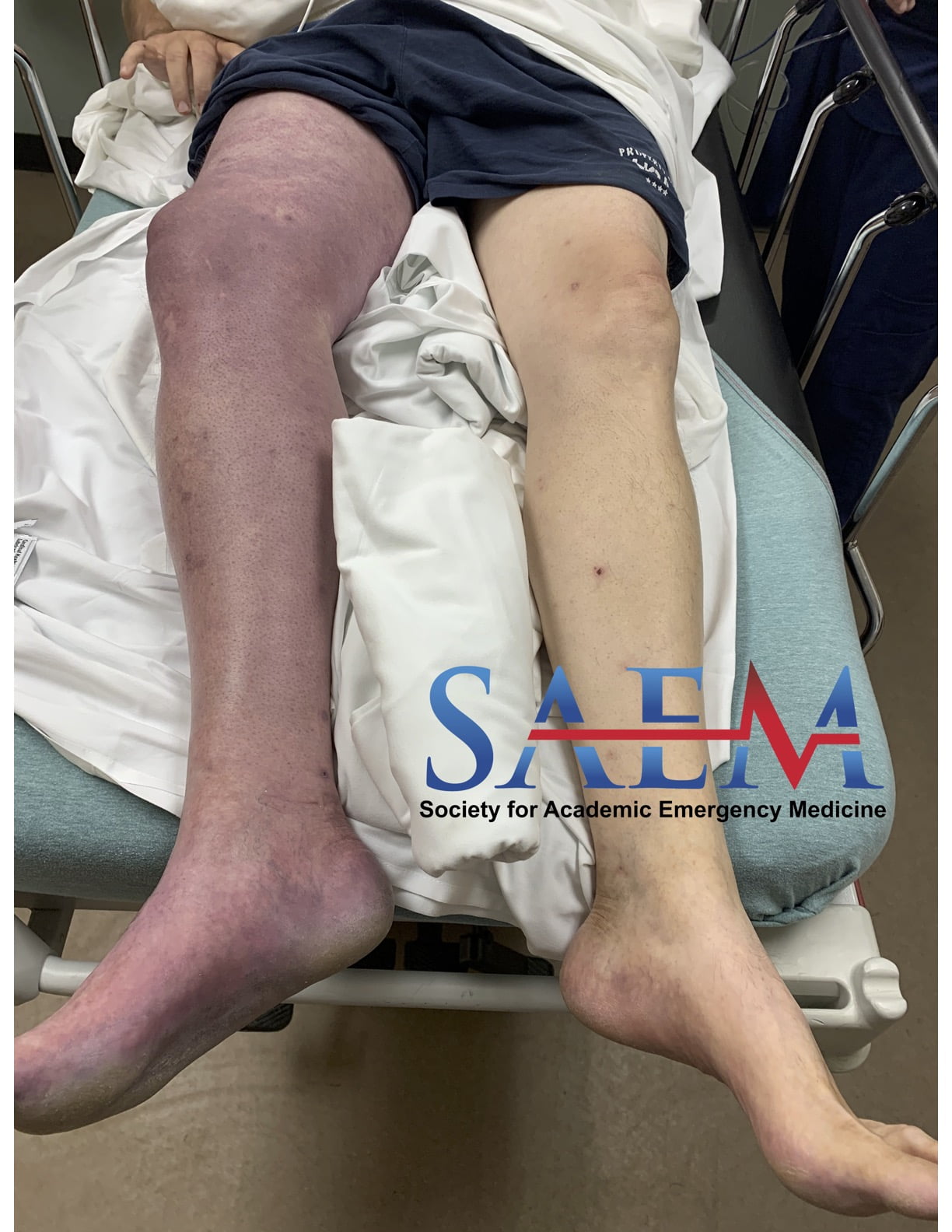
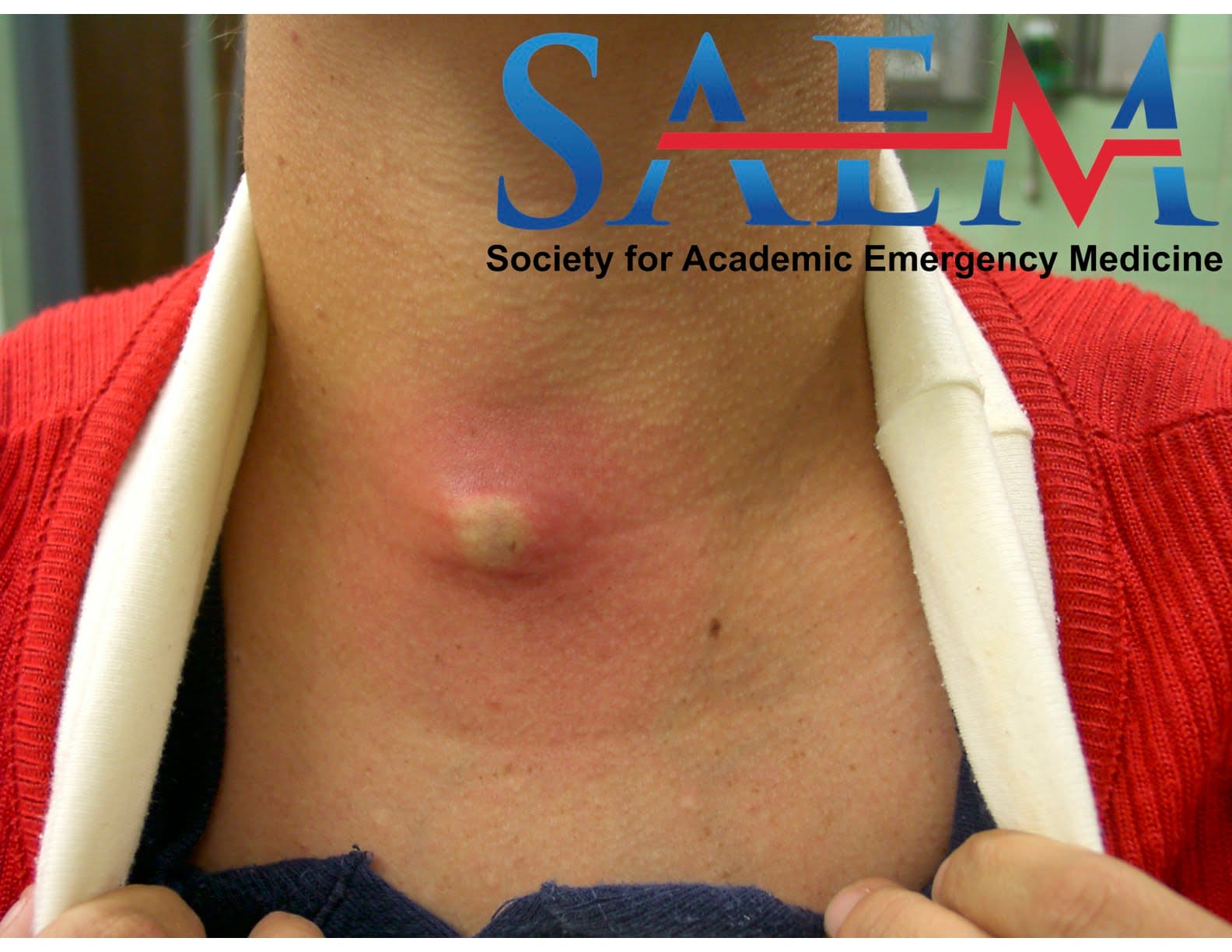
Diagnosis on Sight: Neck Bruising Leads to a Surprise Diagnosis

A 76-year-old female with a history of HTN, TIA, CAD, left CEA, and CKD presented to the emergency department for evaluation of neck bruising and swelling. The patient stated that the night before, she was eating popcorn and choked on a kernel. She states that she coughed to clear her throat and shortly after she developed swelling and bruising to the left side of her neck, which has progressively gotten worse. The patient has a remote history of left carotid endarterectomy and was concerned that her symptoms could be related to the prior surgery. On examination, she had ecchymosis and a hematoma/mass to the left side of her neck without palpable thrill or bruit. A well-healed CEA scar was noted. A CTA of the neck was obtained to determine the source of the ecchymosis/hematoma. What is the diagnosis?

A large neck mass with venous bleeding causing cervical hematoma and ecchymosis.

Explanation:

Neck Mass

Image 2. This axial CT angiogram image shows the large left-sided mass with vessels and hemorrhage, which appears to originate from the inferior parotid.

Spontaneous cervical hematoma is an uncommon condition, which can be life-threatening [1]. This first case of spontaneous neck hematoma was described by Capps who observed this condition in a patient with a parathyroid adenoma [2]. Symptoms of neck hematoma include the classic triad named for Capps, which consists of:

  •       tracheal and esophageal compression
  •       neck edema and ecchymosis
  •       tracheal displacement

The condition can be caused by a variety of etiologies including bleeding from masses, underlying coagulopathies, rupture of aneurysms, and infections [1]. CT angiography is typically the test of choice to evaluate the source and extent of bleeding [3]. Large hematomas can lead to airway compromise and require airway and surgical/IR intervention. Smaller, stable hematomas may be observed and can be self-limited. The underlying etiology of the hematoma should be sought and treated.

Case Conclusion:

The hematoma and ecchymosis resolved over time without intervention. The patient underwent ultrasound-guided lymph node biopsy by interventional radiology. Pathology revealed an aggressive double expressor diffuse large B-Cell lymphoma. A pet scan revealed lymphatic involvement on both sides of the diaphragm. The patient was counseled on treatment options including chemotherapy and after discussion palliative radiation was pursued.  Ultimately, the patient transitioned to hospice care.

Want more visual stimulation? Check out the Diagnose on Sight archives!

References:

  1. Cohen O, Yehuda M, Adi M, Lahav Y, Halperin D. Spontaneous neck hematoma in a patient with fibromuscular dysplasia: a case report and a review of the literature. Case Rep Otolaryngol. 2013;2013:352830. PMID: 24191215.
  2. Zammit M, Siau R, Panarese A. Importance of serum calcium in spontaneous neck haematoma. BMJ Case Rep. 2020 Sep 6;13(9):e237267. PMID: 32895253.
  3. Haynes J, Arnold KR, Aguirre-Oskins C, Chandra S. Evaluation of neck masses in adults. Am Fam Physician. 2015 May 15;91(10):698-706. PMID: 25978199.
By |2021-05-24T08:27:03-07:00Jun 4, 2021|Diagnose on Sight, Heme-Oncology|

Trick of the Trade: Upsize the IV with the tourniquet infusion technique

peripheral iv catheterThere you are, middle of the night and EMS just brought you one of the sickest of the sick: a septic-looking, chronically ill-appearing, frail, and malnourished patient with low blood pressures. They need vascular access for fluids, antibiotics, and possibly even vasopressors. The patient arrives with only a 22-gauge peripheral IV in the hand. You ask for two large bore IVs. But unfortunately, your best nurses and techs can’t find a vein, and their initial attempts are unsuccessful. Do you move right towards ultrasound-guided placement, intraosseous needle, or a central line? What if the patient only needs a fluid bolus, antibiotics, and admission to the floor?

Trick of the Trade: Tourniquet infusion technique

The tourniquet-infusion technique provides a method to increase the chance of a successfully placed larger bore peripheral IV in the volume-depleted patient.

Technique

  1. Apply a tourniquet to the extremity, proximal to the existing smaller-gauge IV access site.
  2. Rapidly infuse 50-100 mL of IV fluids, causing distension of the venous system between the IV and the tourniquet. This distension creates a larger target for venous cannulation in volume-depleted patients.

trick tourniquet infusion technique dilate upsizing vein arm peripheral IV

Tourniquet Infusion Technique: After applying a tourniquet and instillation of an IV bolus of fluids through a small distal 22-gauge IV, large veins are more visible for a second larger-bore IV


Discussion

This technique has been described in the literature for decades [1-3], and has been anecdotally successful in clinical practice. Its methodology capitalizes on pre-existing or easily-placed distal small gauge access (i.e., a 22g IV in the hand) as a stepping stone to larger venous cannulation.

Quinn and Sheikh investigated the employment of this technique for 22 adult patients with an acute abdomen who had been referred from the ED in hypovolemic shock. A peripheral IV had not been obtained in any of these patients using standard cannulation methods. By employing this tourniquet-infusion technique to upsize the IVs, they were able to successfully obtain adequate access for resuscitation in 15 of the 22 patients (68%). They noted no complications secondary to this technique. The authors noted that of the other 7 patients in this small study, 2 died and 5 required ultrasound-guided IJ venous line placement. In total, 15 patients were potentially spared unnecessary central venous catheterization. This technique is a simple, quick, and effective way of establishing a more appropriate line for resuscitation of sicker patients [1].

Pearls

  • For large-bore antecubital IV placement, consider placing a tourniquet in close proximity and just proximal to the elbow joint.
  • Consider the patient’s cardiac and pulmonary history to ensure that an additional fluid bolus is clinically appropriate.

References

  1. Stein JI. A new technique for obtaining large-bore peripheral intravenous access. Anesthesiology. 2005 Sep;103(3):670. doi: 10.1097/00000542-200509000-00041. PMID: 16130004.
  2. Quinn LM, Sheikh A. Establishing intravenous access in an emergency situation. Emerg Med J. 2014 Jul;31(7):593. doi: 10.1136/emermed-2012-202106. Epub 2013 Jun 15. PMID: 23771897.
  3. Williams DJ, Bayliss R, Hinchliffe R. Surgical technique. Intravenous access: obtaining large-bore access in the shocked patient. Ann R Coll Surg Engl. 1997 Nov;79(6):466. PMID: 9422881; PMCID: PMC2502954.
By |2021-05-30T23:44:23-07:00May 31, 2021|Critical Care/ Resus, Tricks of the Trade|

Utility of Nebulized Naloxone

Background

Naloxone can be administered via multiple routes, with nebulization gaining popularity in the past decade. A previous ALiEM Trick of the Trade presented this unique method of administration. In order for nebulized naloxone to be effective patients need to have some level of respiratory effort. It should not be used in patients in respiratory arrest or impending respiratory arrest. It may be a more gentle way to wake up patients to confirm the diagnosis of opioid toxicity and to gather a history. Theoretically, if the patient arouses enough to start experiencing mild withdrawal, they can ‘self-titrate’ and remove the nebulizer mask.

How is it prepared?

Mix 2 mg naloxone (5 mL of  naloxone 0.4 mg/mL) with 3 mL of 0.9% sodium chloride for inhalation in a nebulizer cup.

Evidence

Anecdotal reports tout the benefits of nebulized naloxone, but what does the literature say?

  • Case report of a 46 y/o female with an initial oxygen saturation of 61%. Naloxone 2 mg was administered via nebulization and within 5 mins her oxygen saturation was 100% and mental status was normal [1].
  • Retrospective analysis of prehospital administration in 105 patients with suspected opioid overdose. Following nebulized naloxone,  22% had a “complete response” and 59% had a “partial response.” It’s important to note that the initial respiratory rate was already 14 bpm with GCS of 12 for patients that responded to treatment [2].
  • Prospective analysis of 26 patients with suspected opioid intoxication treated at an inner-city, academic ED. Pre-naloxone the mean respiratory rate was 13 with a median GCS of 11. Following treatment, the mean respiratory rate improved to 16 with a median GCS of 13. Three patients (12%) experienced moderate-to-severe agitation and 2 (8%) became diaphoretic, suggesting precipitation of acute withdrawal [3].
  • Case report of a 20 y/o female with initial oxygen saturation of 62% (respiratory rate not reported). She improved following administration of nebulized naloxone and clinical efficacy corresponded with serum naloxone concentrations [4].


Importantly, aside from the two case reports, the above studies both primarily included patients without severe respiratory depression. As far as the safety of nebulized naloxone, Baumann et al. reported 5 patients (out of 26) who seemed to have mild-to-moderate symptoms of withdrawal following administration [3]. So this raises a question that must be answered on a patient specific basis: Does the benefit of this therapy outweigh the risk in patients who may not require naloxone to begin with? An alternative approach, if IV access is established, is to try low-dose diluted IV naloxone.


Bottom Line

Many of the studied patients may not have needed naloxone in the first place as they had an initial respiratory rate 13-14, with a few developing withdrawal symptoms. Nebulized naloxone may have a role in the “not-too-sick” opioid overdose in whom you want to prove your diagnosis and wake the patient up enough to obtain a history. It is not a therapy for an apneic patient with suspected opioid overdose.


References

  1. Mycyk MB, Szyszko AL, Aks SE. Nebulized naloxone gently and effectively reverses methadone intoxication. J Emerg Med. 2003;24(2):185-187. doi: 10.1016/s0736-4679(02)00723-0. PMID: 12609650.
  2. Weber JM, Tataris KL, Hoffman JD, Aks SE, Mycyk MB. Can nebulized naloxone be used safely and effectively by emergency medical services for suspected opioid overdose? Prehosp Emerg Care. 2012;16(2):289-292. doi: 10.3109/10903127.2011.640763. PMID: 22191727.
  3. Baumann BM, Patterson RA, Parone DA, et al. Use and efficacy of nebulized naloxone in patients with suspected opioid intoxication. Am J Emerg Med. 2013;31(3):585-588. doi: 10.1016/j.ajem.2012.10.004. PMID: 23347721.
  4. Minhaj FS, Schult RF, Fields A, Wiegand TJ. A case of nebulized naloxone use with confirmatory serum naloxone concentrations. Ann Pharmacother. 2018;52(5):495-496. doi: 10.1177/1060028017752428. PMID: 29319329.
Go to Top