


Trick of the Trade: Searching for Comments to a Published Article
One day back in 2005 during my PGY-1 pharmacy practice residency, I remember a conversation with my residency director. He was a Surgical/Trauma ICU pharmacist. There had been a recent article published (I think it may have been one linking ‘tight’ glucose control to decreased mortality in ICU patients). Funny how times change… Anyway, he mentioned all of the ‘discussion’ surrounding the article in terms of comments submitted to the journal. It was my first introduction to the idea that published literature could be challenged through an avenue provided by the journal. Just this past week during EM residency journal [+]
New video series for med students: The Patwari Academy
Similar to Salman Khan of the Khan Academy, which is famous for “flipping the classroom”, Dr. Rahul Patwari is a one-man innovating machine at Rush University’s Department of Emergency Medicine. He has been creating digital whiteboard “chalktalks” on common EM conditions for the past year, which target the senior medical student. These 2-15 minute videos are way too amazing not share with the EM community of learners. I bet these would be really great supplemental learning material for EM medical students everywhere. [+]
The mystique of direct laryngoscopy: Learning and teaching the procedure
This post is about an editorial comment by Dr. Richard Levitan on an article (1) about pulmonary critical care doctors performing intubations in the ICU (2). The study states that pulmonary critical care doctors can successfully perform this procedure. Dr. Levitan reports that intubation in elective anesthesia has a success rate between 98-99%, but when failure occurs the consequence can be catastrophic. The initial success rate of beginners is usually 50%, and it takes about 50 attempts in elective intubations to be 90% proficient. [+]

New blog section on Medical Education by Dr. Nikita Joshi
“I desire no other epitaph…than the statement that I taught medical students in the wards, as I regard this as by far the most useful and important work I have been called upon to do.” – Sir William Osler, renowned physician and believer in bedside medical education And with this quotation I would like to introduce a new segment to Academic Life in Emergency Medicine. One of the most important job descriptions we have as physicians is to be a clinical instructor… while simultaneously running cardiac arrest codes, managing agitated altered mental status patients, and avoiding documentation errors. [+]
Welcome new blog team member: Dr. Nikita Joshi
Welcome our newest team member on the blog with a specific focus on teaching about Medical Education, Dr. Nikita Joshi! She is a graduating EM resident, pursuing a career in academics. "My goal with this blog is to share ideas, thoughts, and experiences about teaching. Teaching is after all one of our most sacred and treasured skills as clinicians. I hope to ignite the same passion I have with the readers and to engage in insightful dialogue."
I joined Twitter. Now what? (Tutorial video #2 – Desktop)
In Part 2 of this Twitter tutorial (Part 1 video), I focus on how to navigate Twitter using the Twitter native website on my desktop/laptop. I personally, however, use Hootsuite (free) so that I can see more items at a single glance. [+]
I joined Twitter. Now what? (Tutorial video #1 – iPhone)
There has been a recent groundswell of interest and support for using Twitter purely for medical education. After getting several requests to get a quick tutorial of how I use it, I thought I would do a quick, on-the-fly video in my hotel room of how I use it on my iPhone (Echofon app) and on my laptop (Hootsuite). This is the first video on using the iPhone for Twitter. [+]
Trick of the Trade: Persistent paracentesis leakage
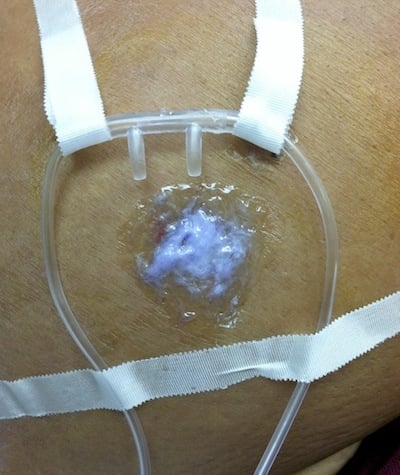
Dr. Matt Borloz (Carilion Clinic) recently emailed me his recent trick in fixing a persistently leaking paracentesis site. Read about his experience: A patient with advanced alcoholic cirrhosis with ascitic fluid leaking from a paracentesis puncture site from a procedure done 2 days prior. Dermabond had initially been applied post-procedure, but it had come loose, and ascitic fluid had been saturating dressing after dressing. [+]
Mythbuster: Urgent dialysis following IV contrast?
Have you ever had to promise the radiologist that you would arrange emergent dialysis for your end-stage renal disease (ESRD) patient after receiving IV contrast? This myth is even perpetuated in the field of nursing. In fact, what prompted this post was overhearing this very topic discussed between a nurse and a recent graduate nurse trainee. [+]
Trick of the Trade: Universal precautions for your iPad
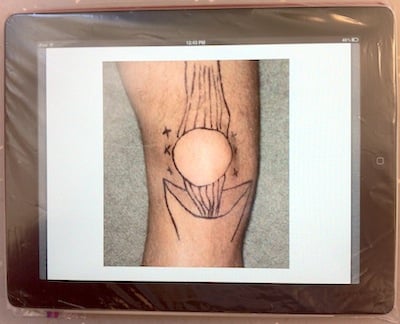
iPads are increasingly being used in medical education in a variety of arenas, including the classroom, the bedside, and small group workshops. I recently taught in a procedures lab with unembalmed cadavers at UCSF’s new anatomy lab (on the 13th floor of the hospital with spectacular views of San Francisco and the Golden Gate Bridge). Everyone was gowned up from head to toe using universal precautions. But wait, what about my iPad? How can I use it to teach at the “bedside” about arthrocentesis? [+]