



Top 10 medical photography tips for a camera phone
A picture is worth a thousand words. My corollary to this statement is that a poorly framed or blurry image significantly detracts from its impactfulness. Plus, it just looks unprofessional. I have had to either retake or Photoshop-edit several photos submitted for blog posts. There have been many amazing photos which I decided not to use because of image quality. [+]
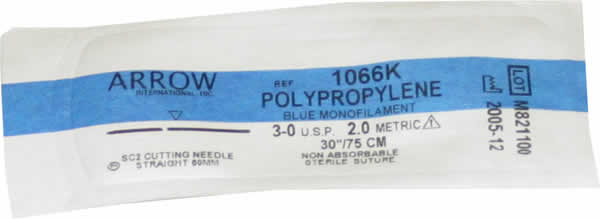
Trick of the Trade: Avoiding a straight-needle needlestick injury
You are finishing up a successful subclavian line procedure. You insert the straight-needle suture needle through the skin to secure the line. When trying to pull it out, you accidentally poke yourself! This is actually a common scenario for a needlestick injury. Although many central line kits now have curved suture needles, many still have straight needles. How can you avoid a needlestick? [+]
Bloom’s Digital Taxonomy
Have you heard of Bloom’s Taxonomy? As active adult learners, we must be conscientious about the what, how, and why we are reading a piece of literature. Being conscientious makes us more efficient, selective, and critical about what we learn. This in turn will help us to provide better care for our patients, which is after all our main goal. Although mainly used to develop curricula, I believe that understanding Bloom’s taxonomy and applying it to our learning may help us to learn more effectively. Bloom’s taxonomy can help us identify learning objectives that require higher level of cognitive function, [+]
PV card: Mnemonics to predict the difficult airway
PV Card: Predictors of a Difficulty Airway See ALiEM (PV) Cards for other resources
Mnemonics for difficult airway predictors
Can you list the difficult airway predictors? Do you know the mnemonics: MOANS, LEMON, RODS, and SHORT? [+]

Director of Growth, Strategic Alliance Initiative, Center for Innovation and Digital Health
Massachusetts General Hospital;
Chief Scientific Officer, Conductscience.com
Best place to suffer a cardiac arrest?
Where's the best place to suffer cardiac arrest? Seattle? Las Vegas? Who's going to give me mouth-to-mouth resuscitation? Will someone know how to use an automatic external defibrillator (AED)? Where is the BEST place to experience a cardiac arrest??? As luck would have it, the best place would be at the ACEP Scientific Assembly. On the first day of Scientific Assembly, an exhibitor collapsed in the convention center without a pulse. At a conference with thousands of emergency physicians, several Good Samaritans immediately sprung into action. An attendee used a CPR mask while another operated an AED. They were able [+]

Trick of the Trade: High volume irrigation of abscesses
Large-sized abscess often have pus trapped in deep crevices and pockets. Irrigation can help express the pus. How can you set up a high-volume irrigation system? [+]
Director of Growth, Strategic Alliance Initiative, Center for Innovation and [+]
ACEP 2012 meeting: Keeping up with Twitter
Are you at the 2012 American College of Emergency Physicians meeting in Denver this week? The who’s who of EM are there now teaching, learning, and networking. Here’s the moving video played at the opening session looking back at the Aurora mass casualty incident shooting. [+]
Trick of the Trade: IV ceftriaxone for gonorrhea
How many times have you given your patient IM ceftriaxone for that presumed gonococcal infection? ... still counting? Many of us learned (or at least thought we learned) that ceftriaxone has to be administered IM to get the ‘depot’ effect. Myth Busted There doesn't appear to be a true depot effect. IV and IM ceftriaxone have very similar pharmacokinetic profiles. Let me prove it to you, straight from the FDA-approved ceftriaxone package insert. Ceftriaxone route 0.5 hr 1 hr 2 hr 4 hr 6 hr 8 hr 12 hr 16 hr 24 hr IV 82 59 48 37 29 [+]
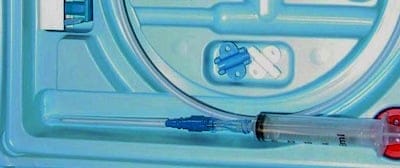
Trick of the Trade: Don’t miss the pneumothorax in needle thoracostomy
A patient arrives in PEA arrest and you note that her left chest has no breath sounds or lung sliding on bedside ultrasound. You suspect a tension pneumothorax. You insert a standard 14g angiocather in the left 2nd intercostal space (ICS). You don’t hear a rush of air. The patient’s clinical condition deteriorates to impending asystole. How sure are you that your angiocatheter actually reached the pleural space? [+]