


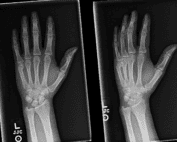
SplintER Series: Punched a Wall
A 27-year-old male presents to the ED with left hand pain after punching a wall. He has pain and swelling on the ulnar side of the dorsal hand. The above hand radiographs were obtained (image courtesy of Mark Hopkins). This patient has a fracture of the 5th metacarpal neck, otherwise known as a Boxer’s fracture. It is so named because a majority of these fractures come from punching an object [1]. Pearl: Unlike most hand and wrist fractures, metacarpal fractures are more likely to occur from axial loading than from a fall onto an outstretched hand (FOOSH) [1]. [+]

SAEM Clinical Image Series: Eye Injury
An 11-year-old male presented to a pediatric trauma center following a motor vehicle collision (MVC). He was the restrained front-seat passenger when his vehicle was struck head-on, causing frontal airbag deployment. His primary complaint was pain around his right eye with associated blurry vision. He denied diplopia, pain with extraocular movements, flashers, floaters, or curtains in his vision. [+]

Thomas [+]

How I Stay Healthy in EM: Keith Henry
Image 1: Prepping for a shift! This month on our “How I stay Healthy” series, we’re featuring Dr. Keith Henry, director of medical student education at Regions Hospital in St. Paul, Minnesota. Dr. Henry tells us about his pre-shift rituals, his on-shift prioritization schema, and his new favorite exercise tool! [+]

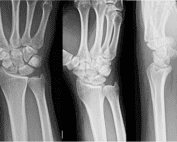
SplintER Series: Pain in the Snuff Box
A 16-year-old male presents to the ED after injuring his wrist during a track meet. The patient was running hurdles when he fell forward, planting his wrist into the ground. The imaging is shown below (courtesy of Dr. Hani Makky ALSALAM, Radiopaedia.org). Scaphoid fracture (Image 2). Pearl: The scaphoid is the most frequently fractured carpal bone [1,2]. Pearl: Fractures occur at the waist, proximal third, and distal portion: 65%, 25%, and 10% respectively [3]. Image 2. Fracture of scaphoid. Case courtesy of Dr. Hani Makky ALSALAM, Radiopaedia.org, rID: 10398 (arrow added by authors). Occurs when [+]
IDEA Series: Virtual “Faux-tation” Rotation for 4th Year Medical Students Interested in Emergency Medicine
Visiting clerkships have traditionally offered the opportunity for extended contact among medical student applicants and residency program representatives, allowing for enhanced assessment of mutual compatibility. Accordingly, visiting clerkships are consistently rated as an essential consideration among residency program leadership when reviewing applications, and among medical students, as they determine “fit” [1,2]. The COVID-19 pandemic has resulted in institutional restrictions on visiting clerkships. Despite the now limited opportunities for medical students to see residency programs of interest in-person, demand for these experiences remains high. Opportunities that allow for increased interaction among medical student applicants and residency programs that maintain compliance with [+]

Treating Blood Pressure in Intracranial Hemorrhage
Blood pressure control in the setting of ischemic stroke has a clearly recognized benefit in patient outcomes. The impact of blood pressure control in hemorrhagic stroke is not as well understood. The ACEP E-QUAL Network podcast, a partnership with ALiEM to promote clinical practice improvements, reviewed this topic with Dr. Latha Ganti (University of Central Florida College of Medicine). Dr. Ganti addressed the evidence behind recommended blood pressure targets and the available medications to achieve control. We present highlights from this discussion with Dr. Jason Woods. What is the goal of blood pressure control in hemorrhagic stroke? Management of blood [+]
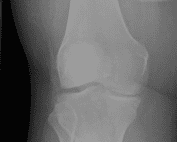
SplintER Series: A Case of Inability to Move the Knee
29-year-old F presents to ED with acute onset knee pain. Reports hearing an audible “pop” after twisting her leg while running down the stairs at home. She explains that her right knee is stuck, and she can neither flex nor extend it. An image is shown below (courtesy of Andrew Murphy, Radiopaedia.org) [+]

Parwaiz Rashidzada, MD

SAEM Clinical Image Series: Pitching Pain
A twenty-year-old right-handed male presented to the emergency department with a past medical history of right coracoid impingement, and three months of increasing right shoulder pain that became suddenly worse. He had a right shoulder arthroscopy nine months ago and played a full season as his baseball team’s pitcher over the past four months. He endorsed no exacerbating symptoms other than movement and has only taken naproxen over the counter for this pain. He denied any family history of clotting disorders. [+]
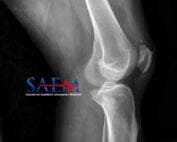
SAEM Clinical Image Series: Knee Pain
A fifty-six-year-old male with a past medical history of legal blindness and remote right quadricep tendon rupture presents to the emergency department via emergency medical services (EMS) after a mechanical fall, complaining of left knee pain. According to the patient, he is in his regular state of health and was walking with his cane when he had a mechanical fall on the sidewalk after tripping on an unknown object and falling onto his left knee. The patient did not hit his head, did not lose consciousness, and has no head, neck, or back pain. The [+]
Anticoagulant Reversal in Hemorrhagic Stroke
Acute management of cerebrovascular accidents can be challenging enough, but questions about anticoagulant reversal in the setting of hemorrhagic stroke add another layer of complexity. The ACEP E-QUAL Network podcast, a partnership with ALiEM to promote clinical practice improvements, reviewed this topic with Dr. Joshua Goldstein (Massachusetts General Hospital, Harvard Medical School). Dr. Goldstein addressed common anticoagulants and their reversal agents, summarizing available literature to inform clinical practice. We present highlights from this discussion with Dr. Jason Woods. What is the goal of anticoagulant reversal? Since it is impossible to go back in time to prevent intracranial hemorrhage (ICH), the [+]