



ACEP E-QUAL Podcast: Buprenorphine After Opiate Overdose
The opiate epidemic continues to be a frontline issue for healthcare systems across the country. The American College of Physicians (ACEP) Emergency Quality (E-QUAL) Network, through its Opioid Initiative Goal, strives to promote the implementation of alternatives to opioids, improved opioid prescribing safety, and adoption of harm reduction strategies such as naloxone prescribing and medication-assisted therapies (MAT). In a two-part series of the ACEP E-QUAL Network Podcast, host Dr. Jason Woods discussed buprenorphine initiation after an opioid overdose in the Emergency Department (ED) with Dr. Andrew Herring, Associate Director of Research and Medical Director of the Substance Use Disorder Treatment [+]
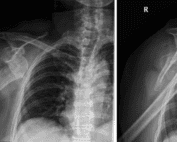
SplintER Series: More Than Just a Shoulder Dislocation?
An 80-year-old female presents to the Emergency Department with right shoulder pain, deformity, and decreased range of motion after falling down half a flight of stairs. AP and Y-views of the right shoulder were obtained (Images courtesy of Kenneth Chang, DO). [+]

Kenneth Chang, DO
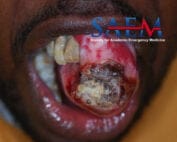
SAEM Clinical Image Series: Oral Trauma and Mass
A 38-year-old African American male without a significant past medical history presented with an oral mass. He was struck on the mouth by a wrench handle about two prior. Since then he has had a growing mass originating from the gum of his left front upper teeth. He is no longer able to eat solid foods and has to use a straw for all oral intake. The patient denies fevers, chest pain, shortness of breath, and weight loss. [+]

How I Work Smarter: Alexandra Mannix, MD
One word that best describes how you work? My work style is very Task-Oriented. I have a To-Do list that I regularly update and is always prioritized. Current mobile device iPhone Computer MacBook Pro (at home). We have PCs at work. What is something you are working on now? I’m currently working on a project looking at both gender and racial bias in the SLOE. This has been something I was interested in for a while, and it’s been really exciting to see the project take off. How did you come up with this Idea/Project? I have a gender research [+]
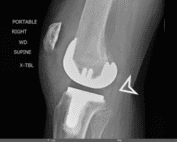
SplintER Series: My Knee, Again!
A 61-year-old F presents to the ED from the orthopedic clinic with acute right knee pain. She endorses that while a physical exam was being performed, she had sudden onset knee pain. Denies any trauma to the knee, radiation of pain, numbness, tingling, or swelling. The above knee radiographs were obtained (Images courtesy of John Kiel, DO). [+]
Parwaiz [+]
ACEP E-QUAL: ACEP Non-STEMI Clinical Policy
In 2018, the American College of Physicians (ACEP) released a Clinical Policy with management recommendations for patients presenting to the emergency department (ED) with concern for non-ST-elevation myocardial infarction (NSTEMI). Dr. Jason Woods hosted an episode of the ACEP E-QUAL Network podcast highlighting key aspects of the new policy. Dr. Woods was joined by lead writer Dr. Christian Tomaszewski from the University of California San Diego, and Dr. Michael Ross, Director of the Chest Pain Center at Emory University. Below are show notes reviewing the recommendations and the process involved in creating the clinical policy. How is a clinical policy [+]
ACEP E-QUAL: The Electronic ICU
Building on already increasing interest in telehealth, the COVID-19 pandemic accelerated the development and implementation of telemedicine services in a variety of clinical settings. In 2018, Dr. Jason Woods hosted an episode of the ACEP E-QUAL Network podcast highlighting the creation of an electronic intensive care unit (eICU) through Emory Healthcare. In this episode, Dr. Tim Buchman and Critical Care Nurse Cheryl Hiddelson share their innovative approach to delivering critical care services via telehealth. We present highlights from this discussion below. What is an eICU? The eICU allows for critical care oversight, without having to be on site. [+]
Buprenorphine prescribing: The Get Waivered Initiative makes it easier to get your DEA-X Waiver
A major development in curbing the opioid epidemic is the introduction of the medication buprenorphine to address opioid addiction. Being able to prescribe this medication, however, requires a special DEA-X Waiver in the United States. Dr. Alister Martin, the Founder of the Get Waivered initiative, is working to reduce the barriers for clinicians to obtain the training and paperwork necessary to obtain this waiver. Dr. Michelle Lin talks with Dr. Martin on this podcast about the backstory of the Get Waivered program, the lowered barriers to obtaining training, and some sneak peaks on what is new on the launching pad [+]

SAEM Clinical Image Series: Eye Pain After Assault
A 33-year-old male presents with intermittent blurry vision and left eye pain for 3 months, and a left-sided orbital headache for 1 day. He reports getting punched in the left side of the head during an altercation a few months ago. The eye pain is worse with ocular movements and is associated with bilateral conjunctival injection and white/green discharge from the left eye. The patient was seen at another emergency department 3 months prior for the same symptoms. He was then found to have left-sided proptosis, visual acuity 20/60 in the left eye, no fluorescein [+]
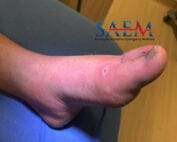
SAEM Clinical Image Series: Surfing Sting
A 38-year-old male presents 8 days after being stung in the left foot while surfing. He reports the sudden onset of sharp pain while walking in the ocean. He was seen initially in the emergency department. The puncture wound on his left foot was anesthetized, explored, and irrigated. No X-ray was obtained, no foreign body was discovered, and he was discharged home. Two days ago, he noticed worsening heat, itchiness, swelling, and skin changes (red bumps and patches extending from the foot up to the lower calf) in his left foot. His current pain is [+]