

About Michelle Lin, MD

ALiEM Founder and CEO
Professor and Digital Innovation Lab Director
Department of Emergency Medicine
University of California, San Francisco

Article Review: Role of instructional technologies in medical education

InstructionalTechWordArt

A conference called “A 2020 Vision of Faculty Development Across the Medical Education Continuum” was held at Baylor College of Medicine in 2010. At this conference, experts convened to discuss the changing role of technologies in medical education.

Their conclusions were summarized in this Academic Medicine article, which discusses 5 trends and 5 recommendations.

Trends

  1. Explosion of new information: It has been postulated that the world’s body of knowledge will double every 35 days by 2015. We are in an age of information explosion. Physicians will have to be able to process an ongoing onslaught of information throughout their career. Learning how to sustain lifelong learning will be critical. 
  2. Digitization of all information: Medical records are slowly transitioning to an all-electronic format. Also in the age of Web 2.0, much of the digital content in health care are posted by the learners. Medical schools and residency programs will have to shift their approach to teaching,  disseminating, filtering, and supporting learning in this digital age.
  3. New generation of learners: Learners in medical schools are primarily “digital natives”. They have grown up with primarily digital textbooks and references. They have grown up with Facebook and Google. In contrast, educators are usually “digital settlers” — not “born digital” but now “live digital”.
  4. Emergence of new instructional technologies: In the Web 2.0 age, there are a myriad of online tools such as blogs, wikis, podcasts, and virtual learning environments. 
  5. Accelerating change: Computers will increasingly play a greater role in our everyday lives. I imagine something like the Minority Report movie. The future is almost here.

Recommendations

  1. Use technology to support learning: Technology shouldn’t replace face-to-face learning but rather supplement areas which are better served using technology. Technology definitely helps with geographically distant learning groups, teaching deliberate practice using simulation, and individualizing learning plans.
  2. Focus on the fundamentals: Keep your eye on the prize. Don’t be tempted to use the new technologies for the sake of being current. First and foremost, focus on learner needs and the course objectives.
  3. Allocate a variety of resources: Faculty should be taught how to effectively use instructional technologies in faculty development workshops. Furthermore, “e-learning specialists” should be available to help faculty create effective courses. These specialists include Web designers, videographers, and e-learning management system experts. 
  4. Support and recognize faculty as they adopt new technologies: Institutional grants should be created to support faculty who want to adopt new instructional technologies. Furthermore, University promotion committees should value e-learning teaching modalities as academic scholarship. I wholeheartedly support this second statement– my blog is still considered a “hobby” rather an academic pursuit. Good thing I love doing this.
  5. Foster collaboration: We, as educators, need to share our ideas and resources nationally and internationally. Examples include the Health Education Assets Library (HEAL), MedEdPORTAL. 

Reference
Robin BR, McNeil SG, Cook DA, Agarwal KL, Singhal GR. Preparing for the Changing Role of Instructional Technologies in Medical Education. Acad Med. 2011 – in early press. PMID: 21346506.


Paucis Verbis: Chemical sedation for severe agitation

haldol ativan versed sedation agitation medications

Haldol, Ativan, and Versed… oh my.

In the Emergency Department, some patients present very acutely and aggressively agitated. This is usually the result of illicit drug use or a schizophrenic who hasn’t been taking medications (or both!). Fortunately, we have an arsenal of medications to help sedate the patient.

One study looked to answer the question of what single IM sedation agent is most effective, as measured by the shortest time to sedation and time to arousal.

PV Card: Chemical Sedation for Agitation


Adapted from [1]
Go to ALiEM (PV) Cards for more resources.

Reference

  1. Nobay F, Simon BC, Levitt MA, Dresden GM. A Prospective, Double-blind, Randomized Trial of Midazolam versus Haloperidol versus Lorazepam in the Chemical Restraint of Violent and Severely Agitated Patients. Academic Emergency Medicine. 2004;11(7):744-749. doi: 10.1197/j.aem.2003.06.015
By |2021-10-16T19:23:38-07:00Mar 25, 2011|ALiEM Cards, Tox & Medications|

Trick of the Trade: Benzoin for opening traumatic, swollen eyelids


EyelidRoll1smsmArrowssm

Patients who sustain facial trauma often have swollen eyelids. They may be so swollen that it is impossible to pull back the eyelids for an ocular exam. You use one of our “Tricks of the Trade”ideas and attempt to “roll” the upper eyelid using the Q-tip trick (above).

Fresh blood on the face, however, makes the Q-tip a little slippery along the upper eyelid, preventing an adequate view of the eye itself.

(more…)

By |2016-11-25T15:43:21-08:00Mar 23, 2011|Ophthalmology, Tricks of the Trade|

Article Review: Barriers to effective teaching

Teacher3d

I think there is no better or more rewarding job than being an educator, especially in the field of Medicine.

There are, however, significant financial, societal, curricular, and environmental barriers which prevent optimally effective teaching in Medicine. In a commentary piece in Academic Medicine, the authors review the barriers and some forward-thinking recommendations for our leaders in medical academia. While the focus of the article is on undergraduate medical education, many concepts apply to graduate medical education as well.
(more…)

By |2016-11-11T18:58:14-08:00Mar 21, 2011|Education Articles, Medical Education|

Paucis Verbis: Strength of diagnostic tests for cholecystitis

MurphyYou have a 40 year-old man who presents to the ED for persistent right upper quadrant abdominal pain for 12 hours after eating a fatty meal. He has no fevers, nausea, flank pain, or dysuria. His physical exam shows no fever and only moderate tenderness in the RUQ without guarding. He has a Murphy’s sign which is improved after a total of 8 mg of IV morphine. His laboratory results, which include a WBC, liver function tests, lipase, and urinalysis, are normal.
Can you safely say that the patient doesn’t have cholecystitis? Can you discharge him for outpatient ultrasonography to assess for symptomatic cholelithiasis?

As bedside ultrasonography becomes more of a staple in Emergency Departments, it is easy to just perform the ultrasound yourself if such a patient presents. If you do not have an ED ultrasound available, however, you need to send this patient for a formal ultrasound because he is still very much at risk for cholecystitis despite having unremarkable lab tests and no fever.

JAMA published a meta-analysis of 17 studies on the test characteristics for cholecystitis. I found it odd that they defined a fever as temperature >35 Celsius. The best performing characteristic was a Murphy’s sign, although the positive likelihood ratio (LR) slightly crossed 1.0 (0.8-8.6).

PV Card: Diagnostic Testing for Cholecystitis


Adapted from [1]
Go to ALiEM (PV) Cards for more resources.

Reference

  1. Trowbridge RL, Rutkowski NK, Shojania KG. Does This Patient Have Acute Cholecystitis? JAMA. 2003;289(1). doi: 10.1001/jama.289.1.80
By |2021-10-16T19:25:53-07:00Mar 18, 2011|ALiEM Cards, Gastrointestinal|

Paucis Verbis: Right and posterior ECG leads

ECG EKG machine

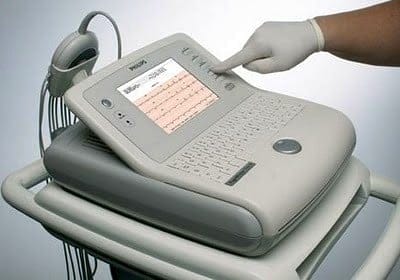
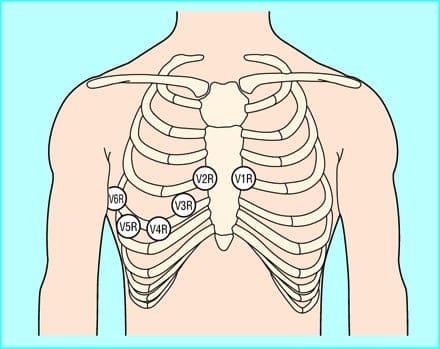
A standard 12-lead ECG can be very telling for patients with chest pain or shortness of breath. A right ventricular (RV) and posterior wall infarct, however, can present very subtly. You can obtain special right-sided (V1R-V6R) and posterior leads (V7-V9), if you are concerned. What are the indications for obtaining right-sided and posterior ECG leads?


Go to the ALiEM Cards for more resources.

Addendum 3/11/11:

Right sided ECG leads (V1R-V6R) are positioned in a mirror image fashion from the standard 12-lead precordial leads.
Right-Sided
Posterior ECG leads (V7-V9) are applied by moving V4-V6 in the posterior positions.
ecg08_f9c

By |2021-10-16T19:28:52-07:00Mar 11, 2011|ALiEM Cards, ECG|
Go to Top