PEM POCUS Series: Intussusception

Read this tutorial on the use of point of care ultrasonography (POCUS) for pediatric intussusception. Then test your skills on the ALiEMU course page to receive your PEM POCUS badge worth 2 hours of ALiEMU course credit.
PATIENT CASE
Johnny is a 2-year-old boy who comes into the emergency department for abdominal pain for the last day. His parents are concerned that he has been having intermittent abdominal pain and has seemed very tired all day. Parents deny bloody stool.
On arrival, his vital signs are:
| Vital Sign | Finding |
|---|---|
| Temperature | 36.9C |
| Heart rate | 110 bpm |
| Blood pressure | 97/50 |
| Respiratory rate | 22 |
| Oxygen saturation (room air) | 99% |
He is tired appearing, and his abdominal exam is soft but diffusely tender. Given his intermittent abdominal pain, you decide to perform an intussusception point of care ultrasound (POCUS) exam.
ULTRASOUND TECHNIQUE
Intussusception is when one part of the bowel telescopes, or gets stuck, in another part of the bowel. Typically intussusception refers to ileocolic intussusception where the ileum becomes stuck in the colon. To perform the ultrasound, start in the right lower quadrant and trace the colon. See below for a step-by-step technique.

Technique
- The patient should be positioned supine.
- To aid in comforting the child, the child can be positioned supine in the parent’s lap while undergoing the scan. Having the parent or another provider offer a toy, book, or phone/tablet to distract the child during the scan can also help ease anxiety.
- Begin in the right lower quadrant (RLQ), using a high frequency linear probe with the probe marker to patient’s right.
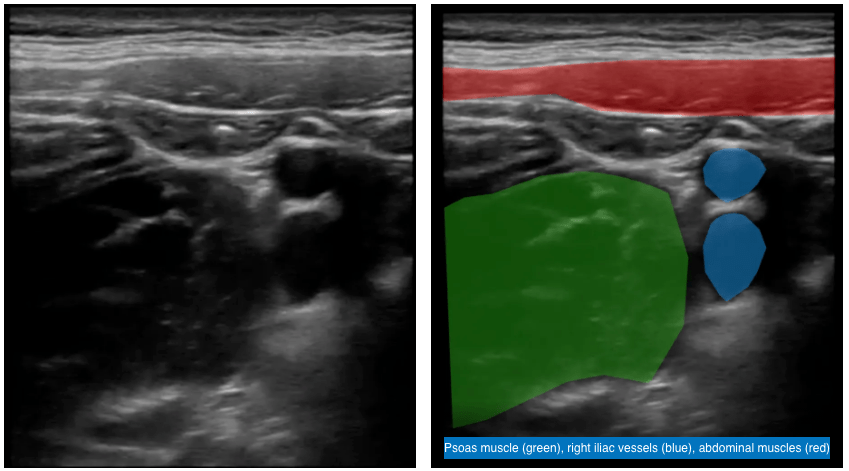
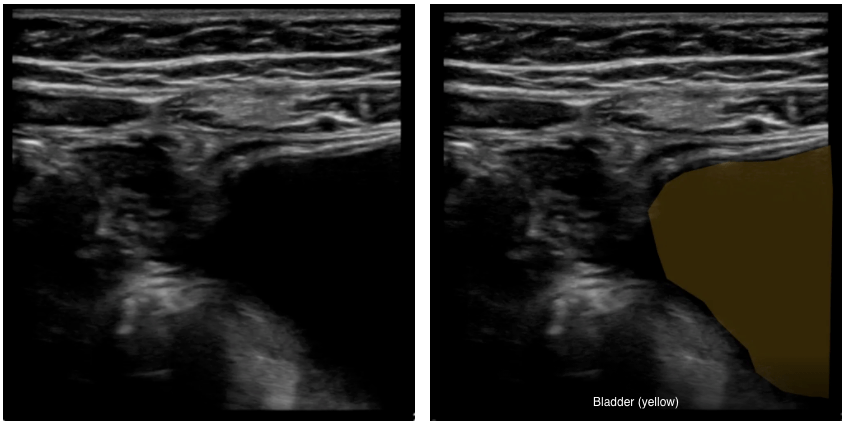
- First, identify the anatomical landmarks in the RLQ (see ultrasound images below):
- Psoas muscle (green) laterally
- Right iliac vessels (blue)
- Abdominal muscles (red)
- Bladder (yellow) medially
Ultrasound image: Anterior Abdomen (RLQ) View
Ultrasound Image: Anterior Abdomen RLQ (More Medial) View
- Perform graded compression, with slow steady pressure to displace bowel gas
- Follow the colon from the RLQ to right upper quadrant (RUQ) until the liver (purple) and gallbladder are identified
Ultrasound Image: Anterior Abdomen (RUQ) View

- Rotate the probe marker to patient’s head and scan the entire length of the transverse colon.
- Rotate the probe marker back to patient’s right and scan the entire length of the descending colon, making sure to scan all four quadrants.
- Save representative video clips and still images of each quadrant.
- If an intussusception is found, measure its diameter in transverse view and note in which quadrant(s) it is found.
- At the end of scan, if you have found an intussusception, re-image the abdomen to make sure it was not transient.
- The provider should maintain awareness of the patient’s comfort throughout the scan.
INTUSSUSCEPTION CLASSIC FINDINGS
Normal (no intussusception)
Abnormal findings
- Look for findings of a sandwich sign (or pseudo-kidney sign) in the longitudinal view and target sign (or donut sign) in the transverse view.
- If visualized, measure the diameter of the intussusception in short axis (transverse) and note which in which quadrant(s) it is located.
Sandwich
Target Sign

Additional Anterior Abdominal Ultrasound Videos
Pro Tip
It can be difficult to distinguish intussusception of the small bowel-small bowel (i.e., when the ileum or part of the small bowel telescopes into itself) versus ileocolic (i.e., when the ileum becomes telescopes into the colon). The former often does not require a procedure for reduction, while the latter typically does. If the target sign diameter is <2 cm and transient, a small bowel-small bowel intussusception should be suspected. The length of the intussusception, or how many quadrants are involved, can also be measured for an idea of how much bowel is involved.
Small bowel-small bowel intussusception
Ileo-colic intussusception
FACTS and LITERATURE REVIEW
Mimickers of Intussusception
There are additional pathologies that can be mistaken for intussusception such as an intussuscepted appendix, appendicitis surrounded by abscess, and Meckel’s diverticulum, which are beyond the scope of this course. Any concerning finding for intussusception should be followed by a confirmatory study by the radiology department.
Benefits of intussusception POCUS scans
Although few studies have looked at point of care ultrasonography (POCUS) for intussusception, the existing studies have shown excellent test characteristics and a decreased length of stay with using POCUS.
Two studies assessed the test characteristics of the intussusception POCUS.
| Publication | Study Methodology | Sensitivity | Specificity |
|---|---|---|---|
| Riera et al. (2012)1 | This journal publication was a prospective study of 82 patients who underwent POCUS by pediatric emergency medicine (PEM) providers. The gold standard was a comprehensive radiology ultrasound. | 85% | 97% |
| Trigylidas et al. (2017) 2 | This abstract reported a retrospective study of 105 intussusception POCUS scans by PEM providers. The gold standard was either a direct radiology over-read of the POCUS scans or a radiology department ultrasound. | 96.2% | 92.6% |
| Lin-Martore et al. (2020)6 | This systematic review and meta analysis included 1,303 patients and 6 studies. | 94.9% | 99.1% |
| Bergmann et al. (2021)7 | This prospective study of 256 children across 17 sites (35 sonologists) compared POCUS and radiology performed ultrasound using a gold standard of clinically important intussusception which was defined as an intussusception that required radiographic or surgical reduction during or within 7 days of the incident ED visit. | 96.6% | 98% |
In terms of ED length of stay (LOS), Kim et al. (2017) reported that after the introduction of an intussusception POCUS scanning protocol, the LOS decreased by >200 minutes.3
Differentiating small bowel-small bowel from ileocolic intussusception
In general, true ileocolic intussusceptions are:
- Found on the right side of the abdomen
- >2 cm in diameter
- Have mesenteric fat (which is white) and lymph nodes in the center
- Do not self resolve
There have been studies looking at distinguishing small bowel-small bowel from ileocolic intussusception. These, however, have been radiology-based and not POCUS studies, making generalizability to the ED setting challenging. Thus, if there is a concern for an intussusception, a radiology ultrasound should be ordered.
One small study with 27 patients by Wiersma et al. (2006) found that small bowel-small bowel intussusceptions had a smaller mean diameter and length compared to ileocolic intussusceptions.4
| Type of intussusception | # of patients and scans | Mean diameter (range) | Mean length (range) | Location |
|---|---|---|---|---|
| Small bowel-small bowel | 10 patients, 11 scans | 1.5 cm (1.1-2.5 cm) | 2.5 cm (1.5-6 cm) | Distributed throughout the abdomen (6 paraumbilical, 2 RUQ, 2 RLQ, 1 LLQ) |
| Ileocolic | 14 patients, 16 scans | 3.7 cm (3-5.5 cm) | 8.2 cm (5-12.5 cm) | All on right side of abdomen |
Lioubashevsky et al 20135 had a larger sample size (174 patients) with similar findings. The authors also measured the ratio of the inner fat core to the intussusception outer wall and identified the presence or absence of lymph nodes within the lesion.
| Type of Intussusception | # of patients | Mean diameter (range) | Mean length (range) | Ratio of fat core to the intussusception outer wall | % of patients with lymph nodes in the lesion |
|---|---|---|---|---|---|
| Small bowel-small bowel | 57 patients | 1.4 cm (1.1-2.5 cm) |
2.5 cm (1.5-6 cm) |
<1 | 14% |
| Ileocolic | 143 patients | 2.6 cm (1.3-4 cm) |
8.2 cm (5-12.5 cm) |
>1 | 89.5% |
References [click to expand] +
- Riera A, Hsiao A, Langhan M, Goodman T, Chen L. Diagnosis of intussusception by physician novice sonographers in the emergency department. Ann Emerg Med. 2012;60(3):264-268. PMID 22424652
- Trigylidas TE, Kelly JC, Hegenbarth MA, Kennedy C, Patel L, O’Rourke K. 395 Pediatric Emergency Medicine-Performed Point-of-Care Ultrasound (POCUS) for the Diagnosis of Intussusception. Annals of Emergency Medicine. October 2017:S155. DOI
- Kim J, Lee J, Kwon J, Cho H, Lee J, Ryu J. Point-of-Care Ultrasound Could Streamline the Emergency Department Workflow of Clinically Nonspecific Intussusception. Pediatr Emerg Care. September 2017. PMID 28926507
- Wiersma F, Allema J, Holscher H. Ileoileal intussusception in children: ultrasonographic differentiation from ileocolic intussusception. Pediatr Radiol. 2006;36(11):1177-1181. PMID 17019589
- Lioubashevsky N, Hiller N, Rozovsky K, Segev L, Simanovsky N. Ileocolic versus small-bowel intussusception in children: can US enable reliable differentiation? Radiology. 2013;269(1):266-271. PMID 23801771
- Lin-Martore M, Kornblith AE, Kohn MA, Gottlieb M. Diagnostic Accuracy of Point-of-Care Ultrasound for Intussusception in Children Presenting to the Emergency Department: A Systematic Review and Meta-analysis. West J Emerg Med. 2020 Jul 2;21(4):1008-1016. doi: 10.5811/westjem.2020.4.46241. PMID: 32726276.
- Bergmann KR, Arroyo AC, Tessaro MO, et al; P2Network. Diagnostic Accuracy of Point-of-Care Ultrasound for Intussusception: A Multicenter, Noninferiority Study of Paired Diagnostic Tests. Ann Emerg Med. 2021 Jul 2:S0196-0644(21)00340-1. doi: 10.1016/j.annemergmed.2021.04.033. Epub ahead of print. PMID: 34226072.
Case Resolution
You place a linear, high-frequency probe on the right side of the patient’s abdomen. You perform a bedside ultrasound scan, viewing transversely and longitudinally through the upper and lower abdomen. You observe the following:
What is the diagnosis?
This is an intussusception!

The intussusceptum (red) is the part of the bowel that has telescoped into the intussuscipiens (blue). When ileum becomes trapped in the colon, this can lead to ischemia and necrosis over time. This is what causes the classic “currant jelly stools”, which are bloody stools.
Tip: The classic triad of colicky abdominal pain, palpable mass and bloody stool are present in less than 50% of patients, and intussusception should be suspected for patients with vomiting, abdominal pain, and/or lethargy.1
Hospital course
Johnny underwent an air enema reduction in the Radiology department, which successfully reduced the ileocolic intussusception.
Reference
- Daneman A, Alton D. Intussusception. Issues and controversies related to diagnosis and reduction. Radiol Clin North Am. 1996;34(4):743-756. PMID 8677307.
The PEM POCUS series was created by the UCSF Division of Pediatric Emergency Medicine to help advance pediatric care by the thoughtful use of bedside ultrasonography.
Learn more about bedside ultrasonography on the ALiEM Ultrasound for the Win series