



Trick of the trade: Discounted medications at pharmacies
Many times, patients who we deem as “noncompliant” with medications may actually be financially unable to afford medications that we prescribe them. Thanks to Amy Kinard, I just learned about this great new website where you can find pharmacies with amazing discounts for common medications. [+]

Paucis Verbis card: C1-C2 injuries
I'm starting to work on co-authoring the next edition of my chapter on "Spine and Spinal Cord Injury" within the textbook "Emergency Medicine" by Dr. Jim Adams (Northwestern EM Chair). There are some useful tables that I created that I thought you might find helpful. This is the first installment covering C1-C2 fractures. The next PV card will cover the lower cervical fractures. I always forget which are stable and unstable. For instance, the above extension teardrop fracture looks innocuous but is an unstable fracture because the anterior longitudinal ligament is ruptured. PV Card: C1 and C2 Fractures and Injuries [+]
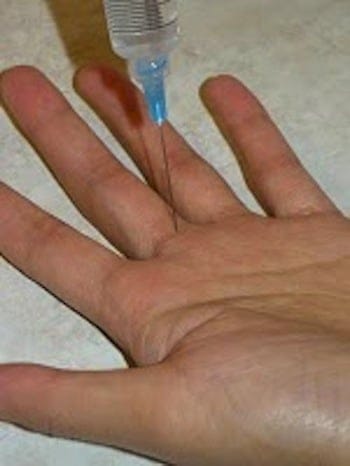
Trick of the trade: Single digital block
Your next ED chart: Finger injury The finger needs to be anesthetized. Patient: “I have had this freezing before. The needles really hurt! Is there anything else less painful? ” [+]

Director of Growth, Strategic Alliance Initiative, [+]
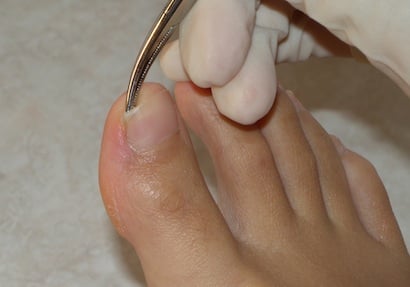
Trick of the Trade: Toenail splinting for ingrown toenails
It is 4 a.m. You pick up a chart. Toe pain. Thinking this could be an easy injury, you walk over to the patient, only to discover: bilateral ingrown toenails. Your heart sinks. In your head, you are thinking: Lateral nail resection? Nail removal? This could take a while. Is there a less invasive method for treating an ingrown toenail? [+]
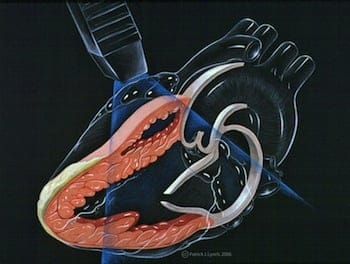
Paucis Verbis card: When murmurs need echo evaluation
Have you been in a situation where you are the first to detect a cardiac murmur in a patient? If you are hearing it in a busy, loud Emergency Department, I find that it's at least a grade III. Should you order an echocardiogram for further outpatient evaluation? It depends on the grade and characteristic of the murmur, in addition to the patient's symptoms. For instance, all diastolic murmurs require an echo. There is a useful ACC/AHA algorithm which helps you decide. PV Card: When Murmurs Need Echocardiography Evaluation Adapted from [1] Go to ALiEM (PV) Cards for more resources. Thanks [+]

Trick of the trade: I got ultrasound gel in my eye!
Bedside ultrasonography is increasingly being used in the ED to examine the eye. For instance, it can be used to detect a retinal detachment, vitreous hemorrhage, and high intracranial pressure. The technique involves applying ultrasound gel on the patient’s closed eyelid. A generous amount of gel should be used to minimize the amount of direct pressure applied on the patient’s eye by the ultrasound probe. Sometimes, however, no matter how careful you and the patient are, some gel accidentally contacts the eye itself. [+]
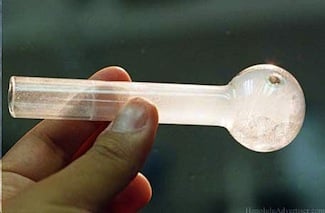
Trick of the Trade: Burned fingertips as a clinical clue
A patient presents to your Emergency Department with altered mental status and somnolence. You don’t smell alcohol on breath and you don’t see needle track marks. What clinical clue points you towards cocaine or methamphetamine ingestion? [+]
Paucis Verbis card: Pertussis
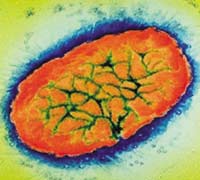
Is your Emergency Department administering Tdap immunization boosters instead of dT boosters? Patients with wounds are getting updated not only for tetanus and diphtheria, but also now for pertussis. Apparently there has been sharp rise in the national incidence of pertussis (Bordetella pertussis shown in image) in 2010. The infection has been documented in both infants (underimmunized less than 3 months old) and adolescents/adults (loss of immunity after 10 years). In fact, the CDC has issued an epidemic warning in California. How do you diagnose pertussis ? What are the classic symptoms? Better yet, how do you rule-it out clinically? You won't like [+]
Trick of the Trade: "Pour some sugar on me" | Reducing a rectal prolapse
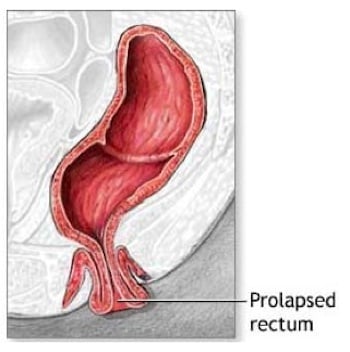
Rectal prolapses are typically caused by weakened rectal muscles, continued straining, stresses during childbirth, weakened ligaments, or neurological deficits. How do you fix them? You can attempt manual reduction of the prolapse by using direct pressure. On the other extreme, corrective surgery can be performed from either an abdominal or perineal approach. Trick of the Trade: Pour some sugar on it. Def Leppard may have been right. Rectal prolapses often are associated with quite a bit of rectal mucosal edema. Sprinkle granulated sugar onto the area. Wait 15 minutes. The sugar reduces the edema by osmotically drawing out the fluid. [+]
Paucis Verbis card: TIMI risk score
How do you risk-stratify undifferentiated chest pain patients in the Emergency Department? There are a multitude of causes for chest pain. We are always taught to think of the 5 big life-threats: ACS, PE, aortic dissection, tension pneumothorax, and pericardial tamponade. So how do YOU risk-stratify your patients for unstable angina (UA) and non-ST elevation myocardial infarction (NSTEMI)? STEMI's are usually obvious. UA and NSTEMIs -- not so much. Fortunately a 2000 JAMA article and a followup Academic Emergency Medicine 2006 study have solidified the TIMI risk scoring system as a reasonable risk-stratification tool for all-comer ED patients with chest [+]
Director of Growth, Strategic Alliance Initiative, Center for Innovation and Digital Health
Massachusetts General Hospital;
Chief Scientific Officer, Conductscience.com
Latest posts by Shuhan He, MD (see all)
- The Discharge Severity Index: Early Research on ED Readmission Risk Assessment - August 14, 2025
- Suboxone and the Emergency Physician: Get Waivered Training - August 12, 2022
- A Tale of Two Epidemics: COVID-19 and the Opioid Crisis - April 23, 2020