


Trick of the Trade: Antibiotic ointment for removal of artificial nail glue from eyelids
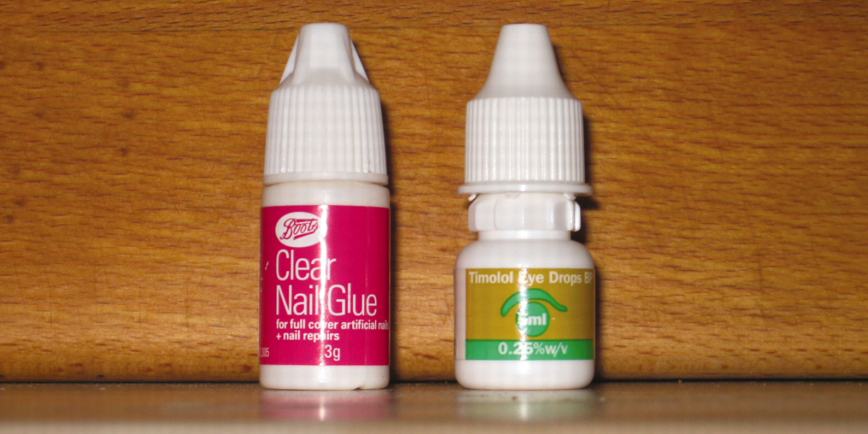
A bottle of nail glue and timolol eye drops (reproduced with permission from BMJ Publishing Group Ltd [1]) You are working a busy shift in your department’s fast track area and sign up for a patient with a complaint of “eye pain.” The patient is a fan of glue-on nails and mistook her nail glue bottle for her eyedrops. Now she is unable to open her eyelid for the exam and you struggle to open it yourself. You want to avoid cutting the adhered eyelashes and wonder if there’s a better solution. Background rise of artificial, press-on nails [+]

How I Educate Series: Tarlan Hedayati, MD
This week’s How I Educate post features Dr. Tarlan Hedayati, the Chair of Education at Cook County Hospital. Dr. Hedayati spends approximately 90% of her shifts with learners, including emergency medicine residents, off-service residents, and medical students. She describes her practice environment as a large, public, urban, Level 1 trauma center. Below she shares with us her approach to teaching learners on shift. What delivery methods do use when teaching on shift? Some of the other attendings joke that they know when I've been working because the garbage can is full of paper towels I've used to write on [+]
SAEM Clinical Images Series: An Adult with a Lower Extremity Rash
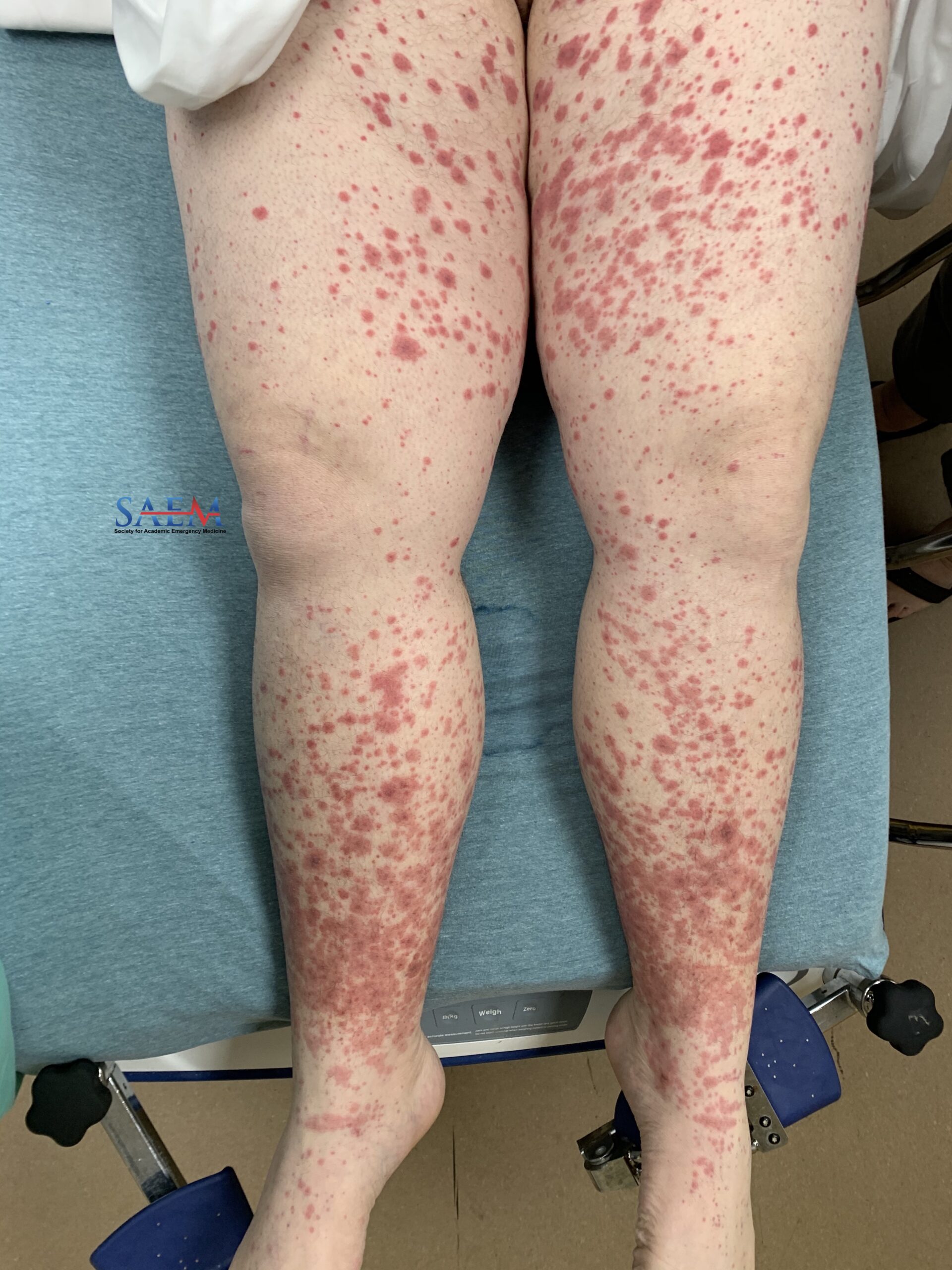
A 37-year-old male with a past medical history of type 2 diabetes presents to the Emergency Department (ED) with a rash. Initial symptoms began one week prior with small spots on the right leg with associated itching and burning. He initially presented to an outside facility where he was diagnosed with an allergic reaction versus scabies and was given a short course of oral steroids and topical permethrin that provided some relief. The rash progressed to bilateral lower extremities prompting re-presentation to the ED. He also reports associated dark urine and nausea. [+]

SplintER Series: Patellar Tendon Rupture
A 46-year-old female with a history of diabetes and morbid obesity presents to the emergency department (ED) with difficulty walking after she tripped on a curb and fell onto her right knee. You obtain X-rays (Figure 1). What is your suspected diagnosis? What is your initial workup in the ED? What is your management and disposition? Figure 1. AP/lateral x-ray of the right knee. Author’s own images. [+]
SAEM Clinical Images Series: Spicy Gum Leads to Spicy Gums
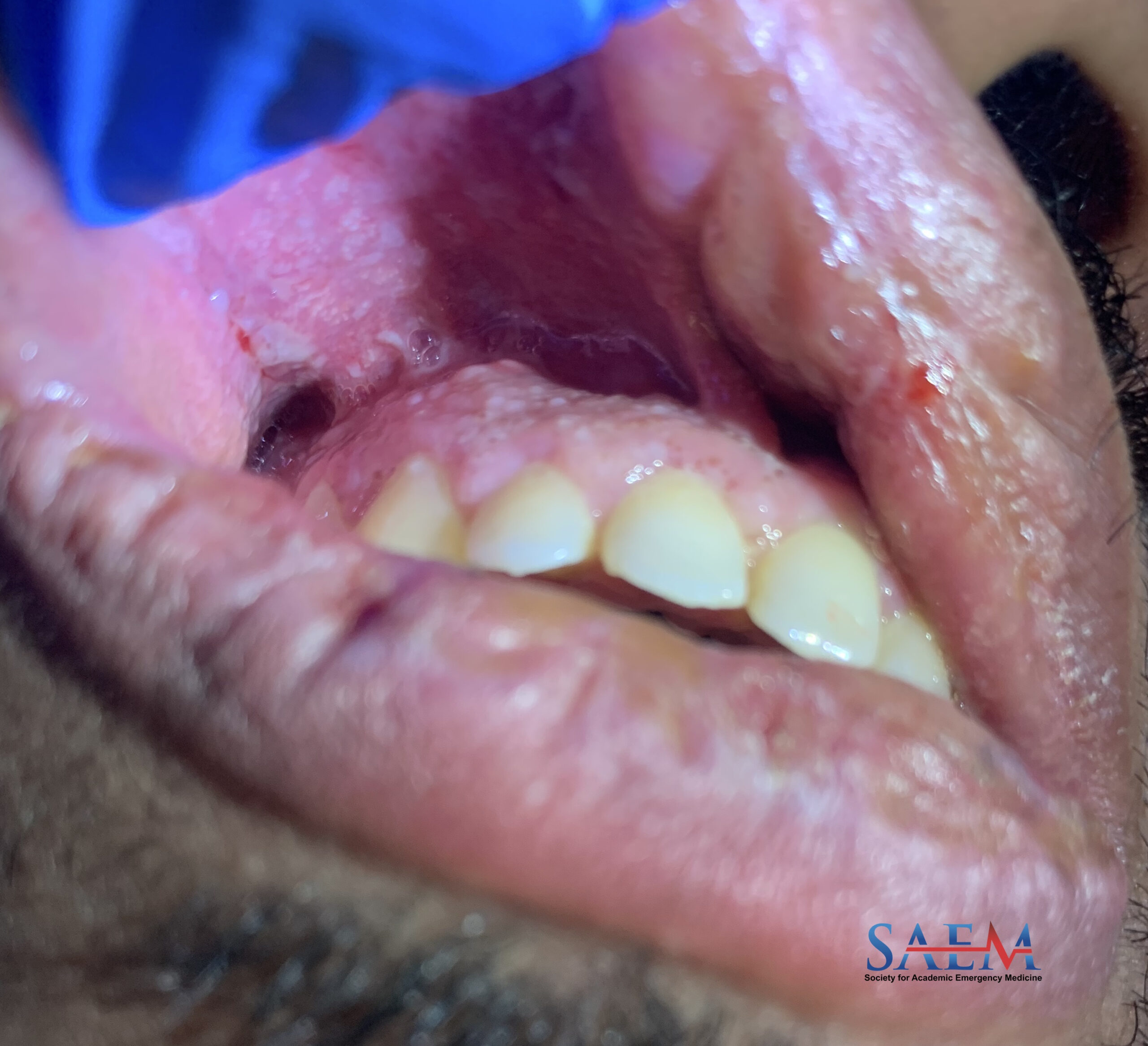
A 32-year-old male with a past medical history of asthma presents with a two-day history of cracked lips and progressively worsening oral pain, associated with white discharge, foul smell, and a metallic taste. The patient presented to urgent care and was sent to the Emergency Department (ED) for a sepsis workup. The worsening sores caused him to eat and drink less, including the gum he normally chews. He endorses oral sex with one [+]

52 Articles in 52 Weeks, 3rd edition (2022)
How can I keep up with so many landmark articles in Emergency Medicine (EM)? This is an often asked question we hear from interns and residents. Published in 2013 (1st edition) and 2016 (2nd edition), the "52 Articles in 52 Weeks" compendium is a compilation of 52 journal articles provided interns a list to read over a 52-week period, at an average pace of 1 journal article per week. We present the updated 2022 compilation. Methodology for Article Selection We primarily build off of the original list from 2016. These 52 articles were refreshed such that newer landmark articles [+]

ALiEM AIR Series | Neurology 2022 Module
Welcome to the AIR Neurology 2022 Module! After carefully reviewing all relevant posts in the past 12 months from the top 50 sites of the Social Media Index, the ALiEM AIR Team is proud to present the highest quality online content related to related to neurologic emergencies in the Emergency Department. 5 blog posts met our standard of online excellence and were approved for residency training by the AIR Series Board. More specifically, we identified 2 AIR and 3 Honorable Mentions. We recommend programs give 3 hours of III credit for this module. AIR Stamp of Approval and Honorable [+]

ALiEM AIR Series | Ortho Upper Extremity 2022 Module
Welcome to the AIR Orthopedic Upper Extremity Module! After carefully reviewing all relevant posts from the top 50 sites of the Social Media Index, the ALiEM AIR Team is proud to present the highest quality online content related to related to Orthopedic Upper Extremity emergencies in the Emergency Department. 3 blog posts met our standard of online excellence and were curated and approved for residency training by the AIR Series Board. We identified 1 AIR and 2 Honorable Mentions. We recommend programs give 2 hours (about 40 minutes per article) of III credit for this module. AIR Stamp of Approval and [+]

SplintER Series: En Pointe
A 32-year-old female presents to the emergency department with right foot pain after rolling her ankle during dance class. On exam, there is mild swelling and tenderness over the 5th metatarsal. The above x-ray was obtained (Figure 1: Case courtesy of Dr. Henry Knipe, Radiopaedia.org, rID: 28104). [+]

Ko, MD, CAQ-SM
Department of Emergency Medicine
New [+]

ALiEM AIR Series | Cutaneous 2022 Module
Welcome to the AIR Cutaneous Module! After carefully reviewing all relevant posts from the top 50 sites of the Social Media Index, the ALiEM AIR Team is proud to present the highest quality online content related to related to cutaneous emergencies in the Emergency Department. 6 blog posts met our standard of online excellence and were curated and approved for residency training by the AIR Series Board. We identified 0 AIR and 6 Honorable Mentions. We recommend programs give 3 hours (about 30 minutes per article) of III credit for this module. AIR Stamp of Approval and Honorable Mentions In an [+]