About Michelle Lin, MD

ALiEM Founder and CEO
Professor and Digital Innovation Lab Director
Department of Emergency Medicine
University of California, San Francisco

Paucis Verbis: An approach to persistent tachycardia

Sinus Tachycardia ECG
Tachycardia is a common clinical occurrence in the ED. Most of the time the etiology can be discerned through the history and physical exam, but sometimes it cannot. This is problematic especially when we are about to discharge a patient home but his/her heart rate is still 115 beat/min. We can’t send this patient home yet. Do we then have to admit them for work-up of persistent tachycardia?

Attached is a list of common causes of tachycardia in the ED, as well as potential diagnostic and therapeutic considerations. Rather than a shot-gun approach, a limited and thoughtful method works best.

Can you think of other potential causes?

PV Card: Approach to Persistent Tachycardia


Go to ALiEM (PV) Cards for more resources.

This useful PV card was made by one of our new star faculty members at San Francisco General Hospital, Dr. David Thompson. Thanks, David!

By |2021-10-12T16:15:00-07:00Aug 19, 2011|ALiEM Cards, Cardiovascular|

The future of the ALiEM blog


It has been over 2 years now that my guest bloggers and I write blog posts 5 days a week. The process of writing, maintaining, and collaborating on ideas for the blog has completely changed my career. It has opened new doors, introduced me to new colleagues and friends worldwide, and clarified the direction of my career.

Now as I find myself involved with more projects, I need to re-structure my time (unless someone can find me an extra hour a day to work). It was a good run though. Honestly, I’m surprised that I maintained this pace for so long. The blog was meant to be my little experiment and foray into the Web 2.0 world to catalog my personal thoughts and learning.


(more…)

By |2019-01-28T22:37:08-08:00Aug 15, 2011|Social Media & Tech|

Trick of the Trade: Splinting the ear

EarHematomaDressing

One of the hardest bandages to apply well is one for auricular hematomas. After drainage, how would you apply a bandage to prevent the re-accumulation of blood in the perichondrial space?

Traditionally, one can wedge xeroform gauze or a moistened ribbon (used for I&D’s) in the antihelical fold. Behind the ear, insert several layers of gauze, which have been slit half way to allow for easier molding around the ear. Anterior to the ear, apply several layers of gauze to complete the “ear sandwich”. Finally, secure the sandwich in place with an ACE wrap, which ends up being quite challenging because of the shape of the head.

(more…)

By |2016-11-11T19:59:20-08:00Aug 10, 2011|ENT, Trauma, Tricks of the Trade|

EM-RAP Educator’s Podcast: How to get promoted in academic EM

LadderClimb3d


Dr. Amal Mattu gives a great 47-minute lecture on “How to Get Promoted in Academic Emergency Medicine”. Catch the podcast from the talk in July’s EM-RAP Educator’s Edition. He pulls many of the lessons from his son’s kindergarten teacher.

Getting promoted in academic EM can often be a challenge and a mysterious process. Why is it some are getting promoted faster than others? What can I do to make sure I’m on track for promotion?

(more…)

By |2016-12-20T10:02:54-08:00Aug 9, 2011|Medical Education|

Paucis Verbis: Spinal epidural abscess

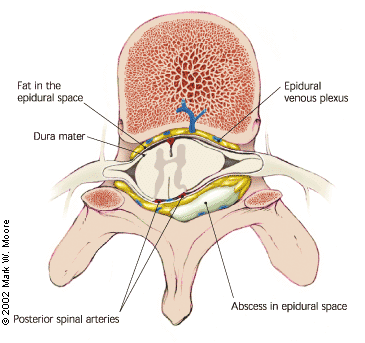
Spinal epidural abscess anatomy illustrationOne of the most challenging diagnoses to make is that of a spinal epidural abscess (SEA), especially if you work in an Emergency Department which cares for many IV drug users and HIV patients. There’s never before been a published diagnostic guideline or algorithm which helps you with risk-stratification.

In the Journal of Neurosurgical Spine, a diagnostic guideline was prospectively evaluated on a small population (n=31) as compared to historical controls (n=55). They found that an ESR test had a sensitivity of 100% if a patient had at least 1 risk factor for SEA. A CRP test was much less helpful.

Not a practical algorithm

Unfortunately, they didn’t study the utilization rate of the MRI scanner with this guideline. Are they getting better results (fewer diagnostic delays and fewer cases of patients later in their clinical course) because they are just MRI-scanning more people? Almost everyone in my ED with back pain would fall into the Urgent/Emergent MRI box…  I’m not a fan of this algorithm.

Regardless, this algorithm may help you in shaping your diagnostic decision and medical decision making documentation.

PV Card: Spinal Epidural Abscess


Adapted from [1]
Go to ALiEM (PV) Cards for more resources.

Reference

  1. Davis D, Salazar A, Chan T, Vilke G. Prospective evaluation of a clinical decision guideline to diagnose spinal epidural abscess in patients who present to the emergency department with spine pain. J Neurosurg Spine. 2011;14(6):765-770. [PubMed]
By |2021-10-12T16:17:13-07:00Aug 5, 2011|ALiEM Cards, Infectious Disease, Neurology|
Go to Top