About Michelle Lin, MD

ALiEM Founder and CEO
Professor and Digital Innovation Lab Director
Department of Emergency Medicine
University of California, San Francisco

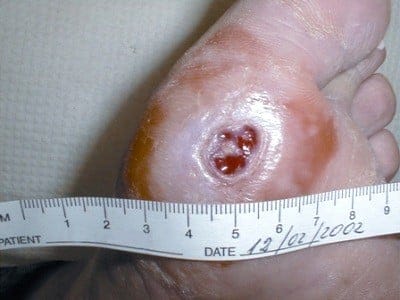
Paucis Verbis: Does this DM leg ulcer have osteomyelitis?

diabetic foot ulcer

We sometimes see diabetic patients in the ED for a worsening foot ulcer. Sometimes it’s the chief complaint. Other times, however, you just notice it on physical exam. So, be sure you examine the feet of your diabetic patients. Occasionally, you’ll be surprised by what you find.

Several questions come up with diabetic foot ulcers:

  • Is it a true diabetic foot ulcer, or is it an arterial or venous insufficiency ulcer?
  • Is there underlying osteomyelitis?
  • How can I best diagnostically work this foot ulcer up for osteomyelitis?
  • What is the Wagner grade of this ulcer? (I think it’d be Grade 2.)

Thanks to JAMA‘s Clinical Rational Examination series, there is a systematic review of diabetic leg ulcers and osteomyelitis. Here are the highlights:

PV Card: Diabetic Leg Ulcer and Osteomyelitis


Adapted from [1]
Go to ALiEM (PV) Cards for more resources.

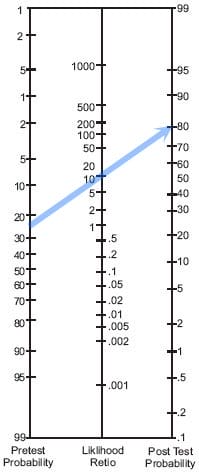
Below is the Fagan nomogram to help you plot out your post-test probability based on your likelihood ratios. The example given is if your pretest probability is 25% and your LR is 10. Your post-test probability would be 80%.

BayesFaganNomogramLine

Reference

  1. Butalia S. Does This Patient With Diabetes Have Osteomyelitis of the Lower Extremity? JAMA. 2008;299(7):806. doi: 10.1001/jama.299.7.806
By |2021-10-12T15:56:51-07:00Sep 23, 2011|ALiEM Cards, Infectious Disease, Orthopedic|

Trick of the Trade: Pediatric ear exam

ChildEaraches2

Performing a physical exam on frightened pediatric patients can often be challenging. I am always thrilled to add more child-whisperer techniques to my arsenal of tricks. I have written in the past about:

What’s your trick on performing an otoscope exam of the ears?

(more…)

By |2019-02-19T18:08:03-08:00Sep 20, 2011|ENT, Pediatrics, Tricks of the Trade|

Paucis Verbis: Legionella pneumonia

Legionella Infection

Did you know that there was an unexplained spike in Legionnaire’s disease (pneumonia caused by Legionella pneumophila) during the 2009 H1N1 flu pandemic?

Since the flu season is rapidly approaching, I thought I would review what Legionnaire’s disease looks like. Yes, they will have a fever, cough, and pneumonia on CXR. These patients are generally pretty sick and almost always need hospitalization. What makes it unique? The trick is to look for extrapulmonary findings, which help to distinguish it from other atypical pneumonias. Relative bradycardia is a sure tip.

Why do we want to differentiate it from other pneumonias? Legionnaire’s disease requires reporting to your state’s health department to help track for outbreaks.

PV Card: Legionella and Legionnaire’s Disease


Adapted from [1]
Go to ALiEM (PV) Cards for more resources.

More information on Legionella from the CDC website.

Reference

  1. Cunha B. Legionnaires’ disease: clinical differentiation from typical and other atypical pneumonias. Infect Dis Clin North Am. 2010;24(1):73-105. [PubMed]
By |2021-10-12T16:00:57-07:00Sep 16, 2011|ALiEM Cards, Pulmonary|

Paucis Verbis: Distracting injuries in c-spine injuries

Cervical spine assessment distracting injuries

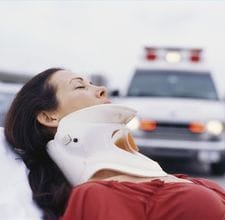
“Distracting injury” is a frequent cited reason for imaging the cervical spine in blunt trauma patients, per the NEXUS study. In the Journal of Trauma in 2005 and 2011, studies aimed to narrow the definition of “distracting injury”. Although both are studies at different sites, both conclude the same:

  • Chest injuries may be considered “distracting injuries” because of their proximity to the cervical spine.

Example

So let’s say you are caring for a non-intoxicated motor vehicle crash patient with an isolated tibia fracture (i.e. a “long bone fracture”), no chest injuries, and no neck pain/tenderness. Per the NEXUS criteria, you might consider this patient to have a “distracting injury” because of the long bone fracture. Instead, the literature now supports your clinically clearing the cervical spine without imaging.

Wait, let’s rethink this. Does this mean that you should get cervical spine imaging for ALL blunt trauma patients with ANY chest wall tenderness?! NO. That’s just crazy. You should still factor in the mechanism of injury, severity of pain, and your clinical gestalt.

So for me, these “distracting injury” studies are helpful such that:

  • If your trauma patient does NOT have chest trauma, it may help you avoid unnecessary cervical spine imaging, as suggested by the NEXUS criteria.
  • If your trauma patient DOES have significant chest trauma, I have a lower threshold to obtain cervical spine imaging despite the neck being non-tender.

PV Card: Distracting Injuries in Cervical Spine Assessment


Go to ALiEM (PV) Cards for more resources.

By |2021-10-12T16:03:39-07:00Sep 9, 2011|ALiEM Cards, Orthopedic, Trauma|

Brief survey: Need your help with my promotions!

OldschoolWith all of the advances in technology and social media, the “old school” world of traditional academia doesn’t know what to do with medical professionals who incorporate technologies into their educational practices. To justify these past 2 years of blogging during my free time, I wanted to collect data on who my readers are and the impact of my blog (if any).

I could sure use a few minutes of your time and input to help with my promotions process. Let’s push traditional academia to change with the times. Thanks a bunch.

(more…)

By |2016-11-11T18:52:07-08:00Sep 7, 2011|Medical Education, Social Media & Tech|
Go to Top