About Michelle Lin, MD

ALiEM Founder and CEO
Professor and Digital Innovation Lab Director
Department of Emergency Medicine
University of California, San Francisco

SAEM 2012 Consensus Conference: Education Research in EM

Group3d

It has just been announced that the upcoming 2012 SAEM annual meeting will feature a full-day Consensus Conference on Education Research in Emergency Medicine. In the past, Consensus Conferences have focused on such areas as “Interventions to Assure Quality in the Crowded Emergency Department” and “The Science of Simulation in Healthcare: Defining and Developing Clinical Expertise”.

There’s introductory information on the SAEM Facebook page. The format is a bit cluttered, so I am reposting here below: 

By |2016-11-11T18:52:37-08:00Jul 26, 2011|Medical Education|

Article review: Message for new generation of educators

Feedback

An interesting article was published in Medical Education which you don’t see too often in journals. It’s a first-person reflective account of Dr. Ronald Harden’s long and internationally well-regarded career in medical education. No p-value. No sample size calculation. His experiences and lessons learned provide great insight. Here’s his advice to current and future educators.

(more…)

By |2016-11-15T22:25:03-08:00Jul 25, 2011|Education Articles, Medical Education|

Paucis Verbis: Diagnostic testing tips for acute abdominal pain
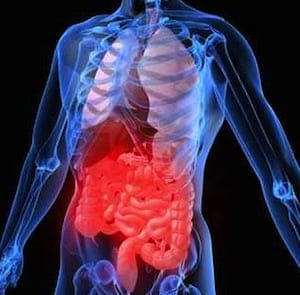
acute abdominal pain

In the most recent EM Clinics of North America publication, Dr. Panebianco et al. discussed the evidence behind diagnostic tests for acute abdominal pain. There were some really great teaching points in this broad-reaching topic.

My favorite pearl: A 3-way acute abdominal series is too insensitive to rule-out any major acute causes of abdominal pain with confidence. So stop ordering them routinely. If you are worried about a perforated viscus, order an upright chest x-ray instead — more accurate and less radiation.


Adapted from [1]
Go to ALiEM (PV) Cards for more resources.

Reference

  1. Panebianco N, Jahnes K, Mills A. Imaging and laboratory testing in acute abdominal pain. Emerg Med Clin North Am. 2011;29(2):175-93, vii. [PubMed]
By |2021-10-12T16:23:35-07:00Jul 22, 2011|ALiEM Cards, Gastrointestinal, Radiology|

Tricks of the Trade: Underwater ultrasonography

Basketweaving

I’ve heard of underwater basketweaving, but underwater ultrasonography?

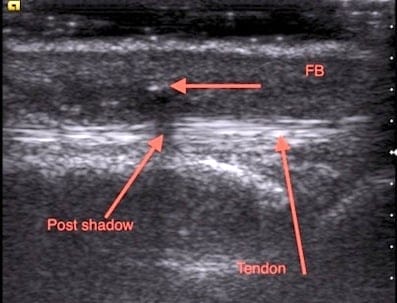
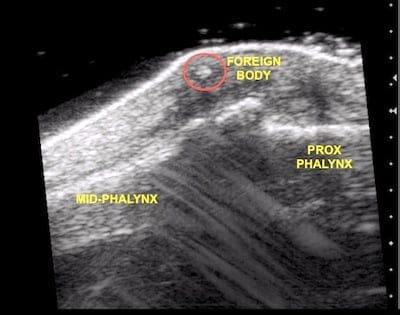
Bedside ultrasonography is a great tool to help find small foreign bodies. Commonly foreign bodies get lodged superficially in the patient’s extremities. Because superficial structures (<1 cm deep) are difficult to visualize on ultrasound, you should apply a really generous, thick layer of ultrasound gel to create some distance. Alternatively, you can add a step-off pad, such as a bag of saline or fluid-filled glove, to place between the patient’s skin and transducer. What’s a quicker and easier way to create some distance yet preserve image quality?

Trick of the Trade

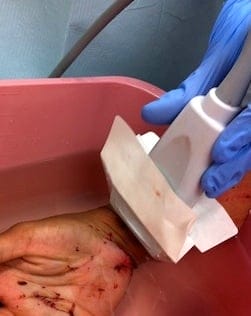
Submerse both the body part and the ultrasound transducer under water.

ultrasonography water bath

For this “bath water technique”, start by holding the transducer perpendicular to the wound and about 1 cm away from the skin. You can adjust the distance to optimize the image quality.

FB_Hand

FB_Hand2

Thanks to Andy at Emergency Medicine Ireland blog for these 2 ultrasound images! 

This submersion technique has been published in American Journal of EM in 2004 as a painless alternative to gel or a step-off pad, because the transducer does not need to apply any pressure on the patient’s wound.

Reference
Blaivas M, Lyon M, Brannam L, Duggal S, Sierzenski P. Water bath evaluation technique for emergency ultrasound of painful superficial structures. Amer J Emerg Med. 2004; 22(7), 589-93 PMID: 15666267

By |2020-04-21T12:30:07-07:00Jul 20, 2011|Tricks of the Trade, Ultrasound|

TED-Ed Brain Trust: Catalyzing an education revolution

ted-icon-1n27gebIf you have not heard of TED videos, I highly encourage you to view them. They are short, inspirational, and professional talks by leaders, scientists, and artists, who focus on bringing together the 3 worlds of Technology, Entertainment, and Design.

Because many of these videos focus primarily on education, TED has just built a new online community of educators called the “TED-Ed Brain Trust“. The mission is to bring together “the expertise of visionary educators, students, organizations, filmmakers and other creative professionals to guide, galvanize and ultimately lead this exciting new initiative.”

(more…)

By |2019-01-28T22:38:43-08:00Jul 19, 2011|Medical Education|

Article Review: Redesigning a Powerpoint lecture using multimedia design principles


Powerpoint
Let’s rethink how we design our Powerpoint slides. Let’s create design principles using Mayer’s cognitive theory of multimedia learning.

Cognitive Theory of Multimedia Learning

In a nutshell, people learn through two channels — words and images. This dual-channel theory suggests that people process auditory and visual stimuli separately. Each channel requires time to process information before merge into a cohesive cognitive concept.

(more…)

By |2016-11-11T18:52:39-08:00Jul 18, 2011|Education Articles, Medical Education|
Go to Top