SAEM Clinical Image Series: Oral Trauma and Mass

oral mass

A 38-year-old African American male without a significant past medical history presented with an oral mass. He was struck on the mouth by a wrench handle about two prior. Since then he has had a growing mass originating from the gum of his left front upper teeth. He is no longer able to eat solid foods and has to use a straw for all oral intake. The patient denies fevers, chest pain, shortness of breath, and weight loss.

(more…)

By |2020-12-11T15:18:37-08:00Dec 14, 2020|Academic, ENT, SAEM Clinical Images|

How I Work Smarter: Alexandra Mannix, MD

Alexandra Mannix

One word that best describes how you work?

My work style is very Task-Oriented. I have a To-Do list that I regularly update and is always prioritized.

Current mobile device

iPhone

Computer

MacBook Pro (at home). We have PCs at work.

What is something you are working on now?

I’m currently working on a project looking at both gender and racial bias in the SLOE. This has been something I was interested in for a while, and it’s been really exciting to see the project take off.

How did you come up with this Idea/Project?

I have a gender research group, which includes female and male faculty from all across the country and Canada. Over the past 2 years, we have published 4 articles (with 3 more in the process). We are in multiple time zones AND are all Emergency Medicine Docs. This group functions primarily on Slack and we use google docs for our writing. Both of these platforms have really helped improve our efficiency and communication.

What’s your office workspace setup like?

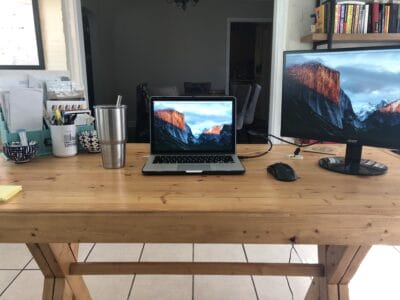
I have an office in my home, which includes my laptop and an extra monitor. Prior to COVID, I did a lot of my work from my work office, but due to COVID, I have been working much more often from home. Having dual monitors has drastically improved my ability and efficiency when working from home.

What’s your best time-saving tip in the office or home?

Make a to-do list, prioritize it, and start at the TOP! It’s so easy to start with the “easiest” task, but starting from the TOP helps me stay ahead of deadlines.

What’s your best time-saving tip regarding email management?

Know it is OK to have unread emails. I have 4 email accounts and it was physically impossible to stay on top of all of them. Prior to starting my faculty job, I always wanted my inbox to say 0. I had heard from so many people to just RESPOND and move on- but when I did this I felt like I was ALWAYS at work. I just can’t live like that. (I also turned off that little red number on the email app on my iPhone. This was mostly done for my wellness).

What apps do you use to keep yourself organized?

Google docs- so I can access my work everywhere (home computer, office computer, cellphone, etc). I also LIVE my life on my google calendar. I have multiple calendars (Personal, Med Ed, Clerkship, Residency, Sim Center, SheMD, Shifts, Etc). Each has its own color, which visually helps me stay organized. I block out days off and post/pre-night shifts, so I don’t accidentally schedule a meeting at noon on those days.

How do you stay up to date with resources?

Twitter… Which I admit is not the best option. I haven’t found a platform I love.

What’s your best time-saving tip in the ED?

Try not to get distracted. Complete a task before moving on. Multi-tasking is basically impossible, but efficiently task completing and task switching IS possible.

ED charting: Macros or no macros?

100% all about the macros and “dot phrases” that include *** (so I have to update them). And DON’T duplicate your work when using Macros. EG. if you already clicked it, don’t type it too.

Advice

  • What’s the best advice you’ve ever received about work, life, or being efficient?

Make a to-do list, prioritize it, and start at the TOP. It’s ok to outsource (groceries, cleaning, whatever). Make your partner a real PARTNER.

  • What advice would you give other doctors who want to get started, or who are just starting out?

Block out time (just like you block out a shift) on your calendar for you, your wellness, and your family.

  • Is there anything else you’d like to add that might be interesting to readers?

Develop good sleep hygiene. It is vital in Emergency Medicine.

Who would you love for us to track down to answer these same questions?

  • Melissa Parsons. @MEParsonsMD
  • Kat Ogle @DrKittyKat
  • Al’ai Alvarex @alvarezzzy

Read other How I Work Smarter posts, sharing efficiency tips and life advice.

By |2020-12-23T13:38:11-08:00Dec 11, 2020|How I Work Smarter, Medical Education|

ACEP E-QUAL: ACEP Non-STEMI Clinical Policy

Clinical Policy

In 2018, the American College of Physicians (ACEP) released a Clinical Policy with management recommendations for patients presenting to the emergency department (ED) with concern for non-ST-elevation myocardial infarction (NSTEMI). Dr. Jason Woods hosted an episode of the ACEP E-QUAL Network podcast highlighting key aspects of the new policy. Dr. Woods was joined by lead writer Dr. Christian Tomaszewski from the University of California San Diego, and Dr. Michael Ross, Director of the Chest Pain Center at Emory University. Below are show notes reviewing the recommendations and the process involved in creating the clinical policy.


How is a clinical policy different than a practice guideline?

The National Guideline Clearinghouse (NGC), a public resource initiative of the Agency for Healthcare Research and Quality (AHRQ), provides rules and frameworks for evidence-based clinical practice guidelines. ACEP refers to clinical practice guidelines in Emergency Medicine (EM) as policies to denote the more prescriptive design process.

What was the process of drafting the policy?

Development of the 2018 ACEP NSTEMI Clinical Policy was a 2-year “labor of love.” Writers, methodologies, and committee members were required to be free from both financial and intellectual conflict of interest.

The clinical policy is a result of a systematic review and critical analysis of available medical literature. Clinical studies were graded on robustness, design, and class of evidence according to the ACEP policy development process which includes internal and external review.

Recommendations were categorized as reflecting high clinical certainty (Level A), moderate clinical certainty (Level B), or mixed clinical certainty (Level C) due to the heterogeneity of results, unclear effect magnitude, bias, among other factors.

What questions did the policy address?

Four critical questions were decided by consensus methods to address the evaluation and management of adult patients presenting to the ED with concern for NSTEMI.

1) If ST-elevation myocardial infarction is excluded, can a combination of bedside and laboratory evaluation in the ED identify patients at low risk for major adverse cardiac events (MACE)?
Level B recommendation: History, ECG, Age, Risk Factors, Troponin (HEART) score < 3 can be used as a clinical prediction tool for a 30-day MACE miss rate between 0-2%.
Level C recommendation: Thrombolysis in Myocardial Infarction (TIMI) score can be used to predict risk of 30-day MACE.

2) Can repeat Troponin testing in the ED be used to identify patients at low risk for MACE?
Level C recommendations:

    • Conventional troponin testing at hour 0 and 3 in low risk (HEART score < 3) patients can predict and acceptable low risk for 30-day MACE.
    • A single high-sensitivity troponin less than the detectable limit on arrival to the ED or negative serial high-sensitivity troponin at hour 0 and 2 is predictive of a low rate of MACE.
    • Patients deemed to be low risk with a non-ischemic ECG and negative high-sensitivity troponin at 0 and 2 hours can be considered low risk for 30-day MACE, allowing for accelerated discharge from the ED.

3) In patients who have been ruled out for acute coronary syndromes (ACS), does advanced cardiac provocative testing prior to discharge from the ED reduce MACE?
Level B recommendation:  Do not routinely use advanced cardiac testing in low-risk patients who have been ruled out for ACS to further reduce 30-day MACE.
Level C recommendation: Arrange follow-up in 1-2 weeks for low-risk patients in whom ACS has been ruled out. If unable to arrange follow-up, consider observation and advanced testing prior to discharge.

4) Should patients with NSTEMI receive antiplatelet therapy in addition to aspirin in the ED?
Level C recommendation: P2Y12 inhibitors and glycoprotein IIb/IIIa inhibitors can be given in the ED or delayed until cardiac catheterization.

What questions remain?

  1. The clinical policy does not address the “delta factor” involved in assessing changes to the cardiac marker levels that may be seen with repeat testing at set time points.
  2. Duration of pain was not discretely addressed, and differences in real-world practice can exist depending on whether the time of onset or time of presentation is considered for defining repeat testing and observation length.
  3. Shared decision-making was not factored into the selection of management steps.

Important points for consideration:

The 2018 ACEP Clinical Policy for NSTEMI was written for the evaluation of patients with suspicion for ACS who presented with chest pain. It does not apply to those presentations of ACS that are considered atypical in nature.

Read a more in-depth summary of the ACEP Clinical Policy on ALiEM. 

Interested in more of the ACEP-EQUAL Podcast?

ACEP E-QUAL: The Electronic ICU


eICU

Building on already increasing interest in telehealth, the COVID-19 pandemic accelerated the development and implementation of telemedicine services in a variety of clinical settings. In 2018, Dr. Jason Woods hosted an episode of the ACEP E-QUAL Network podcast highlighting the creation of an electronic intensive care unit (eICU) through Emory Healthcare. In this episode, Dr. Tim Buchman and Critical Care Nurse Cheryl Hiddelson share their innovative approach to delivering critical care services via telehealth. We present highlights from this discussion below.


What is an eICU?

The eICU allows for critical care oversight, without having to be on site. It provides comprehensive monitoring and data analysis and online audio or video support for patients and families. Utilizing advanced information technology (IT) platforms and approaching with a business strategy, telehealth allows for innovative ways to provide critical care services remotely.

Why is there a need for an eICU?

The US population is aging, with the number of Americans age 65 or older increasing steadily. Demand for critical care services increases with age. The availability of critical care physicians is limited in large areas of the US. Similarly, as more nurses are reaching retirement than those entering the workforce, critical care providers are becoming hard to come by. Recruiting and maintaining critical care providers is only one part of the issue, with staffing on nights, weekends, and holidays creating a constant challenge. Telehealth poses a contemporary solution to the scarcity of healthcare providers.

What does the eICU setup look like?

The eICU is akin to airline control towers. There is 24/7 coverage by nursing and physician staff, overseeing more than a hundred beds. Various screens facilitate a “sentry” role in which surveillance monitoring algorithms allow staff to detect problems possibly even before the bedside staff. The eICU integrates bedside monitor data with additional system-wide data to create different views of what is occurring in the unit being monitored. Staff can track discharge readiness and filter lists by system or condition.

Camera sessions allow for bi-directional communication with patients and families, but also for just-in-time-training with staff as well as consultation with specialists.

What unique challenges has the eICU been able to address?

  • On-site advanced practice providers (APPs) such as physician assistants, nurse-practitioners, can be supervised by critical care nurses and physicians to provide in-person care.
  • Alternative staffing from geographic areas that are in a different time zone can help fill night shifts. The Emory group used travel nurses and physicians who were stationed in Australia.
  • Distance and delay to care become irrelevant when an intensivist can be available 24/7.

What benefits have been observed with the eICU?

The Emory eICU was able to realize decreased mortality, decreased transfer rates, decreased length of stay, and an increase in patient experience metrics for the hospitals it covered compared to other local facilities. Analysis of costs suggested savings of thousands of dollars per patient and increased revenue for small community hospitals that could retain and increase their daily census of critical care patients.

Can this concept be applied to Emergency Medicine?

There may be a role in applying telehealth data monitoring to emergency department waiting rooms in an attempt to identify patients at high risk for sudden deterioration or decompensation.

Interested in more ACEP-EQUAL podcasts?

Listen to the other ACEP E-QUAL podcasts on our Soundcloud account.

SAEM Clinical Image Series: Eye Pain After Assault

carotid cavernous fistula

A 33-year-old male presents with intermittent blurry vision and left eye pain for 3 months, and a left-sided orbital headache for 1 day. He reports getting punched in the left side of the head during an altercation a few months ago. The eye pain is worse with ocular movements and is associated with bilateral conjunctival injection and white/green discharge from the left eye.

The patient was seen at another emergency department 3 months prior for the same symptoms. He was then found to have left-sided proptosis, visual acuity 20/60 in the left eye, no fluorescein uptake, and a normal fundoscopic exam. The patient was instructed to follow up with ophthalmology but did not. The patient denies fevers, chills, dizziness, nausea, vomiting, and abdominal pain.


(more…)

SAEM Clinical Image Series: Surfing Sting

sting

A 38-year-old male presents 8 days after being stung in the left foot while surfing. He reports the sudden onset of sharp pain while walking in the ocean. He was seen initially in the emergency department. The puncture wound on his left foot was anesthetized, explored, and irrigated. No X-ray was obtained, no foreign body was discovered, and he was discharged home.

Two days ago, he noticed worsening heat, itchiness, swelling, and skin changes (red bumps and patches extending from the foot up to the lower calf) in his left foot. His current pain is rated 3/10 and localized to the left foot. The patient is able to walk and bear weight. He has been taking ibuprofen for pain control and is not taking antibiotics. He denies fevers, but reports fatigue and feels more cold than usual.

(more…)

SAEM Clinical Images: Man vs Snow Blower

amputation

A 28-year-old man presents to the emergency department after a snow blower accident while at work. The patient was performing maintenance and he placed his hand into a clogged snow blower while the machine was still on. His hand subsequently got jammed in the snow blower, catching his second and third digits. The patient has an obvious amputation of the right third digit with the stump still connected to the hand via the flexor tendon, which is attached to the distal phalanx. He has pain in the right hand and lack of sensation to the distal phalanx.

(more…)

Go to Top