Human Trafficking in the ED – What you need to know

Human trafficking is a devastating crime, where a human being’s labor is exploited through force, fraud, or coercion, for someone else’s profit (1). For survivors, connecting to support in the community can be incredibly difficult, and may come at the expense of their personal safety (1, 2).

The emergency department (ED) is a rare exception, with some studies estimating that over 60% of trafficked persons will present at some point during their exploitation to the ED (3). Unfortunately, less than 5% of emergency physicians report feeling confident in their ability to identify a trafficked person, citing confusion around patient characteristics and their role as a provider (4).

By learning more about human trafficking, ED providers can better prepare themselves to identify and provide appropriate support to those who experience human trafficking.

What can I do to be ready in the ED?

  • Understand what human trafficking is and its consequences
  • Recognize personal bias
  • Become familiar with how to identify, assess, document, and refer cases of human trafficking
  • Know your options for survivor advocacy

Click to view full-size image.

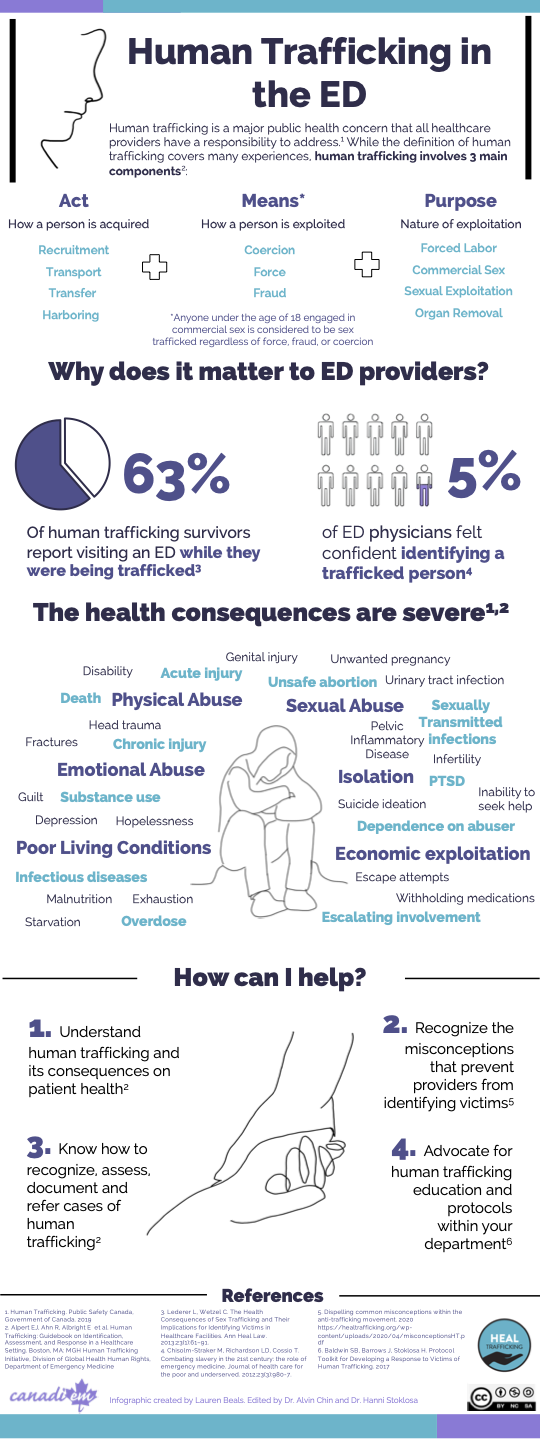
human trafficking overview infographic

Just the Facts – Human Trafficking

What is Human Trafficking?

Human trafficking always involves 3 components –an act, a means, and a purpose.

  • The “act” refers to the role a trafficker is playing in exploiting the person
  • The “means” refers to the use of force, fraud, or coercion to exploit a person
  • The “purpose” is what type of labor they are exploited for (1)

Often human trafficking will overlap with other crimes such as assault, domestic violence, rape, and child abuse (5). Of note, anyone under the age of 18 engaged in commercial sex is considered to be sex trafficked regardless of whether a means is present, as they cannot provide consent.

How many people are affected?

Human trafficking is widespread, but is often undetected, making true estimates of size difficult.

For example, human trafficking prevalence estimates may fail to account for survivors who do not recognize they are being exploited or are afraid to disclose (6, 7).

Who is trafficked?

 While no identity is spared, there are certain populations that are at greater risk. These may include:

  • People of color
  • Children in welfare and juvenile justice systems
  • Runaway and homeless youth
  • Children working in agriculture
  • Indigenous patients
  • Migrant laborers
  • Foreign national domestic workers
  • Patients with limited English
  • Patients with disabilities
  • Members of the LGBTQ community
  • Patients with limited education
  • Patients who use substances (6,8)

Why are they targeted?

The only thing all trafficked persons have in common is their vulnerability (1). Trafficking determinants can be conceptualized as “push” and “pull” factors. Push factors lead people to away from their current situation to trafficking (e.g., abuse, poverty, family conflict). Pull factors, drive an individual to something new that increases the risk of trafficking (e.g., income, housing, access to substances) (9, 10).

Who are the traffickers?

In the same way that anyone can be trafficked, anyone can be a trafficker.

Traffickers may be well known in the community, recruiting victims from places of employment or education (1). They may be a family member. They may also lure at-risk individuals by acting as a romantic partner, or by providing emotional affirmation, financial assistance, and material goods (1).

How do traffickers coerce survivors?

A number of tactics can be employed by traffickers, each tailored to the individual survivor but can include any combination of the following (1).

  • Physical violence
  • Sexual violence
  • Emotional violence
  • Withholding basic needs (food, water, shelter)
  • Intimidation
  • Coercion and threats
  • Economic coercion
  • Social isolation 

Specific situations to be wary of:

  • Runaway or homeless youth – greater incidence of “survival sex,” where sexual acts are exchanged for basic necessities (1, 11)
  • Recent immigrantswithholding documentation/ fear of deportation are used as powerful coercion tactic (1, 5, 6)

What are some of the health consequences of Human Trafficking (6)?

  • Physical abuse (traumatic injury, chronic pain)
  • Sexual abuse (sexually transmitted infections, pregnancy)
  • Emotional abuse (post-traumatic stress disorder, suicide ideation)
  • Poor living conditions (malnutrition, dehydration, exposure injuries)
  • Substance use, overdose
  • Death

10 Common Misconceptions of Human Trafficking

    human trafficking misconceptions

Click to view full-size images

Guide for Emergency Department Providers

What are the primary goals of an ED visit with a potentially trafficked patient?

  1. Address the acute presenting illness or injury
  2. Establish the ED as a haven from trauma or exploitation
  3. Offer additional resources, if appropriate and available

The goal of the visit is NOT to elicit a disclosure.

Your role as a provider is not to investigate or confirm the presence of trafficking, but to respect the autonomy of the patient in front of you, meet their healthcare needs, and empower them to seek additional support on their terms.

What steps should I take during my encounter?

  1. Capitalize on the same “trauma-informed” principles used to care for survivors of intimate partner violence and child maltreatment.
  2. Encounter tips (1, 6, 12)
    • Separate the potential victim from accompanying persons
  3. If difficult, ask the patient to move to another room for an x-ray or routine test.
    • Use a trained interpreter when required
    • Foster trust and establish rapport
    • Use education about rights and resources as an empowerment tool (12)
  4. Providing nonjudgmental education around violence and safety can normalize the sharing of information and open discussion (12)
    • Be patient
    • Always get consent before proceeding with any next steps (physical exam, diagnostic tests, and involvement of other providers)

human trafficking providers guide part 1     

Click for full-size images

Red flags For Human Trafficking (1, 13)

Patient IndicatorsCompanion Indicators
Delayed presentationRefuses to leave
Discrepancy between history and clinical presentationInsists on translating or speaking for the patient
Scripted/memorized historyControlling, interrupting
Hypervigilance, fearfulHas patient’s documents in their possession
Cannot produce identificationEmployer demanding access to medical information
Work-related injury with unsafe conditions
Fearful attachment to a cell phone (often used for communication and tracking)

Red flags for pediatric patients (1, 14)

  • Accompanied by unrelated, non-guardian adults
  • Material possessions you reasonably doubt they would be able to afford
  • Truancy or running away
  • Multiple sexual “partners”

What are the next steps after my assessment?

Any next steps should always be determined by the patient

  • Consider offering admission if unsafe to discharge
  • Clear and accurate documentation (may be relevant to future legal proceedings)
  • Consider notifying security if appropriate (6)

Unless local criteria for mandatory reporting are met, Police should only be contacted at the explicit instruction of the patient  (6, 16).

Interested in advocacy?

Consider implementing an ED and institutional protocol for human trafficking. A complete protocol guide is available through HEAL Trafficking.

References

  1. Alpert EJ, Ahn R, Albright E  et al. Human Trafficking: Guidebook on Identification, Assessment, and Response in a Healthcare Setting. Boston, MA: MGH Human Trafficking Initiative, Division of Global Health and Human Rights, Department of Emergency Medicine.
  2. Human Trafficking. Public Safety Canada, Government of Canada. 2019.
  3. Lederer L, Wetzel C. The Health Consequences of Sex Trafficking and Their Implications for Identifying Victims in Healthcare Facilities. Ann Heal Law. 2013;23(1):61–91.
  4. Viergever RF, West H, Borland R, Zimmerman C. Health care providers and human trafficking: What do they know, what do they need to know? Findings from the Middle East, the Caribbean, and Central America. Front Public Heal. 2015;3:1–9. PMID: 25688343
  5. Canada’s Human Trafficking Laws. British Columbia Public Health Agency. 2014.
  6. Shandro J, Chisolm-Straker M, Duber HC, Findlay SL, Munoz J, Schmitz G, et al. Human Trafficking: A Guide to Identification and Approach for the Emergency Physician. Ann Emerg Med. 2016;68(4):501-508.e1. PMID: 27130802
  7. Global Report on Trafficking in Persons [Internet]. New York; 2014. Available from: https://www.unodc.org/res/cld/bibliography/global-report-on-trafficking-in-persons_html/GLOTIP_2014_full_report.pdf
  8. 2021 Trafficking in Persons Report – United States Department of State [Internet]. U.S. Department of State; 2021. Available from: https://www.state.gov/reports/2021-trafficking-in-persons-report/
  9. Macias Konstantopoulos W, Ahn R, Alpert EJ, Cafferty E, McGahan A, Williams TP, et al. An international comparative public health analysis of sex trafficking of women and girls in eight cities: Achieving a more effective health sector response. J Urban Health. 2013. PMID: 24151086
  10. Calhoun C. Push and pull factors. Oxford Dictionary. Soc Sci Oxford Univ Press. 2002;
  11. Walls NE, Bell S. Correlates of engaging in survival sex among homeless youth and young adults. J Sex Res. 2011. PMID: 20799134
  12. PEARR Tool Trauma-Informed Approach to Victim Assistance in Health Care Settings. Dignity Health, in partnership with HEAL Trafficking and Pacific Survivor Center. 2019.
  13. Identifying Victims of Human Trafficking: What to look for in a healthcare setting. National Human Trafficking Resource Center. The Polaris Project.
  14. Tracy EE, Konstantopoulos WMI. Human trafficking: A call for heightened awareness and advocacy by obstetrician-gynecologists. Obstet Gynecol. 2012. PMID: 22525917
  15. Meshkovska B, Siegel M, Stutterheim SE, Bos AER. Female sex trafficking: Conceptual issues, current debates, and future directions. J Sex Res. 2015. PMID: 25897567
  16. Zimmerman C BR. Caring for Trafficked Persons: Guidance for Health Providers. Health Providers. Geneva, Switzerland: International Organization for Migration. 2009.

How I Work Smarter: Al’ai Alvarez MD

One word that best describes how you work?

Compassion

Current mobile device

iPhone 12

Computer

MacBook Pro

What is something you are working on now?

Where do I begin? The pandemic has opened doors for virtual talks and conferences, so I’m just taking it week by week sometimes. I’m also doing a fellowship, the Stanford Byers Center for Biodesign Faculty Fellowship. I’m learning how to apply design thinking to well-being interventions in the ED, and hopefully collaborating with other high-performance teams. I am also co-directing a conference in May 2022 on High-Performance Resuscitation Teams.

How did you come up with this Idea/Project?

re: High-Performance Resuscitation Teams Conference, I have been attending the Mission Critical Teams Institute summits over the past several years. We wanted to create a conference focused on healthcare and high-performance teams. I’ve had the opportunity to center my areas of interests in Medical Education, Process Improvement (Quality and Clinical Operations), Recruitment (Diversity), and Well-being (Inclusion) through human-centered design. A natural area was focusing on team performance and professionalism under stress.

What’s your office workspace setup like?

I’m in the middle of 5 people-office space. I have a plant, some snacks, and a big monitor. I haven’t been there in months. My home office is somewhat similar.

What’s your best time-saving tip in the office or home?

Paper and pen writing of big deadlines in a week. I’ve tried calendaring after learning from Dr. Jennifer Kanapicki, though I have yet to develop the discipline to do this weekly. My coach offered an alternative, which is focusing on 3 big projects a week to focus my energy. This helps me put things in perspective, as opposed to having so many loose ends, and writing it down cognitively frees up memory space for me.

What’s your best time-saving tip regarding email management?

Quick run-through in the morning, and start deleting.

What apps do you use to keep yourself organized?

On Chrome: OneTab for all my tabs. Omnifocus for my to-do stuff. My calendar is a part of my life so my calendar is an extension of my brain. When2meet to find mutual availability for meetings plus My calendar with zoom links.

How do you stay up to date with resources?

Twitter. I know.

What’s your best time-saving tip in the ED?

Eyeball patients immediately so I have a sense of who’s sick and who’s not. Talk to the nurses. They know more about the patient most of the time. For the rest, I follow the mantra, “Quality care takes time,” and I am on the faster end of the dispositions in my group, as I’ve learned to be more comfortable with managing uncertainties.

ED charting: Macros or no macros?

No macros. I also don’t chart as much as I should. I write for the sake of documenting and not for billing. I’m OK with that. We can’t do it all.

Advice

  • What’s the best advice you’ve ever received about work, life, or being efficient?

    #selfcompassion. Can’t do everything perfectly. Show up. Learn to say no. The power of perspectives. In 1 week, 1 month, 1 year, 10 years will this really matter? This grounds me on how I tackle tasks and often the emotions surrounding deadlines.

  • What advice would you give other doctors who want to get started, or who are just starting out?

    Easier said than done, practicing self-compassion has allowed me to really develop a growth mindset. To start, simply doing a daily mindfulness practice of even 5-10 minutes. This trains my mind to slow things down when things become chaotic. This also trains me to be attuned to how my body reacts to stress, and therefore, tending to it whenever I notice these sensations (neck stiffening up, etc).

  • Is there anything else you’d like to add that might be interesting to readers?

    I may be doing a ton of stuff, and in the background, I’m doing a ton more and failing. For me, the more things I’m working on that I’m truly passionate about, the more I get done. I’m OK with failure, and whenever I do (and not if I do), these offer me a great opportunity to learn how to be better (or choose better opportunities). Last and also very important, I find the collaborations bring more meaning to my work.

Read other How I Work Smarter posts, sharing efficiency tips and life advice.

By |2022-01-18T09:55:16-08:00Jan 21, 2022|How I Work Smarter, Medical Education|

IDEA Series: Escape the Snake Room

IDEA series snake room

The Problem

A snakebite from a venomous snake can result in a potentially life-threatening toxin-mediated disease (1). The WHO considers snakebites to be an important occupational disease in Southeast Asia (2). Particularly in rural areas of Pakistan, snakebites represent a common public health concern. The relatively rare nature of this condition in urban environments, however, limits exposure to it by emergency medicine (EM) residents. Thus, additional focused training is necessary to prepare EM physicians to manage snakebites in a timely and effective manner. 

The Innovation

The “Snake Room” gamification-based, timed activity teaches and assesses clinical practice essentials in the management of snakebites among EM residents. 

The Learners

The target learners were EM residents of all class years, although a similar instructional model could be applied for teaching other uncommon diseases in under-resourced settings to any relevant learner group.

Group Size

Snake Room requires 4 total facilitators (1 facilitator per station for 4 stations). Each facilitator supervises 5-7 participants in each group during the time they attempt the station, for a total of up to 28 participants and 4 facilitators. 

Equipment

This activity utilizes simple and readily available materials, including the following:

  • WHO manual of snakebite management (3): The manual is a comprehensive guide for snakebite management specifically in Southeast Asia. The manual provides management strategies for low-resource settings of relevance to rural areas of our country. The stations were therefore developed in accordance with this reference.
  • Online stopwatch: An online stopwatch was projected on a large screen. A 15-minute timer was started at the beginning of the activity for each group, and was reset before the entry of the next group. 
  • Laptops and speakers: In 2 of the sub-stations, a computer was utilized to display PowerPoint slides as a part of the activity. For example, participants had to view images on the slides and rapidly identify different grades of snake bites, as well as differentiate images of venomous snake bites from other bites (i.e., rodent bites) that patients may present in rural areas. The slides automatically cycled after every 30 seconds. The speakers played snake charmer music in order to create an auditory distraction for the participants to mimic the distracting environment of the ED. 
  • Materials for low-fidelity wound simulation
    • Red slime to mimic features of myonecrosis 
    • Clear occlusive dressings to hold the red slime in place
    • Red, orange, and yellow dry pastel to demarcate inflammation around the bite wound
    • Manikin to demonstrate the bite marks on the lower limb

Description of the Innovation

The “Snake Room” activity took place over a 3-hour period. Four groups consisting of 5-7 members participated. There were 4 stations with 4-5 sub-stations in each station. Each station incorporated gamification and competitive-learning methodology. The substations featured clinical cases, image identification, puzzles, finding the right answer card hidden in the room, and/or low-fidelity wound simulation.

Each group of participants included residents from each class year in order to mimic the team composition most commonly encountered in our clinical environment, where senior level residents supervise a team of junior residents. The activity organizers intentionally formed teams with uniformity in academic and clinical skills to create a level playing field.

Before the start of each station, facilitators also provided a briefing to the group of participants regarding the task and amount of time available to complete it. A projector displayed the time. Groups had 15 minutes to complete each station, and each group attended the stations in the sequential order. Group members had the option to utilize online and/or in-print resources in addition to recall to complete the tasks. 

Effective use of technology was assessed. One of the groups used the Google scan app to identify the key word and obtain the answer to the puzzle.

During the activity, the course director and facilitators actively assessed participant performance as they attempted to work through the stations utilizing a questionnaire with Likert scales measuring the following:

  • Knowledge of snakebite management
  • Problem-solving
  • Leadership skills
  • Communication among team members
  • Allocation of roles among team members
  • Utilization of technology (i.e., mobile devices)
  • Understanding of the task
  • Ability to finish the activity on time
IDEA series snake room completed tasks
Successful completion of the tasks and escape from the Snake Room

The group that completed all of the puzzles and stations successfully in the allotted amount of time and achieved the highest score on the assessments of leadership, task delegation, and communication skills won the competition. 

IDEA Snake Room debrief
Debriefing session with one of the groups

At the conclusion of the activity, participants completed an evaluation form to provide feedback about the activity to the faculty organizers. Participants also received feedback during a debrief session, where faculty identified gaps in knowledge and skills and provided suggestions for how to translate lessons learned to future clinical performance. Later that day, the winning group was announced and each group’s feedback was shared in a single email to all participants, allowing groups to compare their performance. 

Materials for the activity are available upon request by contacting Dr. Shahan at [email protected].

Lessons Learned

  1. The activity allowed faculty to assess core EM skills apart from medical knowledge, such as leadership and communication. EM residents had the opportunity to practice navigating team dynamics, and working in a group within a safe learning environment facilitated collegiality among junior and senior residents.
  2. The faculty who planned the activity sought feedback from participants to optimize future iterations through short-mini interviews with group participants at the end of the activity.
  3. The assessment questionnaire was developed according to local considerations and may warrant adjustment depending on the institution and location in which the activity occurs. Internal and external validation of the assessment tool is in process. 
  4. Substations require careful, intentional planning such that they focus on an isolated aspect of the main theme, such as presentation of the disease or diagnostic test interpretation. 
  5. We incorporated audio distractions to mimic the challenges inherent to the ED environment, where residents must commonly navigate complex clinical scenarios as a team amidst frequent interruptions and competing demands. Visual distractions could also be incorporated. 
  6. Simulations (low- or high-fidelity) can be introduced while planning these sessions, but it should align with the intended learning outcomes and must be appropriately timed to maintain gamification principles. 
  7. The Snake Room activity was well received by EM residents, who requested additional iterations of this activity adapted to other topics. Participants shared their general impression that this activity offers a fun, unique educational experience with a team-based approach. 

Theory behind the innovation

We successfully combined competitive-learning theory with gamification in the Snake Room didactic to result in a positive, impactful educational experience for learners (4). Teaming participants in small groups encouraged collaboration and co-construction of new knowledge in a social constructivist approach. 

Interested in reading more innovations in education?

Read other Ideas in Didactics and Educational Activities (IDEA) series posts on ALiEM.

References

  1. Alirol E, Sharma SK, Bawaskar HS, Kuch U, Chappuis F. Snake bite in South Asia: a review. PLoS neglected tropical diseases. 2010;4(1):e603. PMID: 20126271
  2. Warrell DA. Guidelines for the management of snake-bites. Guidelines for the management of snake-bites. 2010. (https://apps.who.int/iris/handle/10665/204464
  3. World Health Organization. Guidelines for the clinical management of snake bites in the South-east Asia region. 2005.
  4. Robson K, Plangger K, Kietzmann JH, McCarthy I, Pitt L. Is it all a game? Understanding the principles of gamification. Business horizons. 2015;58(4):411-20.

Apply now for the ALiEM Faculty Incubator 2021-22 Class: Scholarship and Community

ALiEM faculty incubator

Happy new year! Make one of your new year’s resolutions to accelerate your scholarly career in health professions education. The ALiEM Faculty Incubator is opening its doors to the sixth class of 30 educator-scholars. We have been thrilled by the quality of collaboration, growth, and scholarship output from this community ever since our first class in 2016. Led by Dr. Sree Natesan as the Chief Operations Officer and Dr. Antonia Quinn, Associate Chief Operations Officer, we are excited to kick off this new year.

We feature an all-star leadership team which includes Dr. Sara Krzyzaniak (Chief Academic Officer), Dr. Michael Gottlieb (Chief Strategic Officer), and Dr. Teresa Chan (Senior Advisor) along with an accomplished and academically productive mentorship community.

Read more about the application process on the Faculty Incubator home page.

The deadline is January 16, 2022.

ALiEM Faculty Incubator logo

Improving Your ED Efficiency: Upgrade This Elusive Skill

Improving Your ED Efficiency ALiEMU emergency department

No specialty in medicine requires “efficiency” more than Emergency Medicine (EM). Being able to seamlessly and quickly move between tasks is a necessary skill to function in the Emergency Department (ED). The controlled chaos and many moving parts can be overwhelming to new learners in the department and takes dedicated time and experience to overcome. Along with learning the necessary medical knowledge, efficiency expertise is crucial to becoming a high-performing emergency physician. Unfortunately, there is minimal formal training on how to maximize efficiency skills, leading many new EM learners (e.g. medical students and junior residents) having to troubleshoot and create these skills for themselves. 

ED Efficiency Themes

Research and anecdotal tips on being an efficient healthcare provider are sprinkled throughout the literature, but there are no established efficiency guidelines or consensus recommendations. Parsing through all available smattering of information in the literature, we identified 3 distinct “themes”: 

  1. Efficiency in workflow practices: This means learning skills that maximize a practitioner’s ability to see more patients throughout the shift. These skills work to help providers navigate patients quickly through the department, maintaining constant flow and maximizing resource utilization. By improving one’s workflow practices, tasks can be completed quickly and more patient’s can be seen overall.
  1. Anticipating roadblocks: Situational awareness of potential hurdles allows providers to more easily find workarounds to keep patients on a forward path. Understanding the intricacies of the health system and the functionality of a hospital allows for better anticipation and planning for future impedances to patient care and progress toward disposition.
  1. Effective team communication: Communication is an integral part of being an EM physician. By improving communication and learning to effectively work in a team, a provider can improve their overall efficiency in the department and can decrease provider mental burden. 

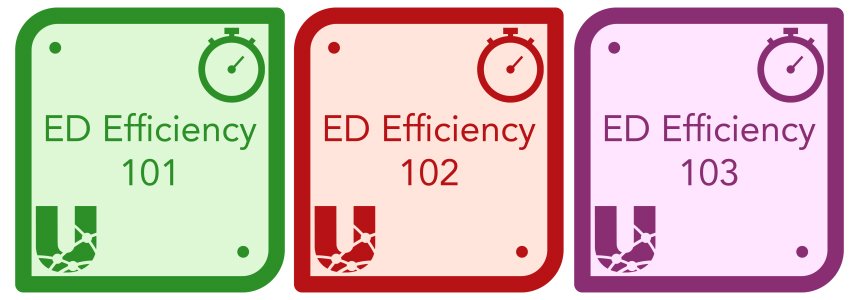
The ALiEMU 3-Course Series

As educators, we believe all skills can be taught. This includes efficiency skills. After distilling the available efficiency literature, we designed 3 courses, based on the above themes to best teach efficiency to new EM learners.

ED Efficiency ALiEMU badges emergency department

Our FREE curriculum uses the ALiEMU platform to simulate real-world scenarios, integrating the lessons in an interactive and fun way. Learners will discover strategies to optimize their time in the ED and begin their journey toward optimal efficiency. 

Examine how your ideas of efficiency fit with the strategies. These concepts may be new, or may already be a part of your EM practice. While operations vary for hospitals and EDs, the content taken as a whole represents the best practices found in the literature. These 3 themes should begin and guide your journey toward efficiency mastery. 

What are some of YOUR best tips for efficiency on shift? Contact us on Twitter (Dr. Guy Carmelli @GuyCarmelli) with any suggestions or feedback.

By |2021-12-16T14:34:48-08:00Dec 17, 2021|Academic, Life, Medical Education, Medical Student|

Teorías de la Educación en la Práctica (Education Theory Made Practical): An International Collaboration

spanish language book Teorías de la Educación en la Práctica

The vast majority of medical education materials (free or with cost) are available in the English language, a consequence of its hegemony as the language of science at a global level. In the world there are about 560 million people who speak Spanish, 460 million are native speakers, so Spanish is the language that has the second largest population of native speakers in the world after Mandarin. Although written English is understood by the Spanish-speaking community of health professionals, the best way to fully understand a text is reading it in the mother tongue!

It is therefore important to thank Teresa Chan from ALiEM and the clinical educators’ team that collaborate in the development of several texts on how to make educational theories practical, for their willingness to translate their material into other languages. The series “Education Theory Made Practical” (ALiEM Library) presents, with a simple but powerful strategy, educational clinical cases and reviews of the main educational theories for the consumption of students, resident physicians, and medical teachers around the world. These heroes and heroines of medical education have made this material available in free digital format, and with the Spanish translation of the first volume of this series (available at the Apple Bookstore and in ResearchGate) will help the community of Spanish-speaking medical educators with high-quality material for use in our countries. There is a great need for similar materials in Spanish, it is our fervent desire that the process of translation of these books continue, to help improve the quality of medical education globally.


La gran mayoría de los materiales de educación médica (gratuitos o con costo) están disponibles en el idioma inglés, consecuencia de su hegemonía como el idioma de la ciencia a nivel global. En el mundo hay cerca de 560 millones de personas que hablan español, 460 millones son hablantes nativos, por lo que el español es el idioma que tiene la segunda población de hablantes nativos en el mundo después del mandarín. A pesar de que la comunidad de profesionales de la salud hispanoparlantes entienden el inglés escrito, ¡no hay como leer un texto en la lengua materna para entenderlo cabalmente!

Es por ello importante agradecer a Teresa Chan de McMaster, Canadá y el equipo de clínicos educadores que colaboran en el desarrollo de varios textos sobre cómo hacer prácticas las teorías educativas, por su disposición para realizar la traducción de su material a otros idiomas. La serie “Teorías de la educación en la práctica” presenta, con un esquema sencillo pero poderoso, casos clínicos educativos y revisiones de las principales teorías educativas para consumo de estudiantes, médicos residentes y profesores de medicina de todo el mundo. Estos héroes y heroínas de la educación médica han puesto este material en formato digital y gratuito, y con la traducción al español del primer volumen de esta serie (disponible en la librería de Apple y en ResearchGate) ayudan a la comunidad de educadores médicos hispanoparlantes a tener un material de excelente calidad para su uso en los países hispanoamericanos. Hay una gran necesidad de materiales similares en español, es nuestro ferviente deseo que continúe la traducción de estos libros para mejorar la calidad de la educación médica en el mundo.


IDEA Series: Acute Venous Thromboembolism (VTE) Escape Room

escape room

Adult learning theory supports medical educators in moving away from long lectures with minimal engagement from the learners [1]. Core emergency medicine (EM) topics lend themselves well to interactive methods such as gamification [2]. Puzzle-based activities can successfully facilitate team building in medical education [3].

EM residents commonly encounter acute venous thromboembolism (VTE) in the ED and must know the spectrum of presentations and approach to evaluation and treatment, including the use of risk stratification calculators.

The Innovation

  • To improve teaching of acute VTE to EM residents, we created a puzzle-based activity called “Acute VTE Escape Room.” Two teams competed against each other to solve the theme case by unlocking clues with mini puzzles, similar to the format of commercial escape rooms.

The Learners

  • As this game comprised part of the intern core curriculum, all participants were interns, with the puzzles targeted to the expected knowledge base of a PGY-1 EM resident.

Group Size

  • Group size was 4-5 learners

Equipment

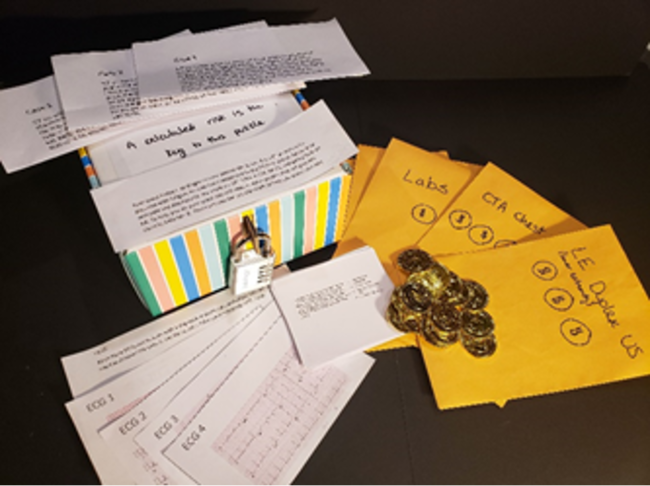
  • Box with the ability to lock it
  • Numerical padlock
  • Tokens
  • Opaque envelopes
  • Laptop or tablet
  • Printed clues, questions and theme case components (Fig 1)
  • Note: If interested in obtaining printouts used in this activity, please contact Dr. Elspeth Pearce on Twitter (@ElspethKPearce)

escape room vte IDEA series

Figure 1. Game Materials

Description of the Innovation

Interns were split into 2 groups to compete against each other and race the clock to solve the case within 45 minutes. Two senior residents, one per group, assisted with the question-and-answer portion of the game. The interns had access to smartphones during the activity, and were encouraged to utilize them to access risk stratification tools during the first mini puzzle.

A theme case of obstructive shock secondary to catastrophic thrombosis of an IVC filter [4] was presented in pieces as the teams unlocked additional components of the case. The teams were given the case stem introducing the patient, chief complaint, and vital signs. They then had to unlock a box using a 4-digit passcode. This first mini puzzle had 3 cases with risk stratification scores that could be deduced. Once they calculated the risk scores they were able to unlock the box and were given the theme case history of present illness, physical exam, and instructions for the next puzzle.

The groups then had to order diagnostic laboratory and imaging tests to further evaluate the patient described in the theme case. Results were made available for tokens, with the cost of the tests similar in scale to what patients might encounter in the ED. This corresponded to an added educational objective to teach residents about resource utilization and cost of care. Labs and ECG cost 1 token and more expensive diagnostics cost 3-5 tokens. The teams earned the tokens by answering written board exam style questions (some sourced from existing board review question banks and others written by the instructor) from volunteer senior residents. Participants received the results of the tests in envelopes after they purchased them with tokens. The envelope for the lower extremity Doppler ultrasound included an additional puzzle necessitating completion in order to obtain the results.

The final mini puzzle included 4 ECGs that could be seen in acute pulmonary embolism with four questions to answer. Participants filled in the answers in boxes. Highlighted boxes yielded a passcode required to access a PowerPoint that then revealed a video of a positive ultrasound for DVT. The interns were expected to interpret this ultrasound, apply this result to the case components they had obtained, and report the final diagnosis and treatment to the instructor. A prize was awarded to the winning team.

Both groups had 45 minutes to complete the activity, allowing the instructor roughly 10 minutes to debrief, answer questions, and deliver a brief lecture on acute VTE. After completion of the activity, the participants filled out a survey evaluating the activity.

Figure 2. Learners Solving Mini Puzzle 2


Figure 3. Learners Solving Mini Puzzle 3


Outcomes

This activity was completed in-person during the hour designated for the intern core curriculum prior to the start of the resident didactic conference. Nine out of ten (90%) interns completed the acute VTE escape room and 6 (66.7%) completed the post event survey (Fig 2). Both groups finished in the time allotted with one group requiring help from the instructor to finish on time. All participants agreed or strongly agreed that the time was used effectively, and the material was presented in a clear and organized manner. Five participants (83.3%) strongly agreed that the material was delivered in an enthusiastic and stimulating way. The comments on the activity were overwhelmingly positive: “Fun and engaging way to learn about the topic”, “I LOVED this activity and really enjoyed it! Thanks for organizing it!”

IDEA Escape Room survey results

Figure 4. Survey Results

Lessons Learned

We successfully developed this game for a small group of residents at approximately the same level of medical knowledge. Adjusting the activity to target a more heterogeneous knowledge base would allow for participation by EM residents of all levels. The questions used for obtaining tokens (mini puzzle 2) and the ECG reading (mini puzzle 3) could be adjusted to the level of learner. We would recommend small group sizes as we discovered the printouts were hard to share amongst the whole group. The debrief session at the end provided a key opportunity to address any remaining questions among learners and clarify any ongoing knowledge gaps. Both groups needed some explanation of the theme case given that it involved a rare and difficult diagnosis to make. As both groups answered some of the most difficult board review questions incorrectly, future iterations may seek to better target questions to the level of the learner.

Theory Behind the Innovation

Gamification, as described by Bíró in 2014, was used as the educational theory foundation for this escape room style activity [5]. Each learner working with a team could create their own path to the correct answers. The groups and the competitive environment provided the motivation to quickly learn and adapt to the puzzles presented. 

The debrief session at the end allowed us to address existing gaps in medical knowledge and unpack emotions experienced by participants during gameplay. Debriefing theory allows the instructors of an activity, usually simulation, to create an emotionally charged event within a safe space for learning [6]. Through the debrief, instructors can identify and address gaps in clinical knowledge uncovered during gameplay.


Read other IDEA Series innovations.

References

  1. Cooper AZ, Richards JB. Lectures for Adult Learners: Breaking Old Habits in Graduate Medical Education. Am J Med. 2017 Mar;130(3):376-381. Epub 2016 Nov 28. PMID: 27908794.
  2. IDEA Series: Toxicology Virtual Escape Room during COVID-19. Academic Life in Emergency Medicine. Accessed September 22, 2021.
  3. Zhang XC, Lee H, Rodriguez C, Rudner J, Chan TM, Papanagnou D. Trapped as a Group, Escape as a Team: Applying Gamification to Incorporate Team-building Skills Through an “Escape Room” Experience. Published online 2018. doi:10.7759/cureus.2256
  4. Pearce EK. An Uncommon Cause of Shock: Acute Thrombosis of the Inferior Vena Cava. J Emerg Med. 2021 Jul;61(1):67-69. Epub 2021 May 8. PMID: 33972133.
  5. Bíró GI. Didactics 2.0: A Pedagogical Analysis of Gamification Theory from a Comparative Perspective with a Special View to the Components of Learning. Procedia – Soc Behav Sci. 2014;141:148-151. Doi: 10.1016/j.sbspro.2014.05.027
  6. Fanning RM, Gaba DM. The role of debriefing in simulation-based learning. Simul Healthc. 2007 Summer;2(2):115-25. PMID: 19088616
By |2021-11-26T16:53:23-08:00Nov 24, 2021|IDEA series, Medical Education|
Go to Top