ALiEM Sim Case Series: Pediatric WPW

Case Writer: Nikita Joshi, MD
Keywords
Pediatrics, Syncope, Wolff Parkinson White (WPW), PALS
Educational Objectives
Medical
- Discuss a broad differential diagnosis for pediatric syncope
- Identify critical findings in pediatric EKG
- Manage WPW tachycardia
Communication
- Obtain a focused history in a pt with WPW focusing upon family history
- Communicate as an interdisciplinary team
Case Synopsis
10 yo boy BIBEMS s/p syncope. Pt was playing on the football field, running down field when he suddenly collapsed. Bystanders quickly went to the boy and within 1 minute the pt had regained consciousness without any intervention. When EMS arrived on the scene, the boy was sitting with his mother telling everyone he wanted to go back and play.Upon arrival in the ED, pt is well appearing, however had a heart rate of 180 bpm and BP of 115/80. EKG shows a wide complex tachycardia rhythm. If team gives AV nodal blocking agents, the pt will devolve into a VF rhythm, and the pt will become nonresponsive. If team administers procainamide, pt will go into a rate controlled rhythm that reveals WPW and should then be placed on a procainamide drip. If team performs cardioversion, the pt will go into a rate controlled rhythm that reveals WPW. If the team does nothing, the pt will eventually go into a ventricular fibrillation cardiac arrest.
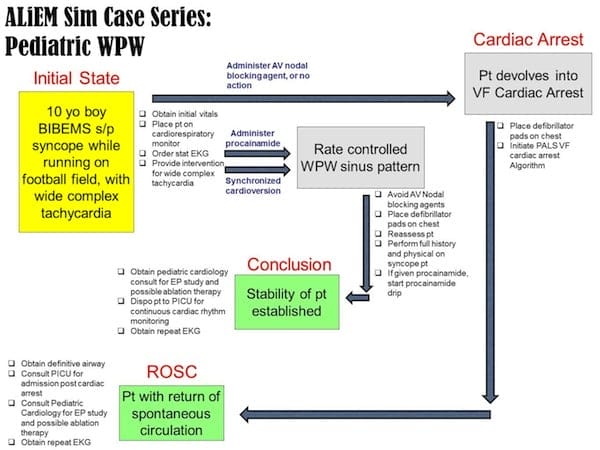
Download PDF of this flowchart
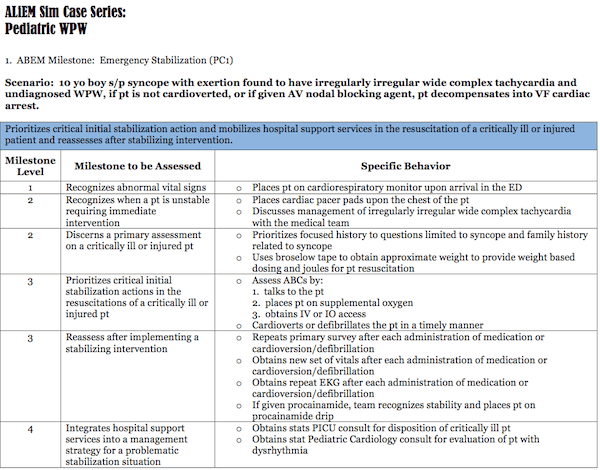
Critical Actions
- Analyze and interpret pediatric EKG for life threatening causes of syncope
- Initiate PALS for tachydysrhythmia
- Avoid AV nodal blocking agents in undifferentiated wide complex tachycardias
- Cardiovert pt early to avoid further decompensation
- Obtain family history of WPW with ablation
Learners
- Residents (EM, pediatrics)
- Nurses
- EMS providers
- Students (medical, nursing, EMS)
Location
ED resuscitation bay
Patient
Equipment
- Advanced airway equipment
- Airway adjuncts
- Broselow tape
- Cardiac monitor
- Cardioverter / defibrillator
- IV fluid
- Pediatric cardiac arrest cart
- Syringes
Moulage
- Sports clothing for manikin
Confederates
- EMS provider – Gives history of well appearing pt on the football field. They did not obtain vitals because pt was so well appearing upon their arrival.
- Mother – Unconcerned of syncopal episode, not good historian, thinks her son does not require medical care
- Nurse – Completes and executes all orders provided
- PICU attending (voice) – Discusses case with team over phone
- Pediatric cardiology attending (voice) – Discusses case with team over phone
Supporting Files / Media
- CXR – normal
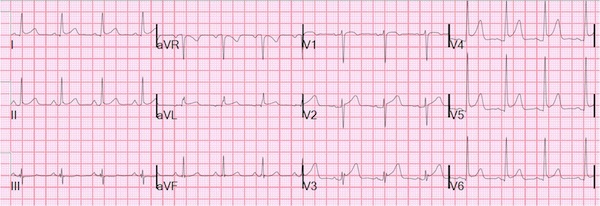
- EKG 1 – wide complex tachycardia, irregularly irregular
- EKG 2 – VF
- Echocardiography – normal, no effusion, good ejection fraction
Translation |
| AV = atrioventricular |
| BIBEMS = brought in by EMS |
| BP = blood pressure |
| CXR = chest x-ray |
| HR = heart rate |
| IV = intravenous |
| LOC = loss of consciousness |
| neg = negative |
| RR = respiratory rate |
| pt = patient |
| s/p = status post |
| T = temperature |
| WPW = Wolff Parkinson White |
| US = ultrasound |
| VF = ventricular fibrillation |
| yo = year old |
References
- Boren SD. Commotio cordis. N Engl J Med. 2010. 362(23):2229-30. PMID: 20568311
- Fischer JWJ. Cho CS. Pediatric Syncope: Cases from the Emergency Department. Emergency Medicine Clinics of North America. 2010. 28;3. PMID 20709241
- Life in the Fast Lane Blog Post: http://lifeinthefastlane.com/ecg-library/pre-excitation-syndromes/
- Mottram AR. Svenson JE. Rhythm Disturbances. Emergency Medicine Clinics of North America. 2011. 29;4. PMID 22040704


 Appendicitis is the most common pediatric surgical emergency accounting for 5% of urgent pediatric outpatient visits for abdominal pain. Computed tomography (CT) and ultrasonography (US) are two imaging modalities used in the diagnostic evaluation of acute pediatric appendicitis. Both have decreased the incidence of negative appendectomy results. It is well known that CT has greater diagnostic accuracy than US for diagnosing acute appendicitis, but there is concern over long-term cancer risk, with routine use of CT in children.