


ALiEM AIR | Renal/Genitourinary 2020 Module
 Welcome to the AIR Renal/Genitourinary Module! After carefully reviewing all relevant posts from the top 50 sites of the Social Media Index, the ALiEM AIR Team is proud to present the highest quality online content related to renal and genitourinary emergencies. 6 blog posts within the past 12 months (as of May 2020) met our standard of online excellence and were curated and approved for residency training by the AIR Series Board. We identified 1 AIR and 5 Honorable Mentions. We recommend programs give 3 hours (about 30 minutes per article) of III credit for this module.
AIR Stamp of Approval and Honorable Mentions
Interested in taking the renal/GU quiz for fun or asynchronous (Individualized Interactive Instruction) credit? Please go to the above link. You will need to create a free, 1-time login account.
Highlighted Quality Posts: Renal/GU Emergencies
| Site | Article | Author | Date | Label |
|---|---|---|---|---|
| emDocs | Complications of Nephrostomy Tubes: ED Presentations, Evaluation, and Management | Michael J. Yoo, MD | 11/11/2019 | AIR |
| RebelEM | Post Contrast Acute Kidney Injury | Salim Rezaie, MD | 1/16/2020 | HM |
| EMCrit | The Myth of Contrast Nephropathy | Josh Farkas, MD | 5/2/2019 | HM |
| EMCrit | Non-Anion Gap Metabolic Acidosis (NAGMA) | Josh Farkas, MD | 9/19/2019 | HM |
| emDocs | EM@3AM: Kidney Transplant Complications | Rachel Bridwell, MD | 12/29/2019 | HM |
| CanadiEM | Testicular Torsion | Subhrata Verma | 11/12/2019 | HM |
(AIR = Approved Instructional Resource; HM = Honorable Mention)
If you have any questions or comments on the AIR series, or this AIR renal/genitourinary module, please contact us! More in-depth information regarding the Social Media Index.
Thank you to the Society of Academic Emergency Medicine (SAEM) and the Council of EM Residency Directors (CORD) for jointly sponsoring the AIR Series! We are thrilled to partner with both on shaping the future of medical education.

 Welcome to the Renal/GU Module! After carefully reviewing all relevant posts from the top 50 sites of the
 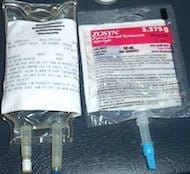 There are a few reasons why piperacillin/tazobactam (Zosyn) is not usually my first choice for a broad-spectrum gram-negative agent in the ED. First, at my institution, the Pseudomonas aeruginosa susceptibilities to pip-tazo are lower than that for cefepime. Second, pip-tazo does not have great CNS penetration, especially compared to ceftriaxone, cefepime, or even meropenem. Third, do we really need the anaerobic coverage that pip-tazo provides for every sick patient? Pip-tazo is great for empiric treatment of intra-abdominal and severe diabetic foot infections, but may not be needed for a hospital-acquired pneumonia. Fourth, with its frequent dosing (every 6 hours), too often the second dose is missed if the patient is still boarding in the ED.
 Intravenous sodium bicarbonate seems like a wonderful drug. It fixes acidosis, pushes potassium into cells, alkalinizes urine, and even helps with smelly feet. However, this literature review of four conditions casts some doubt into the seemingly cure-all that is bicarbonate.
 To provide a resource for evidence-based Emergency Medical education, this list of must-read landmark articles was created to supplement the Emergency Medicine (EM) internship year of training. There are 52 articles so that one article can be read at leisure each week of the year. I searched national databases and polled faculty at the University of Washington to identify articles that faculty would expect any EM resident to be familiar with or that they felt were practice-changing in EM. Articles were selected for the final list based on the quality of study design, sample size, and relevance for EM residents.