


Trick of the Trade: IV ceftriaxone for gonorrhea
How many times have you given your patient IM ceftriaxone for that presumed gonococcal infection? ... still counting? Many of us learned (or at least thought we learned) that ceftriaxone has to be administered IM to get the ‘depot’ effect. Myth Busted There doesn't appear to be a true depot effect. IV and IM ceftriaxone have very similar pharmacokinetic profiles. Let me prove it to you, straight from the FDA-approved ceftriaxone package insert. Ceftriaxone route 0.5 hr 1 hr 2 hr 4 hr 6 hr 8 hr 12 hr 16 hr 24 hr IV 82 59 48 37 29 [+]
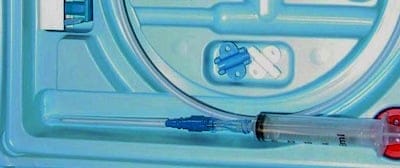
Trick of the Trade: Don’t miss the pneumothorax in needle thoracostomy
A patient arrives in PEA arrest and you note that her left chest has no breath sounds or lung sliding on bedside ultrasound. You suspect a tension pneumothorax. You insert a standard 14g angiocather in the left 2nd intercostal space (ICS). You don’t hear a rush of air. The patient’s clinical condition deteriorates to impending asystole. How sure are you that your angiocatheter actually reached the pleural space? [+]

Mythbuster: Pediatric coin ingestion vs aspiration?
Is this coin in the esophagus or the trachea? The classic teaching for the Boards exam is: Esophageal coins appear in the coronal plane, as shown above. Tracheal coins appear in the sagittal plane because of the cartilaginous tracheal rings. [+]
Trick of the Trade: Safer guidewire disposal
Have you ever accidentally flicked a drop of blood while disposing a straight guidewire into a rectangular sharps bin? The bins just don’t quite fit the wire easily. That’s just an occupational exposure just waiting to happen to yourself. [+]
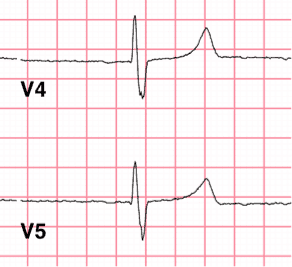
PV Card: Electrolytes and ECG changes
The electrocardiogram can pick up all sorts of electrolyte abnormalities. The most common abnormalities revolve around high and low levels of potassium and calcium. Magnesium derangements typically have nonspecific findings. How do you keep things straight? To make things more complicated, multiple electrolyte derangements can occur at the same time, making ECG interpretation challenging. [+]
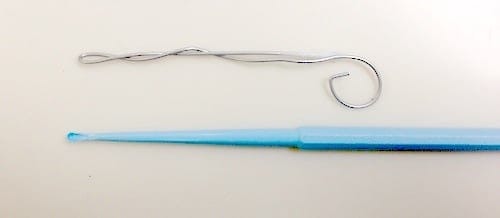
Trick of the Trade: A flexible pediatric ear curette
Having you had trouble seeing a pediatric patient’s tympanic membrane because of impacted cerumen? Scared from that last time you used a rigid curette and caused bleeding in the ear canal? The parents are worried that you hit the brain… [+]
Paucis Verbis: EMTALA rules in the transfer of ED patients
In U.S. academic emergency departments, decisions to accept patients is typically easy, because you have ready access to on-call physicians. When in doubt, accept transfer patients and sort things out later. What are the obligations for those transferring patients to other EDs? What do the EMTALA (a.k.a. "anti-dumping") rules say? When can you transfer unstable patients? As a general rule, the liability falls upon the transferring site and physician. So be sure that your patient won't decompensate in the ambulance during transfer. So, don't transfer that CP patient who is getting ruled-out for an MI or ACS no matter how good [+]

Tricks of the Trade: Calcium gel for hydrofluoric acid burns
A 41 y/o m presents to your ED after an occupational exposure to 30% hydrofluoric acid (HF). The thumb and index finger of his right hand were affected. Upon visual examination, the site of exposure looks relatively benign but the patient is complaining of extreme pain. Beyond giving opioids, what can you do? [+]
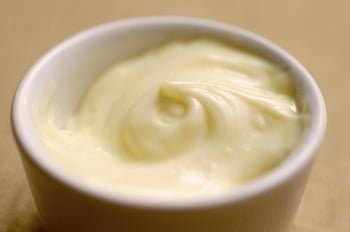
Trick of the Trade: Pass the mayo – getting off black tar
Industrial accidents sometimes involve hot coal tar stuck to a patient’s skin. Coal tar is notoriously challenging to remove once it has cooled and adhered to the skin. The tradition teaching is to apply large quantities of petroleum jelly to the black tar, let it sit for at least 60 minutes, and then diligently try to rub away the tar. Repeat as needed. What if you don’t have any petroleum jelly or petroleum-based products? [+]

Paucis Verbis: Delayed sequence intubation
A 40-year-old man presents with significant agitation and severe respiratory distress from a COPD exacerbation. His oxygen saturation is 75% on room air, and he has diffuse, tight wheezes on exam. You prepare to intubate the patient using a rapid sequence induction protocol: etomidate, succinylcholine, 8-0 endotracheal tube. Or do you? This pocket card discusses the delayed sequence intubation (DSI) protocol made famous by Dr. Scott Weingart and Dr. Rich Levitan.1 Thanks to Dr. Michelle Reina (EM resident at Univ of Utah) and Dr. Rob (Intermountain Medical Center in Utah) for designing this helpful card. Rob has even implemented a DSI protocol in [+]

Director of Growth, Strategic Alliance Initiative, Center for Innovation and Digital Health
Massachusetts General Hospital;
Chief Scientific Officer, Conductscience.com
Latest posts by Shuhan He, MD (see all)
- The Discharge Severity Index: Early Research on ED Readmission Risk Assessment - August 14, 2025
- Suboxone and the Emergency Physician: Get Waivered Training - August 12, 2022
- A Tale of Two Epidemics: COVID-19 and the Opioid Crisis - April 23, 2020