


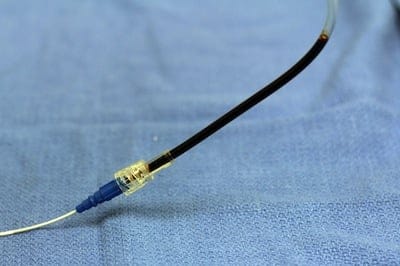
Trick of the Trade: Use the angiocatheter for central lines
Central lines come packed with a long introducer needle (pink arrow) to feed the guidewire through AND a long angiocatheter (yellow arrow). Most people cannulate the vein by using the syringe and the introducer needle. What’s the angiocatheter for? [+]

PV card: Bell’s Palsy Treatment
Bell's Palsy is an idiopathic unilateral facial nerve paralysis. Since the 2009 Cochrane review1 showing that antivirals added no benefit to corticosteroids in Bell's Palsy, I stopped prescribing them. The NNT.com site has concluded the same. Looking at the literature a little more, the recommendations are a little murkier. Some groups are still advocating for antivirals for severe cases, because there may be a very small but questionably positive benefit. "Because of the possibility of a modest increase in recovery, patients might be offered antivirals (in addition to steroids) (Level C). Patients offered antivirals should be counseled that a benefit from antivirals has [+]

Trick of Trade: Umbilical foreign body removal
Emergency physicians are constantly challenged with fishing foreign bodies out of various orifices such as ears, as shown here in an earlier Trick of the Trade using a tissue adhesive. What do you do when an overweight person presents with the cotton portion of a Q-tip lodged in his umbilicus? Skin retractors and direct probing were unsuccessful in removing the cotton. [+]
Patwari Academy videos: Searching the literature to answer Qs
Do you use a PICO method to answering a clinical question using the medical literature? Patient / problem Intervention Comparison Outcome This two-part series provides an introduction in how to search the medical literature to answer your clinical question. This provides a concise overview of epidemiology and statistics. [+]
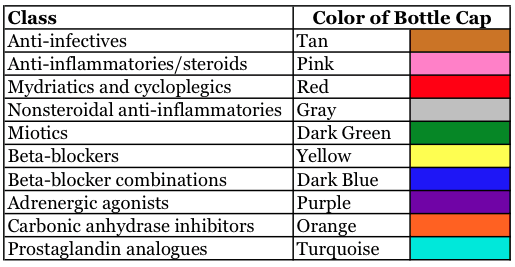
Trick of the Trade: Recognizing eyedrop bottles by color
Have you ever wondered why prescription eyedrops have different color bottle caps? Did you know that the American Academy of Ophthalmology (AAO) has a policy to color-code topical ocular medication bottles caps? Why was this needed? “The Academy’s policy on color coding of eyedrop drug caps was prompted by reports to the Academy and the National Registry of Drug-Induced Ocular Side Effects of serious adverse events resulting from patient difficulty in distinguishing between various ocular medications. With input from the pharmaceutical industry and the Food and Drug Administration (FDA), the Academy’s Committee on Drugs developed a uniform color-coding system.” — AAO policy [+]
Patwari Academy videos: Pediatric head injury – To CT or not?
When would you obtain a CT for a pediatric patient who sustained a head injury? Watch this nice 11-minute video review by Dr. Raul Patwari, discussing the 2009 Lancet PECARN study. [+]

Director of Growth, [+]
Dexmedetomidine (Precedex) as an Adjunct to Benzodiazepines for Ethanol Withdrawal
Sometimes a question is posed on Twitter that generates a great discussion from colleagues ’round the globe. Such was the case for dexmedetomidine. Although benzodiazepines remain the standard of treatment for ethanol withdrawal, particularly seizures and delirium tremens, what’s all the hype about dexmedetomidine? [+]

Trick of Trade: Needle foreign body removal
An IV drug user accidentally breaks off a 25-gauge needle in his/her forearm and presents to your ED for needle foreign body removal. How can you minimize the degree of trauma to the patient? How can you minimize the number of incisions made in order to find and remove this “needle in a haystack”? [+]
Patwari Academy videos: Toxicology
What is your approach to the poisoned patient? Listen to these 4 videos by Dr. Rahul Patwari to build your foundation of knowledge in toxicology. Introduction Toxidromes Testing Decontamination [+]
Director of Growth, Strategic Alliance Initiative, Center [+]

PV card: VBG versus ABG
You obtain a venous blood gas (VBG) on a patient with a COPD exacerbation because you are concerned about hypercarbia. You get a value of 55 mmHg. How correlative is that compared to an arterial blood gas (ABG). There has been a lot of literature on how well the pH correlates between the ABG and VBG but what about pCO2? A small study (n=89) from 20121 found that with a cutoff of pCO2 < 45 mmHg, the venous pCO2 is 100% sensitive in ruling out arterial hypercarbia. When the pCO2 was ≥ 45 mmHg, the VBG was less correlative. Below is [+]
Director of Growth, Strategic Alliance Initiative, Center for Innovation and Digital Health
Massachusetts General Hospital;
Chief Scientific Officer, Conductscience.com
Latest posts by Shuhan He, MD (see all)
- The Discharge Severity Index: Early Research on ED Readmission Risk Assessment - August 14, 2025
- Suboxone and the Emergency Physician: Get Waivered Training - August 12, 2022
- A Tale of Two Epidemics: COVID-19 and the Opioid Crisis - April 23, 2020