



Teaching internationally: More than just a language barrier
I recently traveled to San Salvador to help teach a pediatric and adult ultrasound course. The course was well received and it was wonderful traveling around San Salvador. I wanted to share some of our experiences, and discuss some challenges to educating internationally. More importantly, I want to engage you, the readers to share some of your experiences when educating internationally as well. [+]

Is the 6-12-12 adenosine approach always correct?
The ACLS-recommended dosing strategy of 6 mg, 12 mg, and 12 mg for adenosine may not be appropriate in every situation. There are a few instances when lower or higher dosing should be considered. Caveat: All recommendations are data-based, but many factors affect successful conversion of paroxysmal supraventricular tachycardia (PSVT) including proper line placement and administration technique. [+]
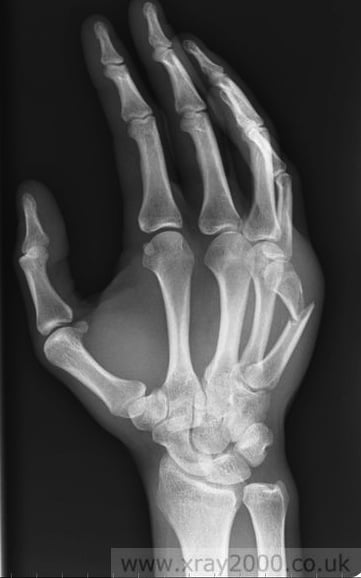
Poll: How would manage a metacarpal fracture in the ED?
I am in the process of creating a PV card on metacarpal fractures, divided into anatomical areas (base, shaft, neck, head), and am realizing that the EM and orthopedic literature don’t quite agree. Actually they are quite vague on whether reductions should occur in the ED vs orthopedics clinic in the next few days. Do you need to close-reduce all angulated fractures in the ED, which are outside of “acceptable” angulations? What exactly are “acceptable” angulations? Some sources say that angulations of 10, 20, 30, and 40 degrees are acceptable for MC neck fractures and only 10, 10, 20, and [+]
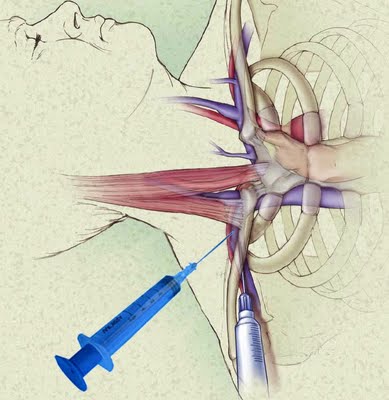
Trick of the Trade: Ultrasound-guided supraclavicular central line
Subclavian central lines are commonly touted as the central line site least prone to infection and thrombosis. The problem is that they are traditionally performed without ultrasound guidance. They are done blindly because of the transducer’s difficulty in getting a good view with the clavicle in the way. [+]
Patwari Academy videos: ACLS (parts 4-6)
Below are the next 3 video installments of Dr. Rahul Patwari’s digital whiteboard talks on ACLS. These videos cover: Cardiac arrest (Vfib and Vtach) Cardiac arrest (More of Vfib and Vtach) Cardiac arrest (Asystole and PEA) I love that each video is less than 15 minutes long. Also, even if you aren’t a medical student, these are great refreshers. For instance, don’t forget that atropine is no longer on the 2010 ACLS algorithm for asystole. [+]

Trick of the Trade: Sterile cover for linear ultrasound probe
You decide to use ultrasonography to help you establish peripheral IV access for and obtain blood cultures from your patient. How can you ensure that you get a sterile sampling to avoid blood culture contamination? Do you need to open a full central-line ultrasound probe cover? [+]

Losing faith in evidence-based medicine: Etomidate and sepsis
In an era where evidence-based medicine is the goal, it is vitally important for practitioners to understand how to prioritize and interpret the onslaught of data coming at us. This fact was driven home for me with a recent publication. Several weeks ago an article was published in Critical Care Medicine entitled “Etomidate is associated with mortality and adrenal insufficiency in sepsis: A meta-analysis.”The point of this post is not to debate if etomidate should be used to intubate septic patients. Etomidate very well may kill people with sepsis. I just don’t know from the data currently available. Using this meta-analysis [+]
Patwari Academy videos: ACLS and the Airway
This videos below include a 2-minute introductory video on the ACLS video and the first 2 (Airway) of 11 video discussions on different components of ACLS. [+]

Director of Growth, Strategic Alliance Initiative, Center for Innovation and [+]

PV card: PE Severity Index (PESI) score
Do you send some of your low-risk patients with pulmonary embolism home? This is a controversial issue which warrants a look at risk stratification tools. The primary one used is the validated Pulmonary Embolism Severity Index (PESI) score. In Lancet 2011, the authors looked at whether PESI class I and II (low risk) patients could be managed safely as outpatients. It turns out in their study, regardless of whether their PESI class I and II patients were treated as outpatients and inpatients, all fared equally well from a complications standpoint (recurrent clot, bleeding from anticoagulation). I like the validated PESI [+]
Take the quiz: Do you know your antihypertensive agents?
Identify the antihypertensive agent: 1. Rapid acting systemic and coronary artery vasodilator with minimal effects on cardiac conductivity or inotropy. Well studied in pregnancy. Caution in patients with left ventricular failure, liver cirrhosis Answer: Nicardipine 2. Predominantly dilates the venous system. Useful in patients with cardiac ischemia, pulmonary edema, or congestive heart failure. Caution in patients with right ventricular failure Answer: Nitroglycerin 3. Drug of choice in eclampsia, pre-eclampsia, and aortic dissection. Contraindicated in patients with congestive heart failure and heart block Answer: Labetalol 4. Decreases peripheral vascular resistance and increases collateral coronary blood flow in an uncontrolled and unpredictable manner and [+]
Director of Growth, Strategic Alliance Initiative, Center for Innovation and Digital Health
Massachusetts General Hospital;
Chief Scientific Officer, Conductscience.com
Latest posts by Shuhan He, MD (see all)
- The Discharge Severity Index: Early Research on ED Readmission Risk Assessment - August 14, 2025
- Suboxone and the Emergency Physician: Get Waivered Training - August 12, 2022
- A Tale of Two Epidemics: COVID-19 and the Opioid Crisis - April 23, 2020