


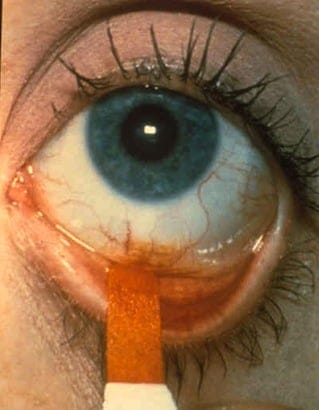
Trick of the Trade: Fluorescein eyedrops
This is a guest post by Dr. Ian Brown (Stanford): The Roberts textbook describes the procedure of corneal fluorescein staining as touching a moistened fluorescein strip to the cornea. Maybe it is an irrational fear of a paper cut to the sclera, or a fear of touching an already abraded cornea with the paper, but I try to find an alternative. I have seen physicians hold the eye open with one hand, hold the fluorescein with a second hand and then drip tetracaine on the paper and let it drip into the eye with a third hand. I, unfortunately, only [+]
Modern EM: Case 1 and 2 – Strep Throat
A sister and brother, aged 7 and 14, respectively present with pharyngitis. The 7F has sore throat, cough, fever, and post-tussive vomiting for 1 day. She has posterior pharyngeal erythema, no lymphadenopathy, no exudate, no petechiae, and looks like a viral URI. The 14M had culture confirmed GAS pharyngitis 3 weeks ago, was treated with PCN-VK and symptoms resolved. Now, he’s in the ED with signs and symptoms of pharyngitis again, including dysphagia, fever, cough, posterior pharyngeal erythema, swollen tonsils, LAD, and petechiae on his hard palate. [+]
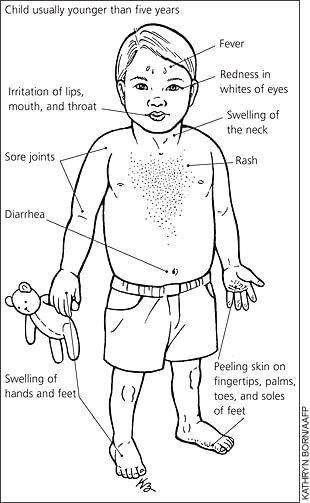
Paucis Verbis: Kawasaki Disease
Kawasaki Disease can be easy to diagnose when you have the pediatric patient, who presents with all 5 of the classic clinical findings. What happens when you have the prerequisite fever for ≥5 days, but only 2-3 clinical criteria? What ARE the 5 classic findings? When do you do waitful watching? When do you perform an echo? When do you treat empirically? Check out the nice flowchart below which addresses these questions. They summarize the most recent (2004) American Heart Association's consensus group's recommendations. PV Card: Kawasaki Disease (AHA 2004) Adapted from [1] Go to ALiEM (PV) Cards for more [+]
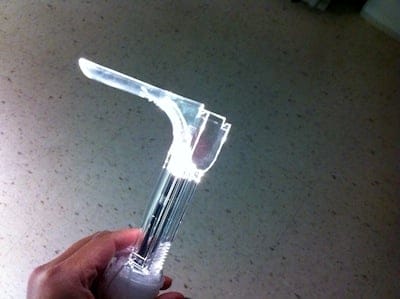
Trick of the Trade: Pelvic speculum for peritonsillar abscess
Peritonsillar abscess drainage in the ED continues to be one of my favorite procedures to perform. There are several tricks to increase your chances for a successful aspiration. One trick involves using a curved laryngoscope to help depress the tongue AND provide a bright light source. What if you don’t have a laryngoscope readily available? [+]
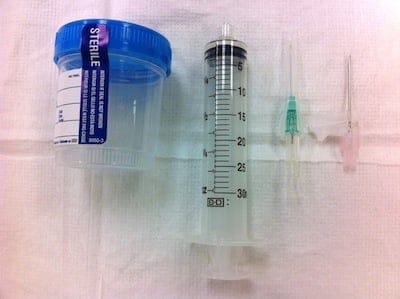
Trick of the Trade: Irrigation fluid is key – but not in your eye!
High pressure irrigation of wounds is critical in reducing the rate of wound infection. There are a variety of commercial irrigation kits which include splash guards. If you are irrigating correctly and generating at least 8 PSI of pressure, some irrigation fluid should splash up and out of the wound. Be careful not to splash irrigation fluid in your eyes. What if you don’t have a commercial irrigation setup? [+]

Paucis Verbis: Continuous Infusions
I have always been envious of the residents who carry around the Continuous Infusions cheat-sheet card, which was created by the UCSF Critical Care Units as part of a campaign for Safe Medication Prescriptions. I want one! So I finally managed to wrangle one away for a few minutes and xerox copy it. Here is the abbreviated card, after paring down the list to just ED-focused medications. PV Card: Continuous Infusions Go to ALiEM (PV) Cards for more resources.
Trick of the Trade: Another magnet trick for metallic FB removal
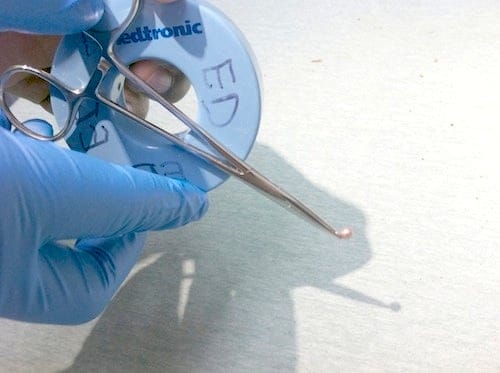
Last week, I talked about the use of Rare Earth Magnets for removing metallic foreign bodies. Sometimes a straight magnet though isn’t quite strong enough to grab a metallic foreign body. If only you had a small magnetic hemostat. This week Dr. Catherine Perry (Culpepper Memorial Hospital) and Dr. Kolapo DaSilva (PGY-2 at UVA) emailed me with a creative solution. They encountered a patient with a BB pellet lodged deeply in the soft tissue. Small mosquito clamps couldn’t get around the BB. A cardiac magnet alone caused the BB to tent the skin up. [+]
Trick of the Trade: Rare earth magnets for metallic FB removal
A child presents to your Emergency Department with a small button battery up her nose. Your usual tricks fail: Occluding the other nostril and having the mother blow in the patient’s mouth forcefully. Using a small curette or forceps to scoop or pull it out. [+]
Paucis Verbis: Anaphylaxis
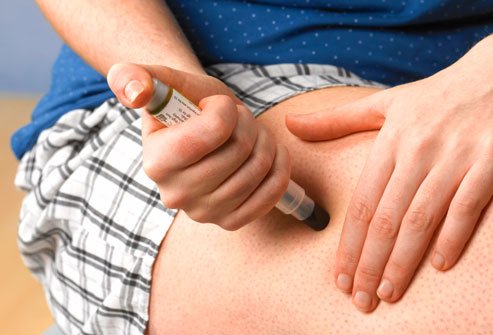
Anaphylaxis is one of the most under-appreciated and under-treated conditions in the Emergency Department. A common misperception is that you need hypotension to diagnose it. Below is a brief summary of the diagnostic criteria and ED treatment protocol. Immediate administration of IM epinephrine is critical. A major challenge is deciding which patients can go home and which need to be admitted, because of the risk of "rebound" or a biphasic anaphylactic response. This may occur as late as 72 hours later, but typically occur within the first 24 hours. There isn't a good answer for this. What's your practice in [+]

Paucis Verbis: Pediatric fever without a source (3 mo-3 yr)
In part 3 of this "Pediatric Fever Without a Source" Paucis Verbis cards, we now cover febrile infants 3 months to 3 years old (PV cards for birth-28 days and 29 days-3 months old). Notes: The algorithm below is a guideline for NON-toxic patients. More ill-appearing children require a more broad workup. For the under-immunized (<2 PCV immunizations) and temperature ≥39.5C, blood cultures may be falling out of favor in the near future, because the incidence of blood culture contaminants is close to exceeding the true incidence of occult bacteremia. PV Card: Pediatric Fever Without a Source (3 Months-3 Years) Go [+]

Director of Growth, Strategic Alliance Initiative, Center for Innovation and Digital Health
Massachusetts General Hospital;
Chief Scientific Officer, Conductscience.com
Latest posts by Shuhan He, MD (see all)
- The Discharge Severity Index: Early Research on ED Readmission Risk Assessment - August 14, 2025
- Suboxone and the Emergency Physician: Get Waivered Training - August 12, 2022
- A Tale of Two Epidemics: COVID-19 and the Opioid Crisis - April 23, 2020