


AIR-Pro Series: Critical Care (part 2) Module
Welcome to the Critical Care (Part 2) Block! Below we have listed our selection of the highest quality posts related to 4 advanced level questions on critical care topics posed, curated, and approved for senior residents by the AIR-Pro Series Board. The blogs relate to the following questions: Advanced ventilatory management Submassive pulmonary embolism management Hypotensive intubation End of life discussion AIR Stamp of Approval and Honorable Mentions In an effort to truly emphasize the highest quality posts, we have 2 subsets of recommended resources. The AIR-Pro stamp of approval will only be given to posts scoring above a strict scoring cut-off of ≥28 points (out [+]
AIR Series and AIR-Pro Series are moving to ALiEMU!
The ALiEM Approved Instructional Resources (AIR) and AIR-Pro series are moving from this ALiEM blog, which uses embedded Google Forms for quizzes into our custom learning management system called ALiEMU. ALiEMU will be our one-stop system for asynchronous learning. For U.S. EM residency programs, this will also serve as a central repository for Individualized Interactive Instruction (III) resources for asynchronous conference credit. The cornerstone e-course already on ALiEMU is CAPSULES — a comprehensive EM pharmacology curriculum, whose authorship and editorial team is led by Dr. Bryan Hayes. For the AIR and AIR-Pro series, we have over 80 U.S. EM residency programs, 4 international EM programs, and 1 PA [+]
AIR Series: Orthopedics Upper Extremity Module (2016)
Welcome to the Orthopedics Upper Extremity Module! After carefully reviewing all relevant posts from the top 50 sites of the Social Media Index the ALiEM AIR Team is proud to present the highest quality orthopedic upper extremity content. Below we have listed our selection of the 14 highest quality blog posts within the past 12 months (as of March 2016) related to orthopedic upper extremity emergencies, curated and approved for residency training by the AIR Series Board. More specifically in this module, we identified 2 AIRs and 12 Honorable Mentions. We recommend programs give 5 hours (just over 20 minutes per [+]
AIR Series: Orthopedics Lower Extremity Module (2016)
Welcome to the Orthopedics Lower Extremity Module! After carefully reviewing all relevant posts from the top 50 sites of the Social Media Index the ALiEM AIR Team is proud to present the highest quality orthopedic lower extremity content. Below we have listed our selection of the 3 highest quality blog posts within the past 12 months (as of March 2016) related to orthopedic lower extremity emergencies, curated and approved for residency training by the AIR Series Board. More specifically in this module, we identified 1 AIRs and 2 Honorable Mentions. We recommend programs give 1 hour (20 minutes per article) of III [+]
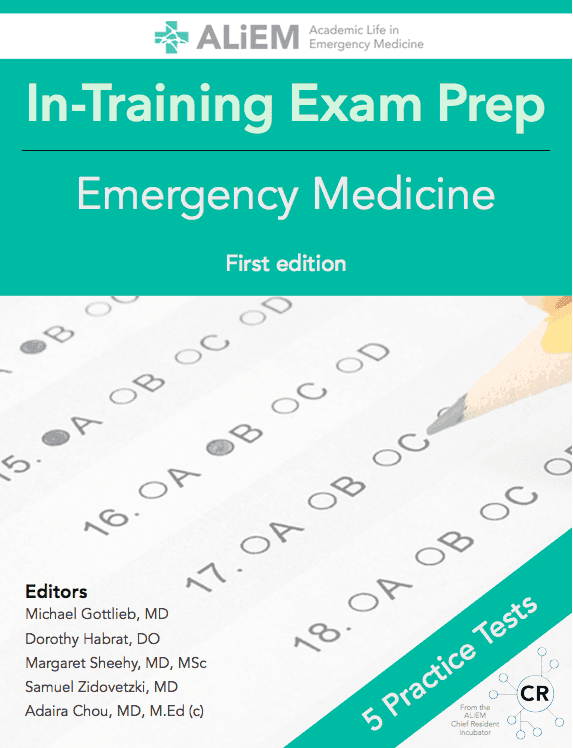
Free ALiEM In-Training Exam Prep Book is now published
It is with great pleasure that we announce the first edition of the ALiEM In-Training Exam Prep Book in both PDF and iBook form. This free book was a year-long project from the Chief Resident Incubator, led by the Editors Dr. Michael Gottlieb, Dr. Dorothy Habrat, Dr. Margaret Sheehy, Dr. Samuel Zidovetsky, and Dr. Adaira Chou with the support of Associate Editors Dr. Nikita Joshi and Dr. Michelle Lin. Over 90 EM residents and faculty from the Incubator and across U.S. emergency medicine residency programs contributed board-review type questions. Five practice tests are included for those preparing for the in-training exam (also known as the in-service exam) or even [+]

Lumbar Puncture on an Anticoagulated Patient in the Emergency Department: Is it safe?
The lumbar puncture (LP) procedure is commonly performed in the Emergency Department (ED). While minor complications of LP such as post-procedure headache or back pain occur somewhat regularly, significant complications such as post-procedural spinal hematomas, are rare.1 Despite their low incidence, these spinal hematomas are associated with a significant amount of morbidity for the patient and increased medicolegal risk for the provider. [+]

Top 10 Secrets to Success as an Emergency Medicine Resident
So you are about to start your first year as an Emergency Medicine (EM) resident in a few short weeks. Or perhaps you are entering a new, more senior resident role in your department. You are probably unsure of what to expect, a bit anxious, but definitely excited to start. As part of a multi-institutional initiative launched by the ALiEM Chief Resident Incubator, chief residents from across the country pooled together what they wanted residents to know to become an amazing resident. After compiling the responses, we came up with these “Top 10 Secrets to Success as a EM Resident”. [+]

Ultrasound For The Win! – 63M with an Erythematous Abdomen #US4TW
Welcome to another ultrasound-based case, part of the “Ultrasound For The Win!” (#US4TW) Case Series. In this case series, we focus on a real clinical case where bedside ultrasound changed the management or aided in the diagnosis. In this case, a 63-year-old man presents with a painful, warm, and erythematous area of his abdomen. [+]

MEdIC Series: Case of the Terrible Code – Expert Review & Curated Commentary
The Case of the Terrible Code outlined a scenario where a resident observed a resuscitation that was not going well. Should he intervene even though the code leader was an attending? How? This month the MEdIC team (Brent Thoma, Sarah Luckett-Gatopoulos, Tamara McColl, Eve Purdy, John Eicken, and Teresa Chan), hosted a discussion around these questions with insights from the ALiEM community. We are proud to present to you the Curated Community Commentary and our 3 expert opinions. Thank-you to all our participants for contributing to the very rich discussions last week. [+]
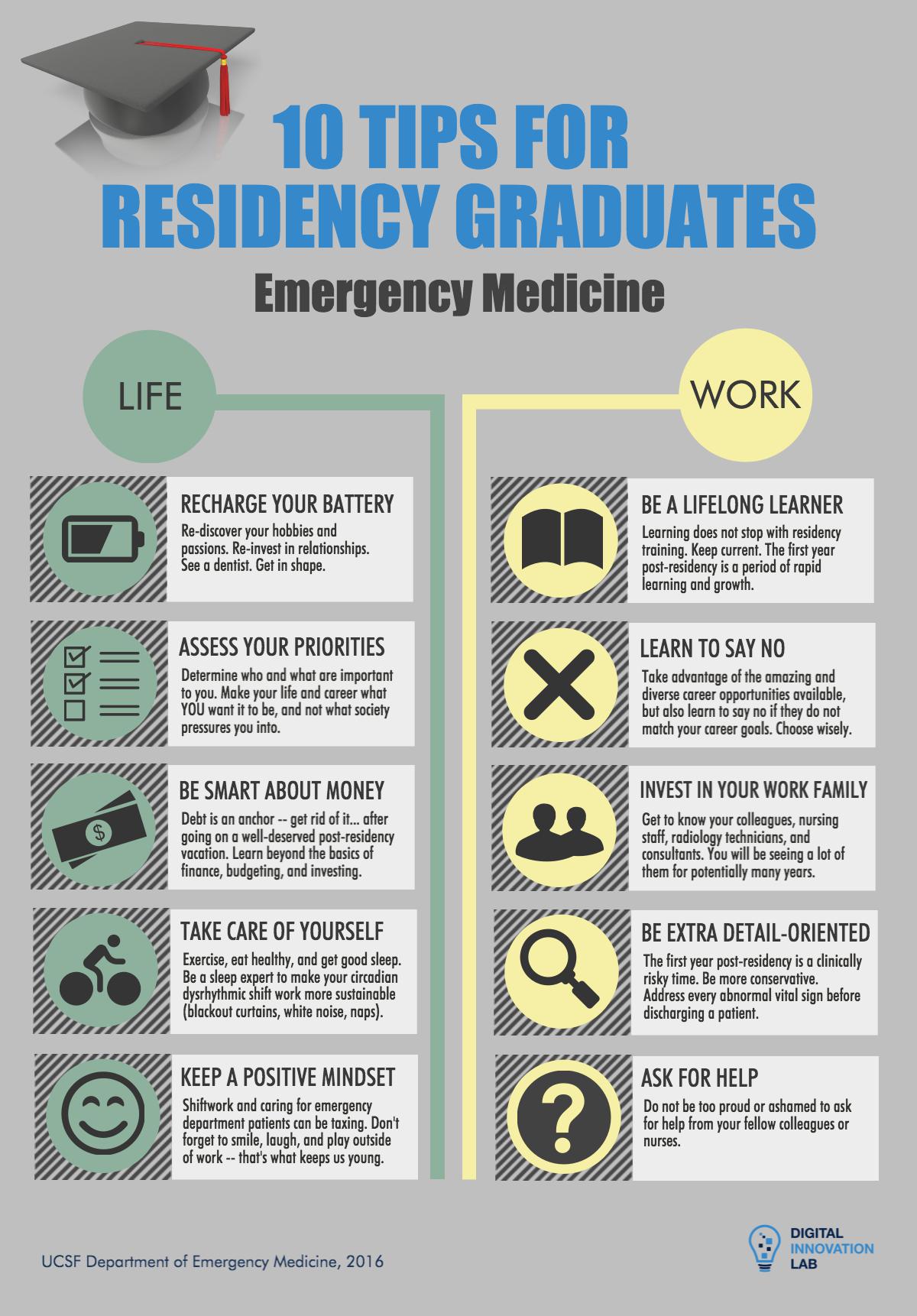
10 Life and Work Tips for EM Residency Graduates
Congratulations to the Class of 2016 graduating class of emergency medicine residents! It is the end of a chapter and a beginning of another. For those of us practicing medicine for so many years, there are many things that we would have done differently… especially in that first year post-residency. In the following infographic, we present crowdsourced reflections and advice for residency graduates from the the UCSF Department of Emergency Medicine faculty. [+]