



Trick of the Trade: Hair tourniquet release
A 3 month old baby presents with distal erythema and swelling of one of her toes. A hair tourniquet is identified. Typically one can try manually unwrapping the tourniquet using forceps, but often only part of the tourniquet can be removed. The distal toe remains swollen and erythematous with delayed capillary refill. As demonstrated by the image above, it can be difficult to identify the hair because of the edema and the thin nature of the hair (especially if the same as the patient’s skin color). In a 2006 review of hair tourniquets in the Annals of Plastic Surgery, they [+]

Paucis Verbis: Approach to increased osmolal gap
We often talk about calculating the anion gap in the evaluation of patients. What about the osmolal gap? When do you calculate this? What's the differential diagnosis for an increased gap? I recently came upon a nice 2011 review in the American Journal of Kidney Disease called "Approach to the evaluation of a patient with an increased serum osmolal gap and high-anion-gap metabolic acidosis". It's always nice to revisit and review this concept. You'll always learn something new. For instance, I didn't know that salicylates cause anion gaps as well as osmolal gaps. So don't forget to calculate an osmolal gap [+]
Survey: Why do you use Twitter?
I recently got a comment on the blog asking why people need to use Twitter, if they're already following blogs. I thought I would open this up to the blogosphere. I personally use my Twitter account (@M_Lin) for a variety of reasons: I tweet the link to my blog whenever there is a new post (I just tweeted a link to this post!) Scan quick, real-time information from clinicians I trust Know "what's hot" in EM, medical education, and education technologies Learn of new blogs and websites which I didn't know about Quickly check tweets on-the-fly on my iPhone during [+]
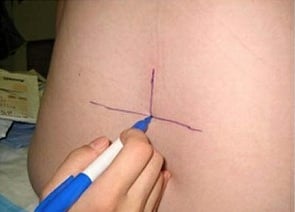
Trick of the Trade: Mark your sites with a Sharpie
Marking the surface anatomy for procedures can significantly increase your chances for success, such as for lumbar punctures and central lines. I can never seem to find surgical skin markers. [+]

Director of Growth, Strategic Alliance Initiative, [+]

Twitter conference notes: High Risk EM and Gaming Symposium
Yesterday, I attended two fantastic conferences and so wasn’t able to make a new Paucis Verbis card: UCSF High Risk Emergency Medicine UCSF Gaming and Learning Symposium [+]
Director of Growth, Strategic Alliance Initiative, Center for Innovation [+]

Trick of the Trade: Ear foreign body
Sometimes classic techniques need to be revisited, especially when I get new photos from the collective readership. Let’s review a painless way to remove beads from the ear canal. You can’t exactly have the patient’s provider blow in the other ear to expulse the bead, similar to a nasal foreign body… [+]
Paucis Verbis: Upper GI bleeding
Do you know what the Blatchford clinical prediction score is for upper GI bleeding? It can help you predict whether a patient with an upper GI bleed is severe and requires urgent intervention. Hot off the presses, JAMA just came out with a great Clinical Rational Examination article on this topic. Thanks to Dr. Ryan Radecki (EMLitOfNote) for the heads up. The likelihood ratios and Blatchford risk stratification score are so useful that I'm breaking my PV rule to keep things down to the size of one index card. Note the absence of a NG lavage result to help you [+]

KidsCareEverywhere-Vietnam study findings: SAEM 2012 meeting
I recently had the pleasure of presenting our KidsCareEverywhere-Vietnam team's study findings at the national SAEM meeting in Chicago. Bottom line Despite knowing English as a second language, Vietnamese physicians were able to easily navigate an English-based, clinical decision support software (PEMSoft) after only a brief 80-minute training session, conducted by non-physicians. Their post-test exam scores improved by 84%!

Trick of the Trade: Stabilizing mandibular relocations
Three weeks ago, I talked about more safely reducing mandibular dislocations. After successful completion of the procedure, how do you make sure that the patient doesn’t re-dislocate the mandible? You definitely should tell the patient to keep their jaw closed as much as possible for the next 24 hours and avoid opening the mouth widely (eg. yawning/laughing). How do you immobilize the mandible? Especially for the chronic dislocators, presumably with more lax TMJ ligaments, you should think about immobilization. This can be done with a head bandage which goes under the chin. You can use kerlix rolls or an ACE [+]
SAEM 2012 meeting and social media
Those of us active in social media had quite an active meeting at the Society for Academic Emergency Medicine meeting in Chicago, IL this past week. First off, Dr. David Marcus (@EMIMDoc) from Long Island Jewish Medical Center, NY gave many of us blogs a kind shout-out. Also, many "iReporters" were on scene to live-tweet various events. Take a look at some of the posts below. Click on #SAEM12 hashtag to see the whole Twitter feed. I remember hearing that there were over 600 tweets! https://vimeo.com/42020417