


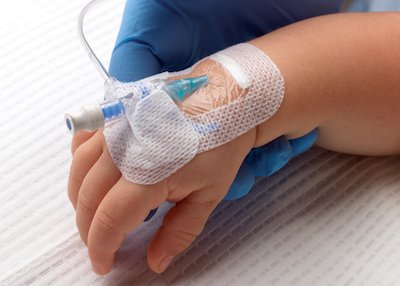
Paucis Verbis: Fever without a source (29 days-3 months old)
In part 2 of this "Pediatric Fever Without a Source" Paucis Verbis cards, we now cover febrile infants aged 29 days to 3 months (PV card for birth-28 days). Note that there is no single correct answer in how to manage these patients. There can be a wide variation in practices, partly because of the slightly different criteria used by the 3 studies. The overarching principle is that "high risk" infants get admitted with IV ceftriaxone and "low risk" infants get discharged with close follow-up +/- a ceftriaxone IV or IM dose. The line between these two risk categories is the [+]

Trick of the Trade: Difficult intubation — making lemonade out of lemons
In many cases of massive GI bleeding, airway control is essential. During endotracheal intubation, suction sometimes just isn’t adequate enough to allow to get a good view of the vocal cords. The pool of blood keeps re-accumulating faster than you can suction. You think you see an arytenoid, pointing you in the direction of the trachea, and so you slide the endotracheal tube in. Unfortunately, when you bag the patient, you realize that you are in the esophagus. [+]

Paucis Verbis: Pediatric fever without a source (Birth-28 days)
Pediatric patients commonly are brought to the Emergency Department for a fever without a source. Management of these patients depends on the patient's age. Today's PV card focuses on the youngest age group: Birth-to-28 days. QUESTION to everyone: Do you correct your age calculation for prematurity? Premature neonates are more at risk for SBI, but I've seen varying practices. PV Card: Pediatric Fever Without a Source (Birth-28 Days Old) Go to ALiEM (PV) Cards for more resources. Keep a lookout for future PV cards which will address fevers without a source in pediatric patients aged 29 days-3 months and 3 [+]

Trick of the Trade: Minimizing propofol injection pain
“Ow, that burnnnnssss… ow! ow! ow! … zzzzzz… As many as 60% of patients report significant pain with the injection of IV propofol. Once a patient experiences pain, it’s too late to reverse it. Often all you can do is to tell them that the pain will subside in a few seconds. What can you do preemptively to minimize the pain of propofol injection? [+]
Paucis Verbis: Antibiotics and open fractures
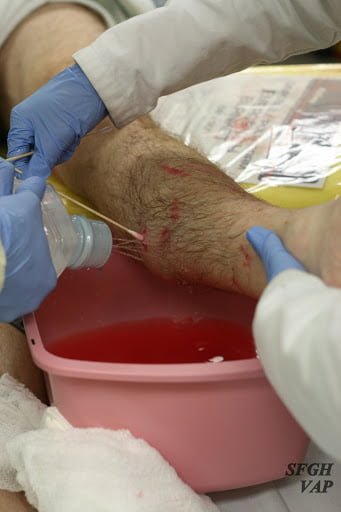
Open fractures come in all shapes and sizes. Sometimes fractures create only a small, innocuous-looking puncture through the skin. Other times they look grossly contaminated with organic material and have significant soft tissue injury. The major concern is wound infection. Prophylactic antibiotics are essential in the ED. Typically antibiotics are first-generation cephalosporins. When do you start adding more coverage with high-dose penicillin or aminoglycosides? Pearl Once you have significant soft tissue injury, you are automatically have a Type III fracture and should add an aminoglycoside. PV Card: Open Fractures and Antibiotics Adapted from [1] Go to ALiEM (PV) Cards for more [+]
Trick of the Trade: Dental Avulsion and Subluxation
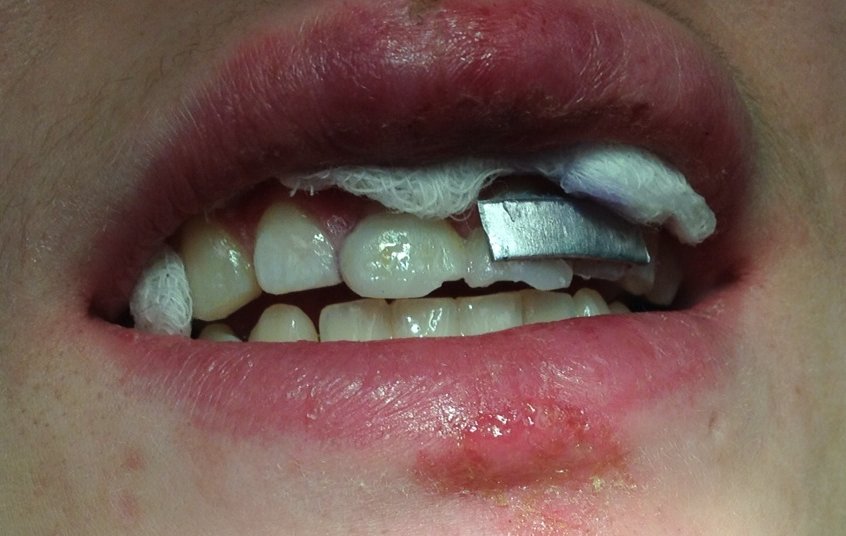
It’s a Friday evening shift in the “minor area” of your ED and a young woman who had imbibed a little too much alcohol comes in with an avulsion of her first left upper incisor after falling and striking her face against the ground. She’s crying because of the event but is otherwise unscathed. At this point it’s time to take care of the avulsion. What to do? Trick of the Trade Dermabond (2-octyl cyanoacrylate) and N95 Nasal Bridge Technique Although originally described for dental avulsions, I have also used this technique to stabilize subluxations. This is temporizing fix [+]

Paucis Verbis card: Interpretation of intraosseous blood
There is a growing number of normal volunteers who agree to get an intraosseous (IO) needle placed. Just search Intraosseous Needle on Youtube. Often you can draw blood out of the needle. How do you interpret the lab values? Are they the same as your peripheral blood draw? Should we even send the blood to the lab? In a 2010 article in Archives of Pathology and Laboratory Medicine, peripheral IV blood from 10 volunteers was compared to blood drawn twice from a single IO line in the humerus. After discarding the first 2 mL of IO blood, the first IO sample [+]
Trick of the Trade: A removable guidewire
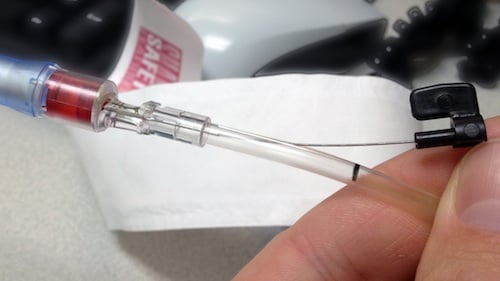
An essential skill of any innovative troubleshooter in the Emergency Department is the ability to recognize when one piece of equipment may be used elsewhere. For instance, what’s your go-to approach when looking for a spare guidewire? Let’s say you are trying to salvage an ultrasound-guided basilic vein IV catheterization. Here’s where I go for guidewires: Central line kits Pneumothorax pigtail kits Seldinger-based cricothyrotomy kits [+]

Blog Incubator Experiment: Be the next big thing in blogging
There are many health and technology incubators out there, which help to build start-up companies into thriving and profitable organizations. Why can’t we do this for those who are thinking about starting a blog? In 2009 when I was thinking about starting the blog, I had lots of support and encouragement. I slowly grew my readership by word-of-mouth and things really got going when the folks over at Life in the Fast Lane, Poison Review, EMCrit, and so many more graciously pointed their readers toward my site. [+]

Paucis Verbis: Serotonin syndrome
Background Serotonin syndrome is caused by the excess of serotonin and presents classically as: Altered mental status Autonomic instability Neuromuscular hyperactivity Fortunately, there's a nice algorithm (Hunter's decision rule) which helps you decide whether it is serotonin syndrome or not. I also include a table, which I adapted from a New England Journal of Medicine review article, which helps you to differentiate it from its mimickers, such as anticholinergic syndrome, neuroleptic malignant syndrome, and malignant hyperthermia. PV Card: Serotonin Syndrome Adapted from [1, 2] Go to ALiEM (PV) Cards for more resources. A video to remind you what clonus looks [+]