



Trick of the Trade: Bend the IV angiocatheter
You identify a great external jugular (EJ) vein to cannulate for IV access. You are having a hard time keeping the angle of the angiocatheter aimed at a shallow angle because the mandible is in the way. This is typical of patients with chubby necks (eg. pediatric patients) or who are unable to rotate their neck. [+]
Paucis Verbis: Genital Ulcers
A few months ago, American Family Physician published a nice review article on the diagnosis and management of genital ulcers. How do you remember the classic appearances of the lesions? I often quickly check references to confirm my suspicions. I find the two following tables helpful to remember. The table of differential diagnoses is from AFP. The article also reviews the confirmatory diagnostic testing and treatment protocols. The table of the clinical characteristics for the main infectious causes is from "The Practitioner’s Handbook for the Management of Sexually Transmitted Disease". Note: Although the primary lesion from Lymphogranuloma venereum (LGV) can have [+]
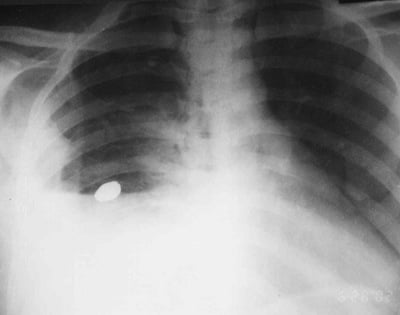
Trick of the Trade: Seldinger chest tube technique using bougie
A 40 year-old man presents with a traumatic hemopneumothorax. He weighs 400 pounds. Chest tubes can sometimes be challenge, especially for those with extra redundant tissue to tunnel through before reaching the intrathoracic cavity. You want to avoid placing the chest tube mistakenly in the subcutaneous space. How can you ensure that your chest tube actually reaches the intrathoracic space? [+]
TED video: The happy secret to better work
If you have a few minutes, take a listen to this rather humorous and thought-provoking TED video about the "intersection of human potential, success, and happiness". The speaker, Shawn Achor, is the CEO of Good Think Inc, a Cambridge-based consulting firm which researches positive outliers -- people who are well above average, and author of "The Happiness Advantage". “If we study what is merely average, we will remain merely average.” https://www.youtube.com/watch?v=fLJsdqxnZb0

Resuscitation 2012 conference
What are you doing the rest of this week? Hop on a plane to Las Vegas and join me at the 2012 Resuscitation conference. It looks to be a great conference. I'll be giving a 3-hour (!) discussion session on "Tips and Tricks in Emergency Medicine" on Friday. Inevitably when I given this talk, I always come away with great ideas from the audience. I'll be sure to write them down and share on the blog.
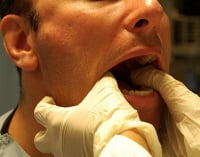
Trick of the Trade: Protecting your thumbs in mandible relocations
Does anyone think that this is generally a bad idea when closed-reducing mandible dislocations? Yes, it's easiest to apply downward pressure on the mandible by pushing down on the occlusal surfaces of the molar teeth. Sometimes, however, when the mandible relocates into place, the teeth clamp shut abruptly - placing your thumbs at risk. How can you prevent any injuries to yourself? One way is to slide gauze into the mouth during your procedure. Start the video around the 1:30 mark for an exam. Trick of the Trade: Mandible Relocations Apply a protective roll of gauze over each thumb. [+]

Paucis Verbis: Blunt Abdominal Injury, Likelihood Ratios
This month's issue of JAMA addresses the question "Does this patient have a blunt intra-abdominal injury?" as part of the always-popular Rational Clinical Examination series. The systematic review of the literature summarizes the accuracy of findings for your blunt trauma patient in diagnosing intra-abdominal injuries. Specifically, likelihood ratios (LR) are summarized. These LRs can be used to plot on the Bayes nomogram below. You draw a straight line connecting your pretest probability and the LR. This yields your posttest probability. The most predictive positive LR include: Abdominal rebound tenderness, a "seat belt sign", ED hypotension, hematocrit < 30%, AST or [+]

Trick of the Trade: Peritonsillar abscess aspiration technique using IV tubing
A few weeks ago, I gave a Tricks of the Trade talk for the Stanford-Kaiser Emergency Medicine residents and faculty. I was overwhelmed by the great, creative ideas that came up during our discussion. An always popular topic is the drainage of peritonsillar abscesses. Sometimes it can be difficult to aspirate from a syringe using only one hand, especially with the awkward angle that you might encounter. [+]
Paucis Verbis: GRACE score for ACS risk stratification
Risk stratification of the undifferentiated chest pain patients in the Emergency Department continues to plague emergency physicians. It's partly the reason why I created a TIMI risk score card for unstable angina and non-ST elevation MI in 2010. Have you heard of the 9-variable GRACE risk stratification score? Thanks to Jeff Bray (physician assistant in a rural critical access ED), I have now. He graciously shared his personal reference card on this with me, which I only minimally reformatted to fit my Paucis Verbis card dimensions. GRACE stands for Global Registry for Acute Coronary Events. It supposedly outperforms the TIMI [+]
Video: How to make a screencast video
A reader, Mark, posted a question yesterday in the chat box about screencapture softwares out there. I personally use iShowU to capture such videos as my instructional video on linking your Evernote account (above) to automatically read and download my weekly public Paucis Verbis notebook. Mark also specifically asked about what Dr. Rob Rogers (Univ of Maryland) uses. [+]