


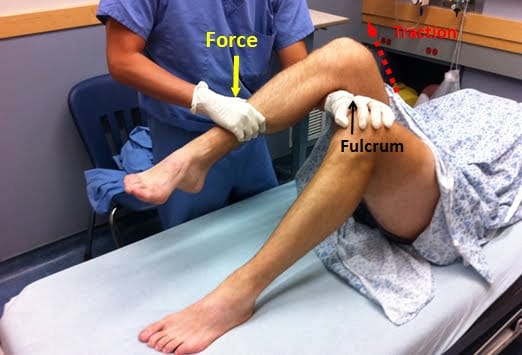
Trick of the Trade: Hip dislocation Part II
As a followup to the blog on the Captain Morgan technique for hip dislocations, I’d like to throw out another similar technique that also does NOT involve climbing up on the gurney. [+]

Director of Growth, Strategic [+]

Trick of the Trade: Tie-over dressing for scalp lacerations
Scalp lacerations are apparently a hot topic these days. This is the third post now on how to apply a bandage to a scalp laceration. Beanie hat using tubular gauze Hair braid dressing [+]
Director of [+]
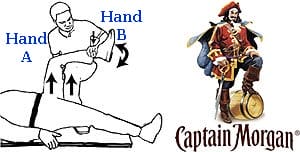
Trick of the Trade: Captain Morgan technique for hip dislocation
https://www.youtube.com/watch?v=WXN9RMjyn4M Relocation of a hip joint is often quite a sight to see in the ED. A commonly taught technique is the Allis maneuver (watch the first 45 seconds of the above video from the Medical College of Georgia). It has always seemed a bit precarious to me having someone stand on the patient’s bed. [+]

Paucis Verbis: Feedback card
Today's Paucis Verbis card is a little different. This card focuses on helping you give talking points when giving feedback to a learner on shift. This could be a medical student or resident. Dr. David Thompson (UCSF-San Francisco General Hospital) sent this great card to me and I thought it was too useful NOT to share. It's handy on shift, which ultimately is the purpose of these Paucis Verbis cards. These are useful especially for senior residents, who are supervising medical students and junior residents. This card can be used in many ways. For instance: Print these cards and fill [+]
Video: Social Media in Medicine – What is it and why?
From LifeInTheFastLane.com’s illustrious Dr. Mike Cadogan. These were the slides from his Social Media in Medicine talk at the recent USC Essentials Conference. It’s time more physicians get involved and join the conversations that are taking place on social media. Join now. [+]
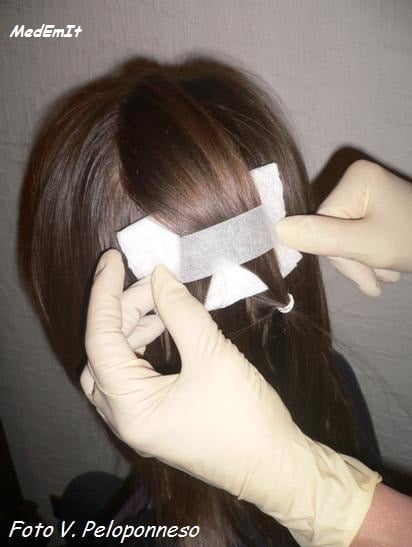
Trick of the Trade: Bandaging the scalp laceration
Scalp lacerations are one of the most common injuries which present to the Emergency Department. Applying a dry bandage over the staples or sutures can be a challenge because the tape just has nothing to adhere to. We reviewed the use of tubular cotton gauze to create a beanie hat, but what should you do if you can’t find any tubular gauze? Ever since I wrote about the beanie hat trick, people in the ED have been using the tubular gauze more and we’re always out of stock whenever I look for it! [+]

Paucis Verbis: Acute vestibular syndrome and HINTS exam
What is your diagnostic approach to the acutely vertiginous patient? The bottom-line question is: Is the cause peripheral or central in etiology? In this great 2011 systematic review article in CMAJ on Acute Vestibular Syndrome (AVS), the authors review how (un)predictive elements of the history and physical exam are. By definition of AVS, symptoms must be continuous for at least 24 hours and have no focal neurologic deficits. Frighteningly, the authors report many of the signs and symptoms (type of dizziness, hearing loss, patterns of nystagmus, Hallpike-Dix) are not as predictive as we classically are taught! The take home point [+]
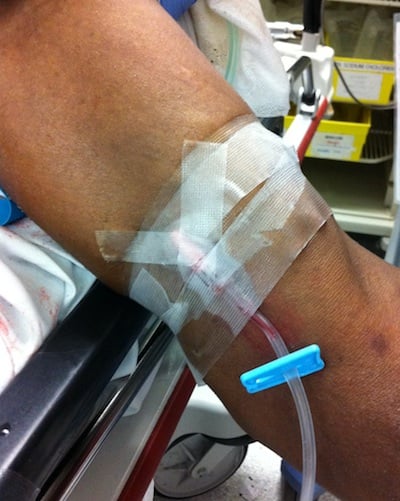
Trick of the Trade: Securing a peripheral IV on sweaty skin
Patients can become extremely diaphoretic with high fevers or if under the influence of PCP or a stimulant. Slippery, sweaty skin can pose a problem when securing peripheral IV’s. Adhesive tapes that are typically designed for securing these IV’s often slip off… immediately followed by the IV falling out. How can you secure the IV … without using staples and sutures? [+]

Crowdsourcing all of your burning questions about EM
Have you noticed that on “Who Wants To Be A Millionaire”, asking the audience as a lifeline almost always results in the right answer (over 90% of the time)? Dr. David Thorisson (Lund University, Scandinavia) recently approached me with a novel idea of doing the same for Emergency Medicine questions. These questions are currently posted to a public Google Docs document, which allows anyone to post and answer questions. [+]
Paucis Verbis: aVR Lead on ECG
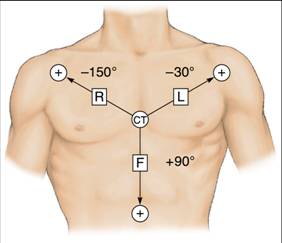
What lead is the most overlooked on the ECG? Answer: aVR Lead This lead can provide some unique insight into 5 different conditions: Acute MI Pericarditis Tricyclic antidepressant (TCA) and TCA-like overdose AVRT in narrow complex tachycardias Differentiating VT from SVT with aberrancy in wide complex tachycardias by using the Vereckei criteria (possibly better than Brugada criteria) PV Card: The aVR Lead on ECG Adapted from [1-4] Go to ALiEM (PV) Cards for more resources. See also: LifeInTheFastLane References Williamson K, Mattu A, Plautz C, Binder A, Brady W. Electrocardiographic applications of lead aVR. Am J Emerg Med. 2006;24(7):864-874. [+]