


SplintER Series: Attack by Bat
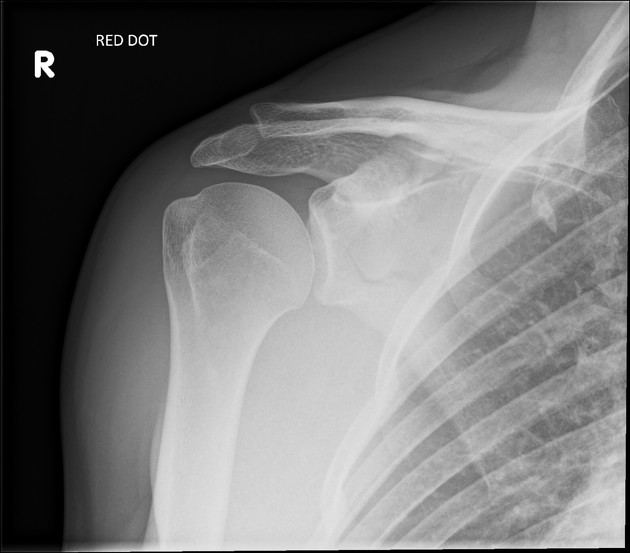
30-year-old male presents to the ED with pain over the right shoulder after being assaulted by a bat. The right arm is held in adduction and has a limited range of motion due to pain. An x-ray of the right shoulder was obtained and is shown above (Figure 1. Case courtesy of Dr. Ian Bickle, Radiopaedia.org, rID: 74640). [+]

BuMin [+]

SplintER Series: The Tooth of the Cervical Spine
80-year-old male patient brought in by ambulance for a witnessed fall. A cervical collar was placed by EMS because of midline neck pain. The patient is neurologically intact. A CT of the cervical spine was obtained and is shown above (Case courtesy of Dr. Talal F M Abdullah, Radiopaedia.org, rID: 58030). [+]
BuMin Kong, MD

Diagnosis on Sight: Neck Bruising Leads to a Surprise Diagnosis
A 76-year-old female with a history of HTN, TIA, CAD, left CEA, and CKD presented to the emergency department for evaluation of neck bruising and swelling. The patient stated that the night before, she was eating popcorn and choked on a kernel. She states that she coughed to clear her throat and shortly after she developed swelling and bruising to the left side of her neck, which has progressively gotten worse. The patient has a remote history of left carotid endarterectomy and was concerned that her symptoms could be related to the prior surgery. On examination, she had ecchymosis and [+]

How I Work Smarter: Miguel Reyes, MD
One word that best describes how you work? Comfortable Current mobile device iPhone 12 Pro Computer Macbook Air What is something you are working on now? Wound Care article, REBEL EM CME content, Journal Reviews How did you come up with this Idea/Project? It was an opportunity that presented itself during the fellowship. It’s a collaborative effort with other faculty members to pull together this large review article, its a lot of work and effort but I think it’ll be worth it. As for the REBEL content, I’ve been working with Salim for a little bit and this chance came [+]

Trick of the Trade: Upsize the IV with the tourniquet infusion technique
There you are, middle of the night and EMS just brought you one of the sickest of the sick: a septic-looking, chronically ill-appearing, frail, and malnourished patient with low blood pressures. They need vascular access for fluids, antibiotics, and possibly even vasopressors. The patient arrives with only a 22-gauge peripheral IV in the hand. You ask for two large bore IVs. But unfortunately, your best nurses and techs can’t find a vein, and their initial attempts are unsuccessful. Do you move right towards ultrasound-guided placement, intraosseous needle, or a central line? What if the patient only needs a fluid bolus, [+]

Utility of Nebulized Naloxone
Background Naloxone can be administered via multiple routes, with nebulization gaining popularity in the past decade. A previous ALiEM Trick of the Trade presented this unique method of administration. In order for nebulized naloxone to be effective patients need to have some level of respiratory effort. It should not be used in patients in respiratory arrest or impending respiratory arrest. It may be a more gentle way to wake up patients to confirm the diagnosis of opioid toxicity and to gather a history. Theoretically, if the patient arouses enough to start experiencing mild withdrawal, they can ‘self-titrate’ and remove the [+]

SplintER Series: Open Fracture
A 65-year-old farmer presents to the ED after his ankle was run over by a piece of farm equipment in the field. His x-ray is shown above (Figure 1: Case courtesy of Dr. Oyedepo Victor Olufemi, radiopaedia.org) He also has an associated soft tissue injury overlying the area that is grossly contaminated with mud and manure. [+]
ACMT Toxicology Visual Pearl: Questions about green pee? Urine luck!
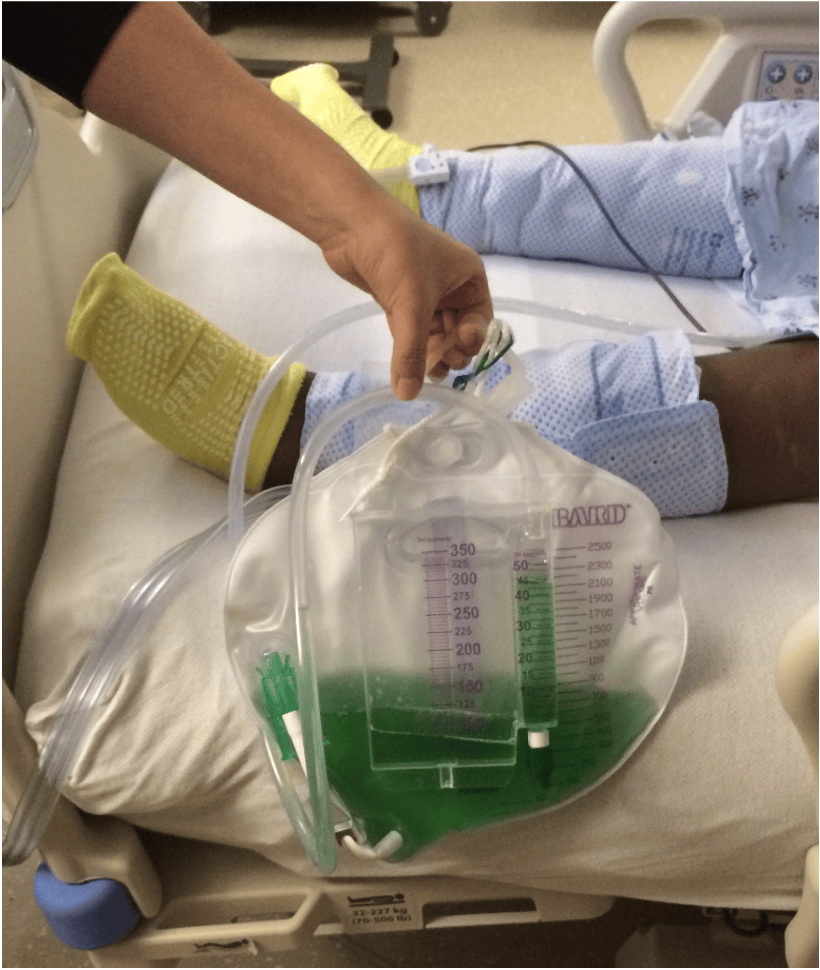
Which of the following medications is likely responsible for this urine discoloration in an intubated and sedated ICU patient? Fentanyl Ketamine Lorazepam Midazolam Propofol [+]


PEM POCUS Series: Pediatric Peripheral IV Access
Read this tutorial on the use of point of care ultrasonography (POCUS) for pediatric peripheral IV placement. Then test your skills on the ALiEMU course page to receive your PEM POCUS badge worth 2 hours of ALiEMU course credit. Take the ALiEMU PEM POCUS: Peripheral IV Quiz - test your skills PATIENT CASE: Child with Sickle Cell Pain Abigail is a 10-year-old girl with known sickle cell disease, who presents with severe atraumatic pain in her hips and back. She is afebrile, but tachycardic and tachypneic with 10/10 pain. Nurses have made several attempts but have been unsuccessful in establishing [+]

How I Work Smarter: Laryssa Patti, MD
One word that best describes how you work? Organized chaos (that's 2 words) Current mobile device iPhone XS Computer 2020 13" Macbook Air + iPad with keyboard as a second monitort What is something you are working on now? Incorporating FOAM into our EM clerkship How did you come up with this Idea/Project? COVID decided for me -- we’re working on a way to keep students engaged even though we’re still semi-distance learning. Additionally, I want to send my students into residency knowing that FOAM exists but needs to be assessed in the same way we think about peer reviewed [+]