



Door to Balloon Time: Are We Measuring the Right Thing?
Door-to Balloon (D2B) time is a time measurement that starts with patient arrival to the emergency department (door) and ends when a catheter crosses a culprit lesion in the cardiac cath lab (balloon). The benefit of prompt primary percutaneous coronary intervention over thrombolytic therapy for acute ST elevation myocardial infarction is very well established. Because of this “time is muscle” strategy, the American College of Cardiology (ACC) launched a national Door to Balloon (D2B) initiative in November 2006. The purpose of this was to recommend a D2B time of no more than 90 minutes. Currently, there is quite a bit [+]

PV Card: Emergency Drug Cards for Adults and Children
Rob Bryant, MD (@RobJBryant13), Amie Hatch, PharmD, BCPS (@Amie_EMPharmD), and Jeremy Bair, PharmD (@bairpharm) from Intermountain Healthcare in Utah have created and adopted a fantastic medication reference card which is used by physicians and nurses in the Emergency Department. The medications were chosen because they are often prone to dosing errors and require time-sensitive ordering. They generously offered to share this incredibly compact resource for free to the Emergency Medicine community as a PV card. If you see them, give them a high-five. [+]

Patwari Academy videos: PALS
Pediatric Advanced Life Support (PALS) guidelines were most recently reviewed in Circulation 2010 1 based on the International Consensus on Cardiopulmonary Resuscitation and Emergency Cardiovascular Care Science which includes treatment recommendations. Dr. Rahul Patwari nicely summarizes these findings in this series of 8 videos [+]
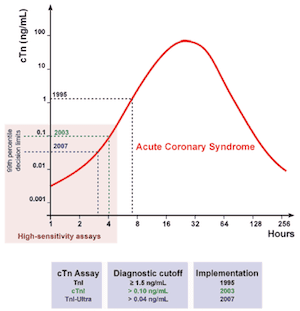
High Sensitivity Troponin Testing
Troponin testing is an important component of the diagnostic workup and management of acute coronary syndromes (ACS). The increasing sensitivity of troponin assays has lowered the number of potentially missed ACS diagnoses, but this has also created a diagnostic challenge due to a decrease in the specificity of the test. From 1995 to 2007, the limit of troponin detection fell from 0.5 ng/mL to 0.006 ng/mL (see below graph). Robert Jesse summed up this frustration with the following quote: When troponin was a lousy assay it was a great test, but now that it’s becoming a great assay, it’s getting [+]

Are Acetaminophen Levels Necessary in All Overdose Patients?
Intentional overdose patients are notorious for giving inaccurate histories. “I took 14 tablets of this and 8 capsules of that. No, wait. It was 3 tablets of this and a handful of capsules of that… This happened about 2 hours ago. Actually, I think it was last night.” Round and round the merry-go-round we go. How should we risk-assess whether acetaminophen is involved? If the patient provides no history of acetaminophen ingestion, do we need to order a level? [+]
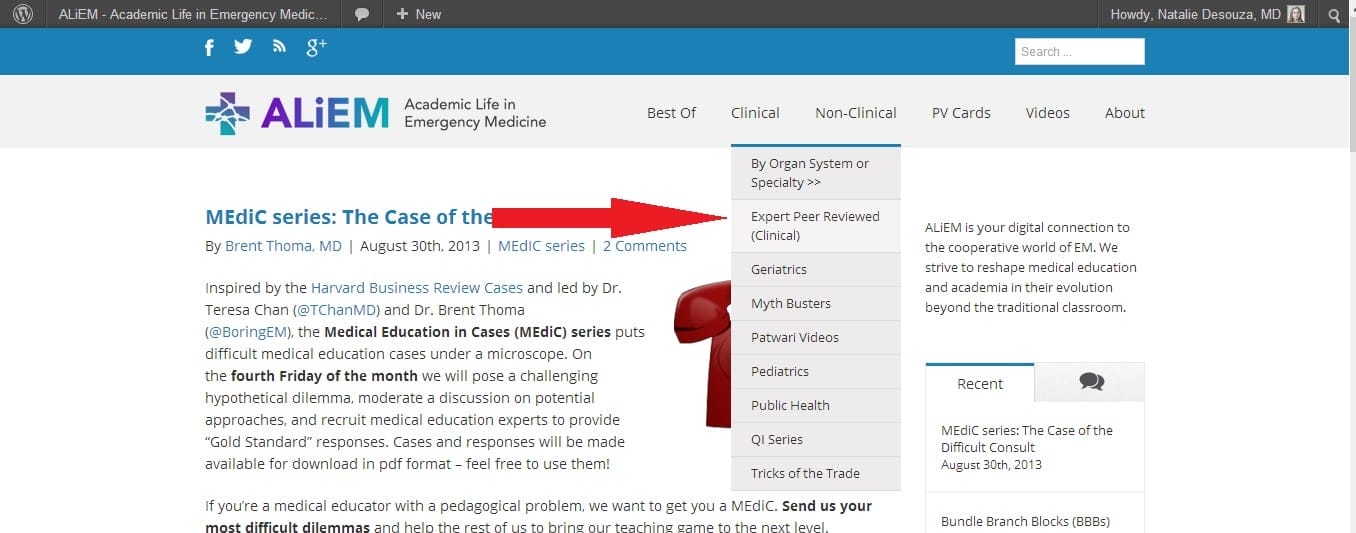
Introducing Open, Post-Publication, Expert Peer Review on ALiEM
Today, we are busting open the concept of peer review for publications on blogs! The peer review process has been criticized for its flaws, but is universally accepted as a necessary part of the scientific process. Peer reviewing allows experts in a field to determine the validity of a study or an article so that those of us who are less expert can reap the benefits of their knowledge. Until recently this process was almost universally pre-publication and anonymous. Authors would go through months of review and revision based on feedback of experts whose name they didn’t even know. In the [+]
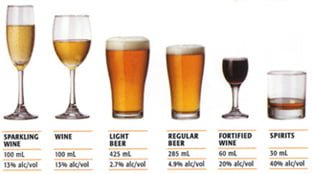
Alcohol Problems Among Older Adults in the ED
The complications of alcohol use can be subtle in older adults, and the effects of alcohol are often incorrectly attributed to aging. Because of its under-recognition, the barriers to screening, and the many subtle ways in which it can present, some have suggested that alcohol misuse has replaced syphilis as the “great masquerader”. If you don’t think alcohol misuse is a problem among older adults in your ED, it may be because it has been hidden in plain sight. [+]

Simulation Trick of the Trade: Blindfold the Leader
Simulations are routine now in medical training. But sometimes routine can start to get boring! All learners now know, especially for high fidelity simulations, to prepare for the unexpected. The stable patient will inevitably crash, maybe when your back is turned; the confederate in the room may or may not be a friend or a foe, you may never know! But these twists have become so integral to the simulation case that most learners know how to deal with it, or at the least know to anticipate it. But here is an idea for adding a new challenge to a stale simulation case. Blindfold the leader! [+]

Bundle Branch Blocks (BBBs) 101
Recently, I have been asked by several students at my home institution (UTHSC at San Antonio) to help them understand bundle branch blocks. This is different than some of my usual posts because it is meant to be more educational than evidence based. So here we go. The normal conduction system of the healthy heart is shown to the right. If there is a delay or block in the left or right bundle, depolarization will take longer to occur. Therefore we get a widened QRS (>0.12 sec or >3 small boxes). [+]

R-Wave Peak Time (RWPT) in Lead II: One Simple Step to Differentiate Wide Complex Tachycardias
There are several algorithms that are currently used to help distinguish Supraventricular Tachycardia (SVT) with aberrancy and Ventricular Tachycardia (VT). Many of these algorithms lack specificity, and let’s face it, who can remember if the absence of an RS complex in the precordial leads is VT or SVT with aberrancy. So what if there was a criterion that had a good sensitivity (SN), specificity (SP), and was one simple step? [+]

Director of Growth, Strategic Alliance Initiative, Center for Innovation and Digital Health
Massachusetts General Hospital;
Chief Scientific Officer, Conductscience.com
Latest posts by Shuhan He, MD (see all)
- The Discharge Severity Index: Early Research on ED Readmission Risk Assessment - August 14, 2025
- Suboxone and the Emergency Physician: Get Waivered Training - August 12, 2022
- A Tale of Two Epidemics: COVID-19 and the Opioid Crisis - April 23, 2020