



ACMT Toxicology Visual Pearls: Awake Seizures?
Which of the following rodenticides, often used to kill the rodent pictured, causes seizure-like activity without altered mental status or a postictal period? Barium Brodifacoum Carbamate Strychnine Zinc phosphide [+]

Announcing ALiEMU SplintER Course: Approach to Splinting
We are so thrilled to announce that we created an ALiEMU Course on the Approach to Splinting, using one of our most popular series, the SplintER Series, as the learning foundation. We have created a custom quiz assessing the learning objectives. Are you a medical student getting ready for your EM rotation or internship? Or an EM resident needing to brush up on your splinting knowledge? Take this free course for 2 hours of ALiEMU course credit, and receive your “Approach to Splinting” badge. [+]
SAEM Clinical Image Series: Juvenile Snake Bite
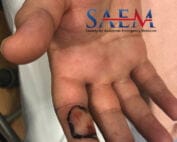
A 62-year-old male presented thirty minutes after being bitten by a snake in his garden. He stated that he thinks his finger was bitten twice. The patient presented with pain and swelling of his right hand and forearm. [+]

Keegan McNally, MD
University of Central Florida College of Medicine

SAEM Clinical Image Series: Atraumatic Proptosis
An 85-year-old female with a past history of hypertension presents with acute right-eye pain, redness, and proptosis/bulging for the past two months that has been worsening over the past two days. She endorses blurry vision that began two days prior. She does not use contacts or glasses. No trauma, headache, or loss of consciousness are reported. She reports a “whooshing” sound in her right ear for two to three months. [+]

ALiEM AIR | Psychosocial 2020 Module
Welcome to the AIR Psychosocial Module! After carefully reviewing all relevant posts from the top 50 sites of the Social Media Index, the ALiEM AIR Team is proud to present the highest quality online content related to psychosocial emergencies. 5 blog posts within the past 12 months (as of July 2020) met our standard of online excellence and were curated and approved for residency training by the AIR Series Board. We identified 2 AIR and 3 Honorable Mentions. We recommend programs give 3 hours (about 30 minutes per article) of III credit for this module. AIR Stamp of Approval and [+]
SplintER Series: An Easily Missed Shoulder Injury
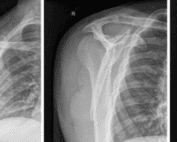
A 30-year-old male presents with right shoulder pain after a motorcycle accident. You obtain shoulder x-rays and see the following images (Image 1: AP, scapular Y, and axillary views of the right shoulder. Author’s own images). What is the most likely diagnosis, typical mechanism of injury, expected physical exam findings, appropriate imaging modalities, and management plan? [+]

Victor Huang, MD
SAEM Clinical Image Series: An Oropharyngeal Mass
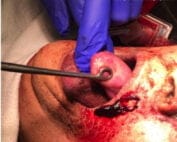
A fifty-year-old male presented to the emergency department (ED) unconscious with CPR in progress. Per EMS report, the patient was found down surrounded by emesis with no pulse or respirations. Fifteen minutes of CPR was performed prior to arrival in the ED with a King Tube in place. The King Tube was filled with emesis and increasingly difficult to bag. The King Tube was removed to attempt intubation and maximize oxygenation and ventilation. When the Mac 4 blade was placed in the mouth, a large, pink, fleshy, and vascularized structure was seen in the mouth [+]
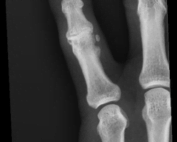
SplintER Series: A Jammed Finger
A 50-year-old male presents to the emergency department with a new inability to extend his 5th digit of the left hand. He states he was playing a game of pick-up basketball last week when he jammed the finger while attempting to catch a pass from a teammate. An AP and lateral radiograph of the digit is obtained (Image 1 courtesy of Dr Alborz Jahangiri, Radiopaedia.org). What is your diagnosis? What causes this injury? What exam maneuver can help diagnose the underlying injury before the deformity is evident? What is the treatment/management of this injury? What [+]
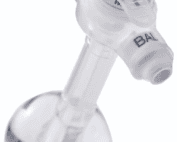
Unlocking the MIC-KEY: Understanding and Troubleshooting Low-Profile Gastrostomy Tubes
You are working an overnight clinical shift at your community emergency department when a worried mother brings in her 15-year-old child with cerebral palsy due to their gastric tube “coming out.” As you begin to obtain a history of the patient’s gastric tube (when it was placed, where it was placed, why is it in place, etc.) you realize you will be the one replacing it tonight, and frankly you haven’t done this before. The following post serves as a refresher on the use, placement, and complications of gastrostomy tubes. [+]
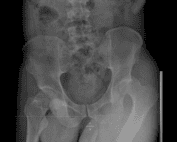
SplintER Series: Hip Pain Following an MVC
A 48-year-old female presents to the emergency department after a high-speed motor vehicle collision (MVC). She is complaining of left hip pain. Her radiographs are shown (Image 1 courtesy of Dr Ayaz Hidayatov, Radiopaedia.org, rID: 52760). What is your diagnosis? What is the likely mechanism of injury? What physical exam findings are expected? What is your management in the emergency department and when should you consult orthopedics? [+]

Director of Growth, Strategic Alliance Initiative, Center for Innovation and Digital Health
Massachusetts General Hospital;
Chief Scientific Officer, Conductscience.com
Latest posts by Shuhan He, MD (see all)
- The Discharge Severity Index: Early Research on ED Readmission Risk Assessment - August 14, 2025
- Suboxone and the Emergency Physician: Get Waivered Training - August 12, 2022
- A Tale of Two Epidemics: COVID-19 and the Opioid Crisis - April 23, 2020