


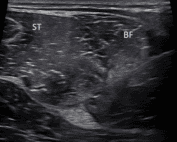
SplintER Series: “Pop in the Posterior Thigh”
A 20-year-old male presents with right posterior thigh pain and difficulty walking after he felt a “pop” while sprinting in a race. An ultrasound of the right posterior thigh is performed and the above image is seen on the transverse view without compression (Image 1. ST- semitendinosus; BF – bicep femoris; H – hematoma. Courtesy of Matthew Negaard, MD). [+]

SAEM Clinical Image Series: The Insidious Rash
A 60-year-old African American female with a history of hypertension presents to the emergency department for an itchy, diffuse rash. She first noticed the lesions a few years prior, and they have progressively become larger and more inflamed. The lesions have become severely pruritic over the last couple of months. Steroid creams did not appear to improve symptoms. Currently, the lesions on her arm have become painful with yellow drainage. The patient denies nausea, vomiting, and fever. [+]
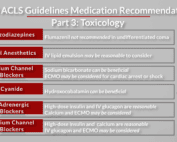
2020 ACLS Guidelines on Medications for Toxicology-Related Conditions
The 2020 ACLS guidelines provide recommendations on the medication-specific management recommendations for toxicology [1]. Although the name of the guidelines emphasize they are ‘Advanced,’ these are still relatively basic toxicology recommendations and largely apply to patients in cardiac arrest or refractory shock. There are also our 2020 ACLS guideline summaries on vasopressor and non-vasopressor medications used during cardiac arrest and arrhythmia management. Benzodiazepines Flumazenil if NOT recommended in undifferentiated coma (COR3, LOE B-R) Cocaine Benzodiazepines, alpha blockers, calcium channel blockers, nitroglycerin, and/or morphine can be beneficial for hypertension, tachycardia, agitation, or chest discomfort (COR 2a, LOE B-NR) Pure beta-adrenergic blockers may [+]
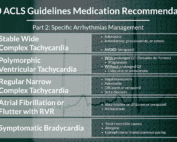
2020 ACLS Guidelines on Medications for Management of Specific Arrhythmias
The 2020 ACLS guidelines provide recommendations on the medication-specific management for arrhythmias including wide-complex tachycardia, regular narrow-complex tachycardia, atrial fibrillation/flutter, and bradycardia [1]. There are also our 2020 ACLS guideline summaries on vasopressor and non-vasopressor medications used during cardiac arrest and toxicology-related conditions. Wide-complex tachycardia (WCT) Wide-complex tachycardia Medication(s) Evidence Hemodynamically stable Adenosine COR 2b, LOE B-NR Amiodarone, procainamide, or sotalol COR 2b, LOE B-R NOTE: Verapamil is harmful COR 3, LOE B-NR Polymorphic VT with long QT (torsades de points) Magnesium COR 2b, LOE C-LD Polymorphic VT without long QT Lidocaine or amiodarone COR 2b, LOE C-LD Regular [+]
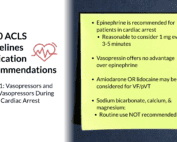
2020 ACLS Guidelines on Vasopressors and Non-Vasopressors During Cardiac Arrest
The 2020 ACLS Guidelines were published in October 2020 [1]. This first of 3 blog posts will focus on vasopressor and non-vasopressor medications during cardiac arrest. Part 2 will focus on specific arrhythmia management and Part 3 will focus on toxicologic interventions. Summary There were no major updates for vasopressors and non-vasopressors used during cardiac arrest. The American Heart Association (AHA) published Highlights of the 2020 Guidelines [PDF] as a clear and concise summary. Now that the AHA is releasing focused updates in the 5-year period between guidelines (like this one on lidocaine), fewer major changes likely will be needed when [+]

Social Medicine in the Emergency Department: Not all conditions can be treated with medicines
On the day we met Jane, a woman in her 70’s with diabetes and mobility impairment, she was visiting an Emergency Department (ED) for the 50th time in the past year. Jane was experiencing homelessness and spent much of her day riding public transportation in her wheelchair. Bystanders, often concerned for her health after noticing she had an episode of incontinence, would call 911 after which Jane would be brought to the nearest ED. On the day Jane came to our ED, our multidisciplinary ED-based Social Medicine team was asked to help in her care. She was very thin, her [+]
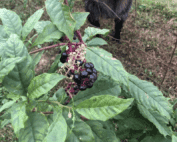
ACMT Toxicology Visual Pearls – A Poke in the Belly
Which component of the pictured plant is the cause of gastrointestinal symptoms when ingested? Histamine Lectins Oxalates Ribosomal inhibiting proteins Saponin glycosides [+]

Caitlin Baldwin, DO
Jefferson Health - Northeast
Latest posts by Caitlin Baldwin, DO (see all)
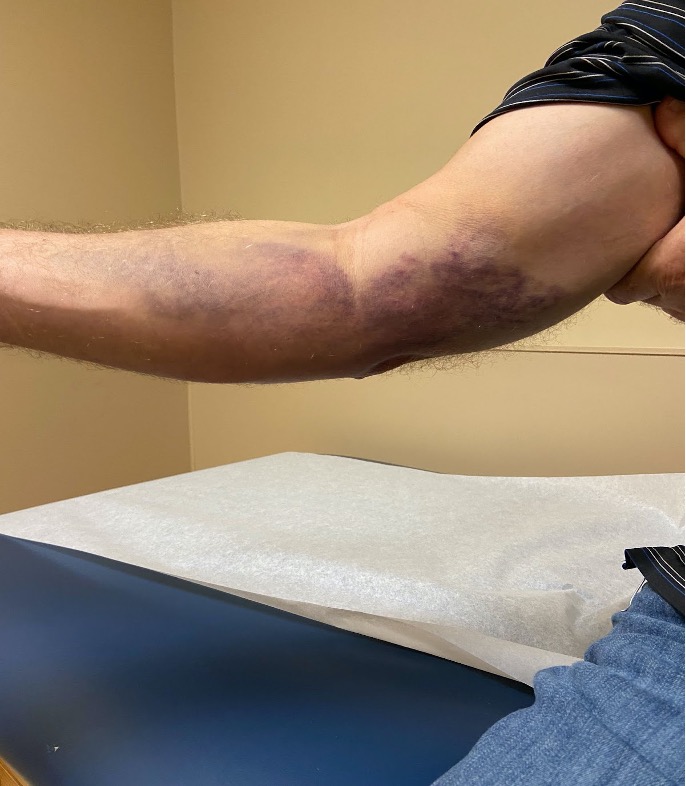
SplintER Series: A Fateful FOOSH
A 66 year-old man presents with right anterior elbow pain, ecchymosis, and a “lump” in his right upper extremity after a ground level fall (Figure 1). What is your suspected diagnosis? What physical exam maneuver(s) can help you confirm your diagnosis? What is your initial workup in the ED? What imaging confirms the diagnosis? What is your management and disposition? Figure 1: Case Courtesy of Dr. Peter M. Martin [+]
Doxycycline vs Azithromycin: Think Twice About the 2020 CDC Guideline Update on Treatment of Gonorrhea and Chlamydia
When the new Centers for Disease Control and Prevention (CDC) recommendations1 regarding the treatment of uncomplicated gonorrhea (and indirectly chlamydia) debuted like a slice of antibiotic resistance doom, it felt like another “gift” had arrived from 2020. Intramuscular (IM) ceftriaxone dosing has increased from 250 mg to 500 mg (or 1 g for weight ≥150 kg). Empiric chlamydia coverage switched from a single dose of 1 g of azithromycin to doxycycline 100 mg PO BID for 7 days. Being deferential to CDC expertise, many providers accepted them uncritically. Compliance rates with a switch from a 1-time to a 7-day regimen are not [+]

Free eBook Announcement: Emergency Medicine Resident Simulation Curriculum for Pediatrics (EM ReSCu Peds)
The Emergency Medicine Resident Simulation Curriculum for Pediatrics (EM ReSCu Peds) is here! This free ebook contains 16 EM resident-tested, peer reviewed cases covering essential pediatric content identified through a robust modified Delphi process [1] with experts across the United States. Each chapter contains robust supporting materials to help educators prepare, execute, and debrief cases with residents at every level to help supplement the clinical experience. Download the EM ReSCu Peds eBook We request some basic demographic about you and how you plan to use the educational cases in the download form to provide us with necessary insights whether [+]

Director of Growth, Strategic Alliance Initiative, Center for Innovation and Digital Health
Massachusetts General Hospital;
Chief Scientific Officer, Conductscience.com
Latest posts by Shuhan He, MD (see all)
- The Discharge Severity Index: Early Research on ED Readmission Risk Assessment - August 14, 2025
- Suboxone and the Emergency Physician: Get Waivered Training - August 12, 2022
- A Tale of Two Epidemics: COVID-19 and the Opioid Crisis - April 23, 2020