


Review: Emergency Medicine: Avoiding The Pitfalls and Improving The Outcomes
A pitfall is defined as “an unapparent source of trouble or danger; a hidden hazard” by thefreedictionary.com. In the book Emergency Medicine: Avoiding the Pitafalls and Improving the Outcomes edited by Dr. Amal Mattu along with Dr. Deepi Goyal, you can find many pitfalls that should be considered when managing patients in the emergency department. The book, relatively affordable ($57) when it comes to print hard-bound textbooks, consists of 13 quick-read chapters of common chief complaints in emergency medicine. Some of the authors in this book include: Drs. Peter DeBlieux, Jairo Quintanilla, Robert Rogers, Michael Winters, and others. [+]

Patwari Academy video: Discharge instructions
Read more about the writing of appropriate ED discharge instructions. Clear communication of your thoughts and recommendations are a crucial part of patient care despite their no longer being in the ED. Learn about the pearls and pitfalls in writing instructions in this short 7.5 minute video. 1 [+]
SAEM/CORD slides: Social Media for Emergency Educators
As requested by an audience member at today’s talk at SAEM, Drs. Rob Cooney, Mike Bond, and I are sharing our slides and handout on Social Media for Emergency Medicine Educators with you here. [+]

Director of [+]
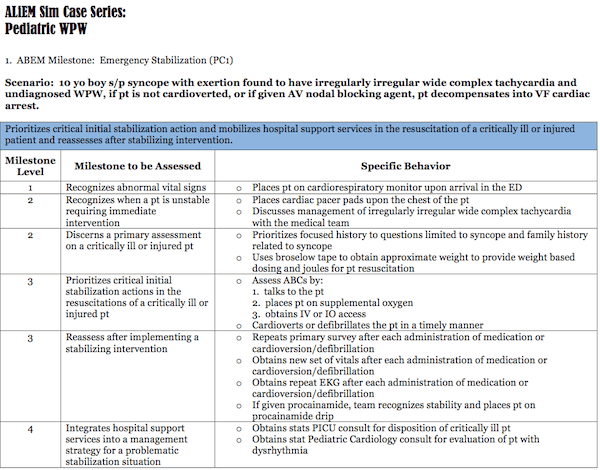
ALiEM Sim Case Series: Pediatric WPW
Case Writer: Nikita Joshi, MD Keywords Pediatrics, Syncope, Wolff Parkinson White (WPW), PALS Educational Objectives Medical Discuss a broad differential diagnosis for pediatric syncopeIdentify critical findings in pediatric EKGManage WPW tachycardia Communication Obtain a focused history in a pt with WPW focusing upon family historyCommunicate as an interdisciplinary team Case Synopsis 10 yo boy BIBEMS s/p syncope. Pt was playing on the football field, running down field when he suddenly collapsed. Bystanders quickly went to the boy and within 1 minute the pt had regained consciousness without any intervention. When EMS arrived on the scene, the boy was sitting with [+]
PV card: Early repolarization vs STEMI on ECG
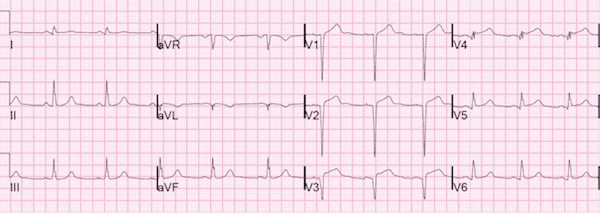
You are handed an ECG for a 50 year old man with moderate chest pain for 2 hours now and no associated symptoms typical for ACS, PE, aortic dissection, or any other red flags of chest pain. He has no prior ECG's on file. Is this early repolarization or ST elevation MI? Should I activate the cardiac catheterization lab? Image courtesy of Dr. Steve Smith at HQMedEd-ecg.blogspot.com Here are some great literature-based pearls compiled by Dr. Jason West (@JWestEM), an EM resident from Jacobi/Montefiore. PV Card: ECG - Early Repolarization vs ST Elevation MI Adapted from [1–7] Go to [+]
Three predictors for success in cardiac arrest resuscitations
The goal of resuscitation in cardiac arrest is to respond in a timely, effective manner that leads to good patient outcomes. Resuscitation is not taking an ACLS and BLS course and going through the motions of a code. There have been several studies looking at the quality of intubation and CPR, and their association with good patient outcomes. [+]
Improving Consultation Communication Skills
Talking to colleagues is an essential skill especially as we advocate for our patients. We should not only know what’s going on with our patients, but also how to communicate our thoughts effectively and succinctly with our colleagues. In a great article by Dr. Chad Kessler et al 1 just published Academic Medicine, the authors state that although “communication skills may not develop naturally, [they] can be taught and fostered through evidence-based educational models.” [+]
Patwari Academy videos: Salter Harris fractures
Dr. Rahul Patwari discusses Salter Harris fractures in pediatric patients with a helpful mnemonic to help you remember the categories. He also poses several questions in the first video, which are answered in the second video. [+]
Deception and Simulation
Have you ever created a simulation case with hidden objectives that the learners were not aware of? Would you ever purposefully try to trick or deceive learners in a simulation case? Simulation can be used to reinforce clinical and procedural knowledge. It can teach important teamwork skills. It can also be used to learn about ourselves in morally and ethically challenging situations. [+]
PV card: Ectopic pregnancy
Ectopic pregnancy is the leading cause of maternal death in the first trimester of pregnancy. A recent JAMA systematic review,1 from The Rational Clinical Examination series, looked to risk-stratify women in early pregnancy presenting with abdominal pain or vaginal bleeding for ectopic pregnancy. The authors set out to identify the accuracy and precision of elements in the history, physical examination, beta hCG, and ultrasound in ectopic pregnancy. The systematic review consisted of 14 studies (n=12,101). The search consisted only of English language studies from 1965 to 2012 in which ectopic pregnancy was the final diagnosis with 100 or more patients per article. The [+]