


Simulation cases: How to write the storyboard
Last week I wrote about the important components in writing a simulation case. It is an exhausting list, but the thoroughness pays off. The next big task is writing the actual case storyboard, which can be done in many ways. All revolve around the concept of action and reaction. The key to a well written simulation case is understanding the actions that the learners will take, the actions that they should take, the actions they shouldn’t take. [+]

Built a 20-person worldwide educator panel in two hours
Yesterday I had the pleasure of sharing my thoughts to an enthusiastic crowd of UCSF preclinical medical students on one of my favorite topics “Technology and Social Media in Emergency Medicine”. This is the perfect target audience to teach about developing a workflow habit for keeping up with digital information, since they are only starting to grow their clinical knowledge foundation. On the morning of my noon talk, I regretted not recruiting some fellow FOAMed (Free Open Access Meducation) supporters to email me their thoughts about why social media is here to stay in medical education. How great would it have been to [+]
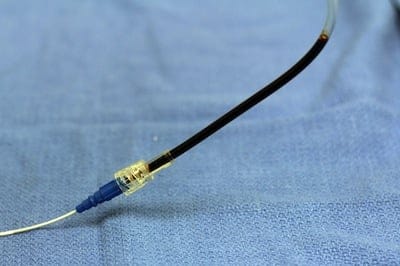
Trick of the Trade: Use the angiocatheter for central lines
Central lines come packed with a long introducer needle (pink arrow) to feed the guidewire through AND a long angiocatheter (yellow arrow). Most people cannulate the vein by using the syringe and the introducer needle. What’s the angiocatheter for? [+]
MOOC: Clinical problem solving with Dr. Lucey
According to Wikipedia, MOOC stands for Massive Open Online Course, was coined by Dave Cormier (@davecormier) in 2008 during a course called “Connectivism and Connective Knowledge” in a course led by George Siemens (@gsiemens) and Stephen Downes (@oldaily). All three are educators from Canada who specialize in online learning, learning and technology, and connectivism. As the name implies the course is open to thousands of people online. Although thousands of people sign up only a very small percentage finish the course. [+]
Writing a Medical Simulation Case
It can be a daunting task to write a medical simulation cases. Regardless of prior experience in simulation, writing cases is a different skill set than programming or working a high fidelity simulator. It’s more similar to writing a play– at times an impromptu play! What is a Medical Simulation Case? It usually entails a patient encounter with a healthcare provider (learner) where an event occurs, and the learner is expected to perform actions. After some time, or after certain actions are performed, the facilitator stops the simulation, and debriefing ensues. [+]

PV card: Bell’s Palsy Treatment
Bell's Palsy is an idiopathic unilateral facial nerve paralysis. Since the 2009 Cochrane review1 showing that antivirals added no benefit to corticosteroids in Bell's Palsy, I stopped prescribing them. The NNT.com site has concluded the same. Looking at the literature a little more, the recommendations are a little murkier. Some groups are still advocating for antivirals for severe cases, because there may be a very small but questionably positive benefit. "Because of the possibility of a modest increase in recovery, patients might be offered antivirals (in addition to steroids) (Level C). Patients offered antivirals should be counseled that a benefit from antivirals has [+]

Trick of Trade: Umbilical foreign body removal
Emergency physicians are constantly challenged with fishing foreign bodies out of various orifices such as ears, as shown here in an earlier Trick of the Trade using a tissue adhesive. What do you do when an overweight person presents with the cotton portion of a Q-tip lodged in his umbilicus? Skin retractors and direct probing were unsuccessful in removing the cotton. [+]
A Tea-Steeping or i-Doc Model for Medical Education?
There was a great article written by Dr. Brian Hodges (@BDHodges1) and published in Academic Medicine1 in 2010. Dr. Cunningham (@amcunningham) provided the link via Twitter in a discussion about different models of competence in medical education. [+]

Patwari Academy videos: Searching the literature to answer Qs
Do you use a PICO method to answering a clinical question using the medical literature? Patient / problem Intervention Comparison Outcome This two-part series provides an introduction in how to search the medical literature to answer your clinical question. This provides a concise overview of epidemiology and statistics. [+]
Making Your Match Rank List
This is the moment your whole medical school career has been hinging upon: Match Rank List Time! It is time to get serious and come up with a rank list that maximizes your chances of getting your first choice residency. Ranking programs is a personal decision making process, because everyone has different priorities and life circumstances. Therefore, no one piece of advice applies to everyone. This is a run down of my own personal thoughts of what is important. [+]