


Paucis Verbis Card: CNS Infections
PV Card: CNS Infections Here is another installment of the Paucis Verbis (In a Few Words) e-card series on the topic of CNS infections from EM Clinics of North America 2009. Adapted from [1] Go to ALiEM (PV) Cards for more resources. Reference Somand D, Meurer W. Central nervous system infections. Emerg Med Clin North Am. 2009;27(1):89-100, ix. [PubMed]
Article review: Failing at feedback in medical education
Most of the medical education literature on feedback is teacher-focused rather than learner-focused. In other words, focus is paid towards teaching faculty how to give feedback which: Is non-judgmental Is non-threatening Is specific Consists of both positive and constructive elements Offers alternatives [+]

Paucis Verbis Project: A peripheral brain e-card series
A few days I wrote about my "peripheral brain" note cards that I carry with me on each ED shift. These cards contain brief summaries of updated guidelines, evidence based literature, and clinical pearls. I constantly get requests for a copy of them, but they are fairly outdated now that I'm out of residency. So starting today, I'm going to start periodically posting new note cards in Word and PDF format that can be printed on any 4x6 inch index card. These will be posted every Friday. Feel free to download, edit, change font or font size, and use. You [+]
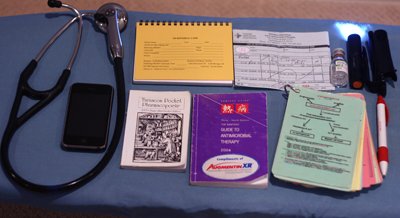
What’s in your pocket on an ED shift?
I am always curious about what people carry in their scrubs and lab coat pockets. Often you can identify residents based on what they are carrying or wearing. Stereotypically, I find the following: Long reflex hammer jutting way out of the lab coat pocket – Neurology Plaster smears on their scrub tops and bottoms – Orthopedics Fluffy animal on their stethoscope and/or lab coat – Pediatrics LMP wheel – Obstetrics/Gynecology Small textbook in lab coat pocket – a medical student [+]
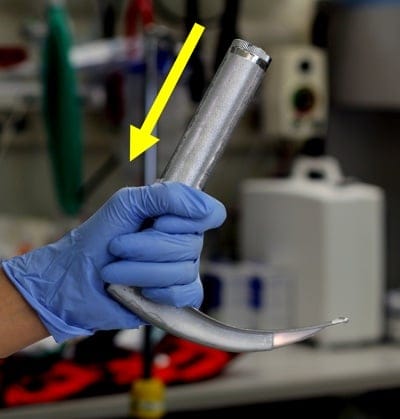
Trick of the Trade: Laryngoscope lifting strength
You are about to endotracheally intubate a patient. As you struggle to elevate the laryngoscope more anteriorly, has your left hand ever trembled while trying to see the vocal cords? Before you say, “I think the cords are too anterior, hand me the [insert your favorite backup airway adjunct]”, let’s focus on some basics. How can you gain significantly more laryngoscope lift strength? You can do more left arm bicep/tricep exercises, or… [+]

Tricks of the Trade: Diagnosing retinal detachment with ultrasound
In a sneak peek of my ACEP News’ Tricks of the Trade column, Dr. Patrick Lenaghan, Dr. Ralph Wang, and I will discuss how bedside ultrasonography can significantly improve your ocular exam. Here is a classic example. A patient presents with acute onset right eye pain and blurry vision. She possibly has a field cut in her vision. Her pupils are a teeny 2 mm in size in the brightly-lit Emergency Department. You are having a hard time getting a good fundoscopic exam to comfortably rule-out a retinal detachment. [+]

Faculty hero: Ernest Wang (part 2)
Clinical Assistant Professor, NorthShore University HealthSystemAcademic Director, Center for Simulation Technology & Academic Research (CSTAR)Associate Program Director, University of Chicago EM Residency [+]

Director of Growth, Strategic Alliance Initiative, Center for Innovation and Digital Health
Massachusetts [+]
Article review: Neuro exam documentation
Medicolegal woes often can be tracked back to poor documentation by the physician. This article is a retrospective chart review of 384 EM resident charts, focusing on the documentation of the neurologic exam. Charts were selected if their chief complaints were neurologic or psychiatric in nature. A non-validated measurement tool for evaluating a neurologic exam was created based on discussions with attending emergency physicians. I have to agree with the chosen criteria. Documentation in each of the following criterion receives 1 point for a maximum score of 8. [+]

Trick of the Trade: Subclavian line gone north
In patients requiring central venous access, which vein do you prefer? In descending order, I prefer subclavians, internal jugulars (IJ), and then femorals. There is increasing evidence that subclavian central venous lines are superior to femoral lines (JAMA 2001) with respect to iatrogenic infection and thrombosis rates. In 9% of subclavian lines, however, the line tip ends up in the ipsilateral IJ, instead of the superior vena cava (SVC) – see chest xray below. These lines are unusable in the long term because of the risk of cathether thrombosis in this low-flow area. The line must must be rewired. [+]

Faculty hero: Ernest Wang (part 1)
Ernest Wang, MD Clinical Assistant Professor, NorthShore University HealthSystem Academic Director, Center for Simulation Technology & Academic Research (CSTAR)Associate Program Director, University of Chicago EM Residency [+]
Director of Growth, Strategic Alliance Initiative, Center for Innovation and [+]