Paucis Verbis card: Angioedema
Recently, a patient presented with angioedema after starting taking an ACE-inhibitor. There was upper lip swelling, similar appearing to the case above. He also experience a hoarse voice. Before the advent of fiberoptic nasopharyngoscopy, it was assumed that there may be laryngeal edema. Fortunately, using technology, we were able to visualize a normal epiglottis and a grossly normal laryngeal anatomy. Should patient with angioedema be admitted? The 1999 study on admission guidelines, of course, should be weighed with physician judgment and the patient's social issues. The study was retrospective and the results should be weighed carefully. For me, generally I [+]
Trick of the trade: Ear foreign body extraction
A 6-year old boy has placed a hard bead in his ear and presents to the ED for care. How do you remove this foreign body as painlessly as possible? You can just barely see the edge of the bead by just looking at the external ear. By experience, you know that mini-Alligator clips and forceps will not be able to sufficiently grab the edges of the bead. Additionally it may push the bead in even further. [+]

Work in progress: How can you balance ED crowding and education?
I’m working on writing a CORD consensus article on the impact of ED crowding on education and innovations towards maintaining educational excellence. We posited 2 scenarios of ED crowding: Overwhelming numbers of active ED patients Many ED boarders who are awaiting inpatient beds and who are taking up rooms which normally would have been used to see new patients What approaches do you know of which improve the ED educational experience for learners? We have thus far categorized innovations into 3 areas: [+]

Article review: The next 10 years in medical education
“Medical Education in the United States and Canada in 1910” was a landmark article, published by Abraham Flexner (shown in photo) in 1910. It’s commonly referred to as the Flexner Report. It revolutionized medical education in its call for higher quality and standardization. In summary the report advocated for the improvement of medical education and medical schools in 4 areas: [+]
Paucis Verbis card: Knee exam
How accurate is the clinical knee exam? JAMA published a meta-analysis trying to answer this question. Although they include patients with acute and chronic knee pain, it's a good general review of the knee anatomy, historical clues, and exam elements. In the ED, the knee exam is challenging because we see very acute injuries where knee pain and swelling often preclude an accurate exam. For patients with an equivocal exam, be sure to refer for orthopedic follow-up. A repeat exam should be performed once the pain and swelling subside. This installment of the Paucis Verbis (In a Few Words) e-card [+]

Tricks of the trade: Chemical sedation options
You walk into a room where a patient is screaming and thrashing about in his/her gurney from some stimulant abuse. PCP, cocaine, methamphetamine… or all of the above. When the number of people (police officers, security guards, nurses) is greater than the patient’s pupil size, you KNOW that you’ll need some chemical sedation. What intramuscular sedation regimen do you use? [+]
Work in progress: Poster on blogging
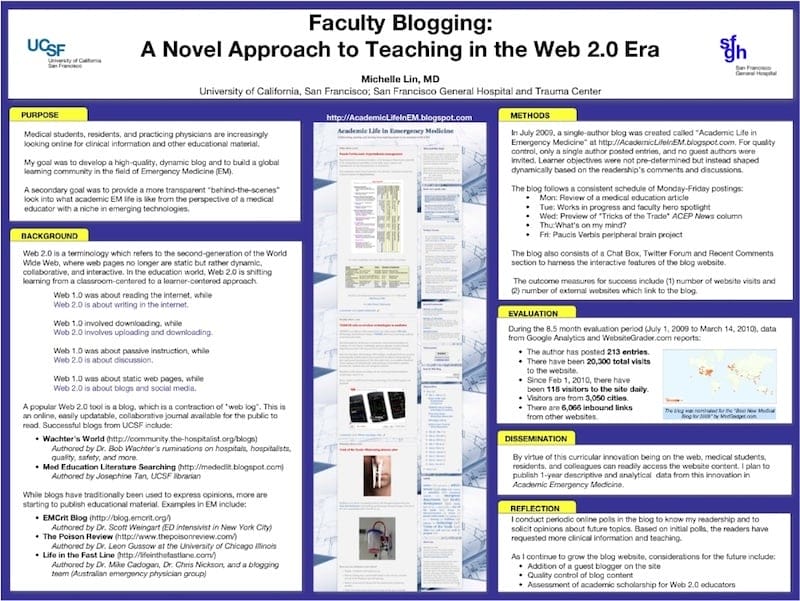
I need your help with a project! My poster on blogging was accepted to the annual UCSF Academy of Medical Educator’s Education Day. Feelings of joy and validation were quickly followed by terror and inadequacy. In order to get my poster costs reimbursed, I have to get feedback from my co-authors and incorporate that feedback into the poster. As you can see from the poster title on top, I have no co-authors! Since you are all my virtual co-authors, I thought I’d solicit for comments and suggestions. [+]
Article review: ED crowding and education
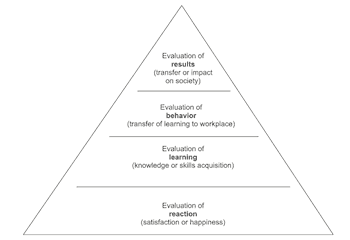
"The effect of ED crowding on education" My heart almost stopped when I read this article title in Amer J of Emerg Med. This was the premise of my recently completed study - using a prospective, time-motion methodology. I'm in the process of writing the manuscript. Did I get scooped by my friends at U Penn?Whew. Fortunately, no. Different methodology.This study was a cross-sectional study looking at learner assessment of education, using a validated tool called the ER (Emergency Rotation) Score. The results are interesting. The problem We know that ED crowding negatively impacts clinical care. How does it impact [+]

Paucis Verbis card: Hyperkalemia management
Hyperkalemia is a common presentation in the Emergency Department, especially in the setting of acute renal failure. In one shift, I had 4 patients with hyperkalemia! All had from some form of renal failure. This installment of the Paucis Verbis (In a Few Words) e-card series reviews the treatment options for hyperkalemia. PV Card: Hyperkalemia Adapted from [1] Go to ALiEM (PV) Cards for more resources. Reference Weisberg L. Management of severe hyperkalemia. Crit Care Med. 2008;36(12):3246-3251. [PubMed]
Trick of the Trade: Minimizing abscess odor
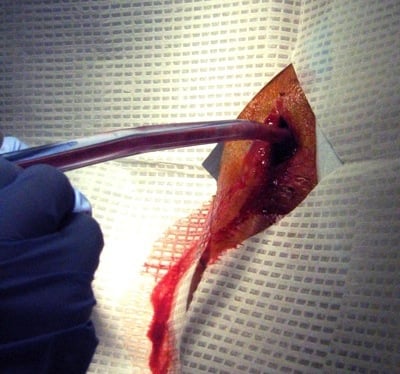
Building on my theme of combating odors in the Emergency Department (see Toxic Sock Syndrome), foul-smelling pus from large abscesses has got to be one of the most nauseating smells in the ED for me. Trick of the Trade Use a Yankauer to suction up pus [+]