



Trick of the Trade: Retracting Swollen Eyelids
Eyelids can become edematous from blunt trauma and local inflammation, making it difficult to visualize the orbit. How do you retract the eyelids, if you don't have the fancy ophthalmology eyelid retractors? Trick of the Trade Use a Q-tip I thought of this idea when I was rolling up a projector screen in a conference room. Why can't we use this rotational concept on the upper eyelid to retract it? Rest the Q-tip on the surface of the upper eyelid and slowly rotate the Q-tip to "roll" the eyelid out of the way. Below are a series of photos of [+]
Amazing video: Awake endotracheal intubation
Videos are priceless when trying to teach procedures. This amazing teaching video by Dr. Michael Bailin at Mass General demonstrates a novel way of anesthetizing the airway during an awake intubation. Inject 3 cc of lidocaine using a small butterfly needle through the cricothyroid membrane. This causes coughing, which spreads the lidocaine throughout the upper airway. Inject 5 cc of atomized lidocaine through the fiberoptic scope port to anesthetize the posterior oropharynx and vocal cords. Slide the endotracheal tube over the fiberoptic scope. [+]

Trick of the trade: Eye irrigation setup
Morgan lens are placed to irrigate eyes splashed with foreign substances. Whenever I place them, images of horror and torture movies arise. Especially for patients who aren't used to having something touch their eyes like contact lens, the Morgan lens gives them the heeby-jeebies. For the past several years, I've stopped using Morgan lens and have started using something that all Emergency Departments have -- nasal cannulas for oxygen administration. They are perfect for high-volume eye irrigation. Instead of attaching the nasal cannula to an oxygen port, attach it to the end of IV tubing, which in turn is attached [+]
Joining the Research Blogging community
Yesterday, I posted a review of an Academic Medicine education article on how to prepare medical students for their clinical clerkships, based on the Kolb learning cycle model. My blog post is now also linked and searchable from the Research Blogging network at http://researchblogging.org. Thanks to Life in the Fast Lane, who told me about the site. [+]

Article review: Preparing for clinical clerkships during medical school
Do you remember the sheer terror you felt, when you first started your medical school clinical rotations? Your first two years were probably spent in classrooms and small-group labs discussing anatomy, pharmacology, pathology, etc. Then BAM! You are thrown into the deep end of the pool. You are now on a clinical team of medical professionals taking care of actual patients! [+]

Paucis Verbis card: ABG interpretation
I have yet to find a better arterial blood gas interpretation review article than the 1991 Western Journal of Medicine summary by Dr. Rick Haber. This installment of the Paucis Verbis (In a Few Words) e-card series reviews ABG Interpretation. The recent addition of an ABG machine in our ED has made a tremendous difference in our ability to care for undifferentiated patients. This is a refresher in making heads and tails of mixed acid-base disorders. Adapted from [1] Go to ALiEM (PV) Cards for more resources. Reference Haber R. A practical approach to acid-base disorders. West J Med. 1991;155(2):146-151. [PubMed]

What do you do with old posters?
In academia, it is common practice to make posters of your abstracts for national conferences. Once you are done presenting, what DO people do with the posters? I have several posters rolled up in my garage collected over the years. If the answer is nothing, why can’t we find a more creative way to display static (or even video) content during abstract sessions? Perhaps use a large LCD screen instead of posters taped to a backboard? [+]
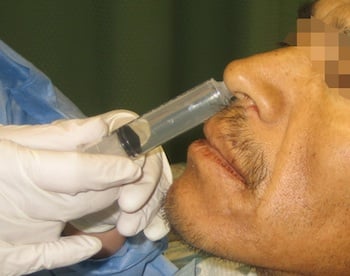
Tricks of the trade: Anesthetizing the nasopharyngeal tract
Nasogastric tube placement is one of the most uncomfortable procedures in the Emergency Department. Why can’t we find a painless way to do this? Now that I am doing more fiberoptic nasopharyngoscopes, this issue is coming up more and more frequently. I’ve been using NP scopes mainly to check for laryngeal edema in the setting of angioedema. These recent photos visualize a normal epiglottis and normal laryngeal anatomy, respectively. [+]
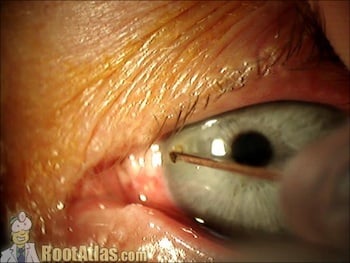
Great teaching video: Corneal FB removal
Patients often come into the ED for eye pain. One of my favorite procedures is removal of a small foreign body embedded in the cornea. There is a great instructional video on removing such foreign bodies and the use of a ophthalmic burr on removing rust rings. The video recommends using either a 30-gauge or 18-gauge needle. I prefer the less innocuous-looking 29-gauge insulin/TB needle. Can you imagine someone coming towards your eye with a large 18-gauge needle?! [+]

Article review: The future of EM
As I was perusing through a recent Academic Medicine journal, I came across this interesting perspective piece on Emergency Medicine, written by national leaders in our specialty. This article essentially states that how the nation addresses ED crowding will define the future of EM. Currently, Emergency Departments are at a breaking point where overwhelming demands are commonly placed on under-resourced practices. [+]