



Paucis Verbis: Acetaminophen toxicity
Did you know that the American Association of Poison Control Centers reports that 10% of poison center calls are related to acetaminophen ingestions? That's a lot. This Paucis Verbis card reviews the basics of acetaminophen toxicity. I included the Rumack Matthew nomogram to help you plot out the patient's risk for hepatotoxicity. In the Emergency Department, we often screen for acetaminophen toxicity for patients who may have ingested substances as a suicide attempt. We check the serum acetaminophen level 4 hours post-ingestion. Occasionally, we are surprised by a toxic level because in the first 24 hours, because symptoms are can [+]
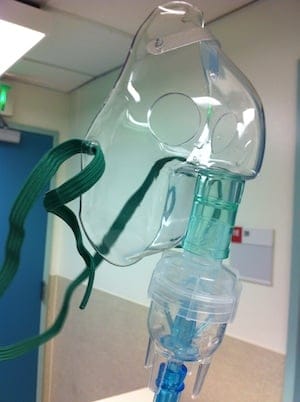
Trick of the trade: Nebulized naloxone
Overdoses of long-acting opiates, such as oxycodone and methadone, are challenging to manage, especially if these patients are chronically on opiates. On the one hand, you want to reverse some of the sedative effectives with naloxone so that they aren’t near-apneic and hypoxic. You also want to be able to take a history from them. On the other hand, you don’t want to abruptly withdraw them with naloxone such that they become violent and agitated. It is a fine balancing act. Long-acting opiates present a separate challenging because naloxone wears off fairly quickly in 30-45 minutes. [+]

Paucis Verbis: Influenza – To treat or not to treat?
Influenza season typically peaks in the United States during the Jan-Feb months and can start as early as October. You can read about the 2011-12 seasonal flu data on the CDC website. Should you give a patient with influenza an antiviral agent or just provide supportive therapy? This Paucis Verbis card summaries the CDC's Advisory Committee on Immunization Practices (ACIP) recommendations for this upcoming 2011-12 flu season. I also let patients with uncomplicated influenza who are going to be managed as outpatients know that a 5-day course of osteltamivir or zanamivir will cost them about $50-80. Often that sways them [+]
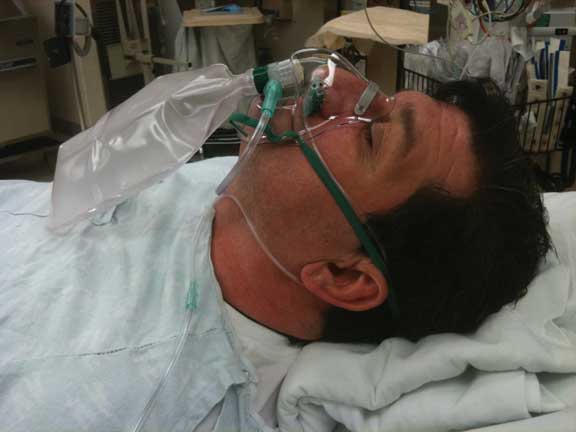
Trick of the Trade: Nasal cannula oxygenation during endotracheal intubation
You are managing a 300-pound patient with a long history of severe COPD, who now requires intubation because of a pneumonia and COPD exacerbation. You anticipate that the patient may be a difficult airway intubation and may desaturate quickly during laryngoscopy. While you are setting up to orotracheally intubate this patient, you preoxygenate this patient as best as you can with a non-rebreather mask. What can you do to prolong the patient’s time-to-desaturation so that you aren’t as rushed to place the endotracheal tube? [+]
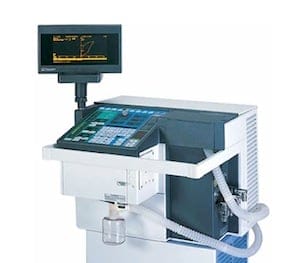
Paucis Verbis: Ventilator settings for obstructive lung disease
Following up with last week's Paucis Verbis card on Ventilator Settings for Acute Lung Injury and ARDS, here is the card on Ventilator Settings for Obstructive Lung Disease. This is for patients who present with acute asthma or COPD exacerbation who require endotracheal intubation. What initial ventilator settings should you set for these patients? Go to ALiEM (PV) Cards for more resources. Thanks to Dr. Jenny Wilson for the card and Dr. Scott Weingart for the original stellar podcast from which this card was derived.
Paucis Verbis: Ventilator settings for acute lung injury and ARDS
A patient presents with severe multilobar pneumonia and refractory hypoxia requiring endotracheal intubation. The respiratory therapist connects your patient to the ventilator. "What settings would you like your patient on?" Back in 2010, Dr. Scott Weingart posted a great podcast on "Dominating the Vent". It's such a fantastic distillation of the practical aspect of ventilator setting management of all intubated patients except those with an acute asthma or COPD exacerbation, Dr. Jenny Wilson and I thought this would be a great Paucis Verbis card to have in your peripheral brain. Note: The tidal volume should be calculated based on Predicted [+]

Trick of the trade: Quieting the shaky EKG tracing
A patient with Parkinson’s disease presents with chest pain to your ED. Her tremors prevent you from getting a good quality EKG because of the movement artifact. How can you eliminate this artifact? (No cheating with rocuronium.) [+]


Paucis Verbis: Neutropenic fever in cancer patients
A 65 y/o man with a history of prostate cancer presents to your ED from home appearing fairly well and a mild cough for 3 days. His vital signs are: Temperature 39 C BP 160/80 HR 60 RR 14 Oxygen saturation 99% on room air His absolute neutrophil count (ANC) comes back at 300 cells/mm3. His chest xray shows a right middle lobe pneumonia and a central line catheter tip ending in the SVC. Is this patient "high" or "low" risk per the Multinational Association for Supportive Care in Cancer (MASCC)? Does this person require inpatient admission? What antibiotics would [+]
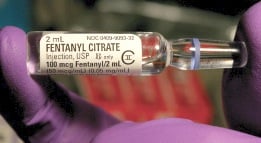
Trick of the Trade: Opioids for air hunger
A patient presents with significant shortness of breath from a COPD exacerbation. His room air saturation is 80%, respiratory rate of 30, and is uncomfortably seated in a tripod position. You administer the usual regimen: Oxygen by face mask Nebulized albuterol and atrovent Solumedrol Bipap Set up for possible intubation With the Bipap mask on, the patient’s subjective sense of dyspnea and “air hunger” seems to make it harder for him to tolerate the tight-fitting mask. [+]

Trick of the Trade: Needlestick hotline 888-448-4911
You are a fourth-year medical student and super-excited to be doing your first supervised central line procedure on an actual patient. You have done so many central lines on mannequins and simulations. You feel ready. In your excitement, however, you stick yourself with the 22 gauge finder needle after you successfully get a flash-back of the patient’s venous blood. After handing off the procedure to your senior resident, you go into a mild panic. Your patient is a known HIV patient with an unknown CD4 count and viral load. After taking off your gloves and washing your hands, you report [+]
Director of Growth, Strategic Alliance Initiative, Center for Innovation and Digital Health
Massachusetts General Hospital;
Chief Scientific Officer, Conductscience.com
Latest posts by Shuhan He, MD (see all)
- The Discharge Severity Index: Early Research on ED Readmission Risk Assessment - August 14, 2025
- Suboxone and the Emergency Physician: Get Waivered Training - August 12, 2022
- A Tale of Two Epidemics: COVID-19 and the Opioid Crisis - April 23, 2020